

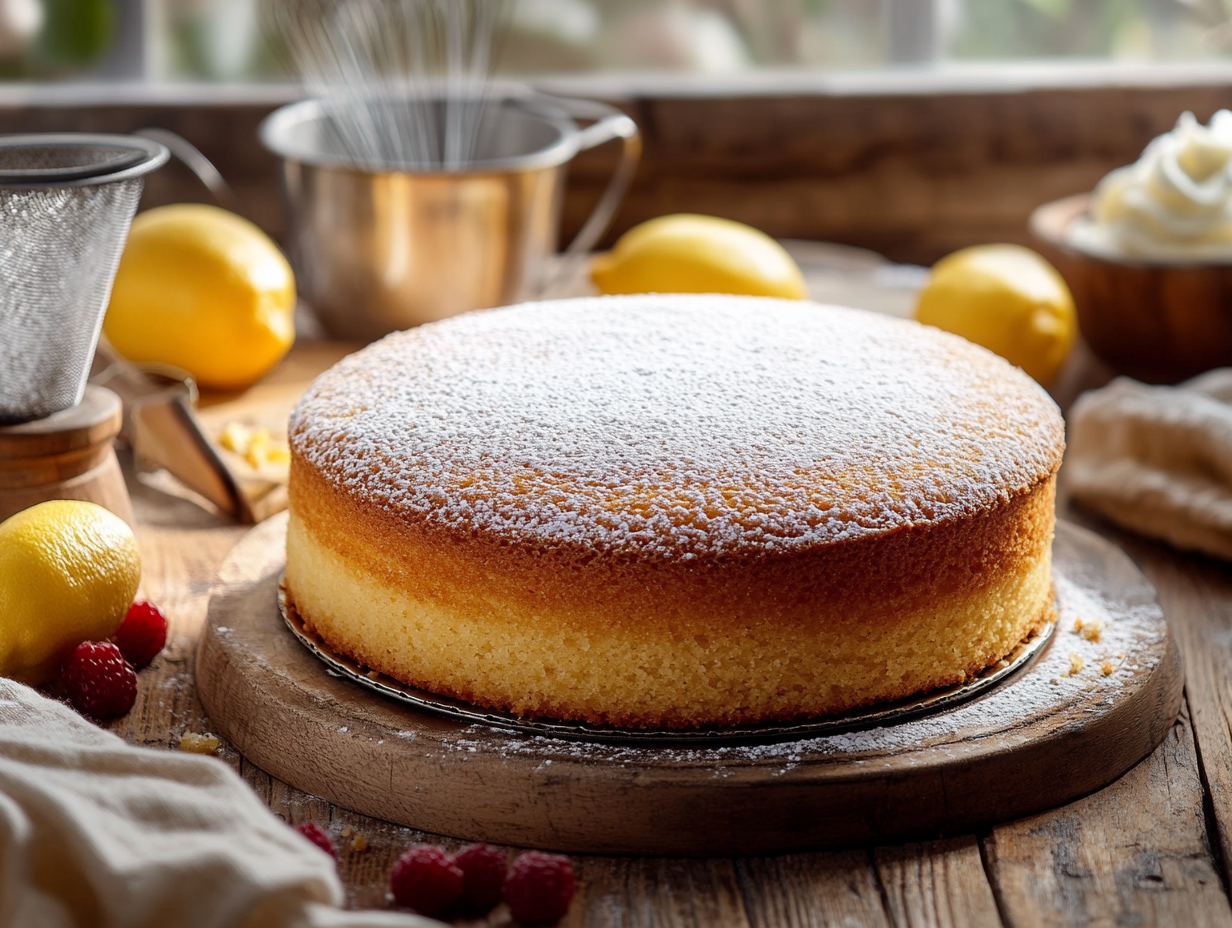
Gâteau de Savoie is a French sponge cake made with just eggs, sugar, flour, cornstarch, lemon zest, and vanilla — no butter, no oil. It rises entirely from whipped eggs, which gives it a genuinely light crumb that most butter cakes can’t match. If you need a cake that slices cleanly into 8 or more portions without feeling heavy, this is a reliable choice.
The short version of why this works
Two things carry this cake. First, the yolks and sugar need to be whisked until the mixture is pale, thick, and falls from the whisk in a slow ribbon — this usually takes 3 to 5 minutes with an electric mixer. That step dissolves the sugar and builds the base structure. Second, the egg whites must be folded in gently and in stages; rushing this deflates the air you just worked to build. The flour and cornstarch go in last, sifted directly over the batter and folded with a wide spatula in slow, deliberate strokes. The cornstarch keeps the crumb tender by diluting the gluten in the all-purpose flour. Get those two steps right and the cake does the rest.
Mistakes to avoid
- Using eggs straight from the fridge. Cold egg whites whip poorly and take much longer to reach soft peaks. Pull your eggs out at least 30 minutes before you start.
- Greasing the pan sides. Grease only the bottom and line it with parchment. The batter needs to grip the ungreased sides as it climbs — a fully greased pan causes the cake to pull away and sink in the center.
- Opening the oven before 35 minutes. This cake is fragile while it’s still setting. An early blast of cold air will cause it to collapse. Use the oven light to check color instead.
- Cutting it warm. The crumb is too soft to slice neatly until the cake is fully cool. For parties or bake sales where clean slices matter, let it cool completely — at least 90 minutes — before cutting.
- Overmixing after the flour goes in. Once the dry ingredients hit the batter, fold only until no dry streaks remain. Extra strokes develop gluten and tighten the crumb.
Keeping it fresh
Stored at room temperature under a cake dome or wrapped loosely in plastic, this cake stays good for 2 days — the crumb actually softens slightly overnight, which many people prefer. For longer storage, wrap individual slices tightly in plastic wrap and freeze for up to 6 weeks; thaw at room temperature for about an hour. Skip the powdered sugar dusting until just before serving — it absorbs into the surface within a few hours and disappears. If you’re baking ahead for a party, the unfrosted cake freezes well whole: wrap it in two layers of plastic wrap once fully cooled, freeze, and dust with powdered sugar after thawing.
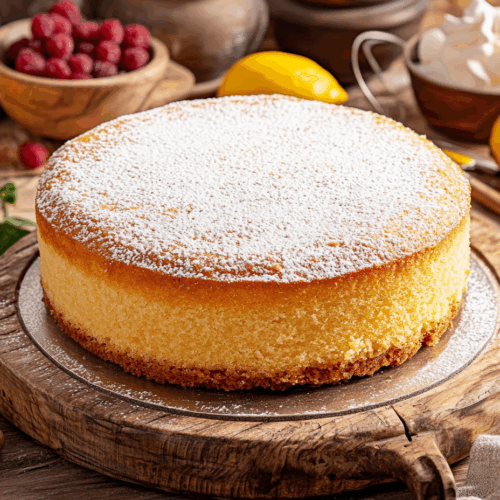
Gâteau de Savoie (Sponge Cake)

Equipment
- 9-inch round cake pan
- Mixing Bowls
- Whisk or electric mixer
- Rubber spatula
- Sieve
- Cooling Rack
Ingredients
Ingredients
- 5 large eggs preferably organic
- 1 cup granulated sugar
- 1 teaspoon vanilla extract
- 1 tablespoon lemon zest freshly grated
- 1 cup all-purpose flour sifted
- ¼ cup cornstarch
- ¼ teaspoon salt
- 2 tablespoons powdered sugar for dusting
Instructions
- Preheat your oven to 325°F (160°C). Grease the 9-inch round cake pan and line the bottom with parchment paper for easy removal.
- Separate the egg whites and yolks into two mixing bowls. Whisk the egg yolks with the granulated sugar until pale and light, then stir in the vanilla extract and lemon zest.
- In a separate bowl, whisk the egg whites with a pinch of salt until soft peaks form. Gently fold the beaten egg whites into the yolk mixture, using a rubber spatula.
- Sift together the flour and cornstarch. Gradually fold the dry ingredients into the egg mixture, ensuring not to deflate the batter.
- Pour the batter into the prepared cake pan and smooth the top. Bake for 40-45 minutes or until the cake is golden and a skewer inserted into the center comes out clean.
- Allow the cake to cool completely on a cooling rack before removing from the pan. Dust with powdered sugar before serving.
Notes
- For added flavor, consider a dusting of fine cocoa powder along with the powdered sugar.
- Serve slices with homemade whipped cream or fresh berries for a burst of freshness.
Nutrition
Common questions
Can I double this recipe to make two cakes at once?
Yes, but mix each batch separately rather than doubling in one bowl. A double volume of egg whites is harder to fold evenly without deflating, and the batter is sensitive to overworking.
My cake came out dense and flat. What went wrong?
The most common cause is deflated egg whites — either they were underwhipped, or they were folded in too aggressively. Aim for soft peaks that hold their shape but still look glossy, and fold slowly using a wide spatula.
Can I use cake flour instead of all-purpose flour?
You can, but the recipe already uses cornstarch to soften the crumb, so the difference is small. If you do swap, use the same volume measurement and expect a very slightly more delicate texture.
Do I need a stand mixer, or will a hand whisk work?
A hand whisk works, but plan for 8 to 10 minutes of steady whisking to get the yolk-sugar mixture pale and the whites to soft peaks. An electric hand mixer cuts that to about 3 to 5 minutes total.
Can I bake this in a different pan size?
A 9-inch springform pan works well and makes unmolding easier, especially if you’re baking multiples for a gathering. Avoid pans smaller than 8 inches — the batter will overflow before the center sets.
How do I know the cake is done if my oven runs hot or cool?
The skewer test is the most reliable indicator — it should come out completely clean, not just mostly clean. The top should also be deep golden and spring back when lightly pressed in the center.
Try these next
- Rustic French fig cake
- Fluffy Castella sponge cake
- French brown butter chocolate tart
- Pear and almond cake