

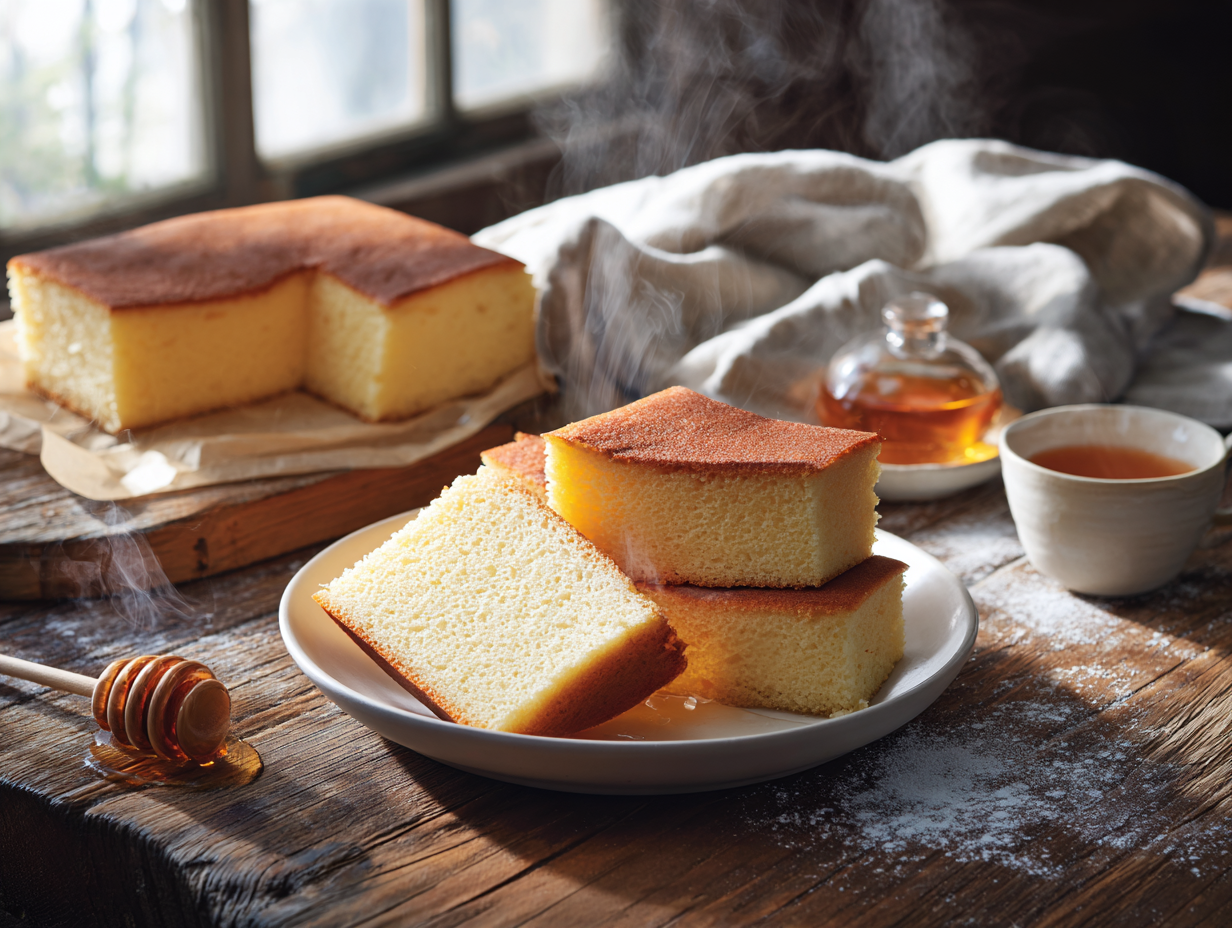
Castella is a Japanese sponge cake made from just five ingredients — eggs, sugar, flour, milk, and honey — held together entirely by well-beaten eggs rather than butter or baking powder. The crumb is tight, moist, and gently springy, with a mild honey sweetness that doesn’t fade after a day or two. It’s one of the better make-ahead cakes you can bake: it actually improves overnight as the texture settles.
Before you start
Two things determine whether this cake works. First, egg temperature: cold eggs won’t whip to the thick, ribbon-stage foam this recipe needs, and without that foam there’s no structure. Pull your eggs out at least 45 minutes before you start. Second, the ribbon stage itself — when you lift the beaters and the batter falls back in a thick, slow ribbon that holds its shape on the surface for a few seconds before sinking, you’re there. Under-whipped eggs produce a dense, rubbery result. Don’t rush this step; it typically takes 8–10 minutes with a hand mixer, not the 5 minutes listed as a minimum. Everything else in this recipe is forgiving. These two steps are not.
Mistakes to avoid
- Deflating the batter when adding flour: Use a wide silicone spatula and fold in a J-motion — scrape the bottom, turn, repeat. Stirring in circles knocks out the air you just spent 10 minutes building. Stop the moment you see no dry streaks.
- Skipping the water bath or pan insulation: A bare pan on a rack bakes the bottom and sides too fast, creating a rubbery crust. Set your pan inside a larger baking dish with about an inch of hot water, or double-pan it by placing your lined pan on a second empty baking sheet. Either method keeps the heat gentler and more even.
- Opening the oven door in the first 40 minutes: Castella is sensitive to temperature drops. Resist checking until the 45-minute mark. A sudden drop causes the center to sink and stay sunken.
- Cutting it while warm: The crumb needs time to set. Slicing a warm Castella gives you a gummy, compressed edge. Let it cool completely in the pan — at least 1 hour — before lifting it out.
- Using coarse granulated sugar: Coarse sugar doesn’t dissolve fully into the egg foam, which leaves a slightly gritty texture. Fine granulated (sometimes labeled caster sugar) dissolves cleanly. Skip the garnish of powdered sugar on top — not worth the extra dish, and it gets absorbed quickly anyway.
Shopping notes
Most ingredients here are pantry staples, but two are worth a note. For the honey, a mild variety — clover or acacia — keeps the flavor subtle and lets the egg sweetness come through. A bold honey like buckwheat will overpower the cake. Fine granulated sugar is sold as caster sugar in some stores; if you can’t find it, pulse regular granulated sugar in a food processor for 30 seconds. That’s all you need.
Storage and freezing
Castella keeps well at room temperature for up to 3 days wrapped tightly in plastic wrap — the texture is actually best on day two, once the crumb has had time to settle and the honey flavor deepens. For longer storage, refrigerate for up to 5 days; bring slices to room temperature for 20 minutes before serving, since cold Castella feels denser than it should. To freeze, wrap individual slices in plastic wrap, then place in a zip-top bag; they keep for up to 6 weeks. Thaw overnight in the refrigerator or at room temperature for about an hour. This makes it a practical choice for baking several days before a gathering — bake, cool, wrap, and refrigerate until the day before you need it.
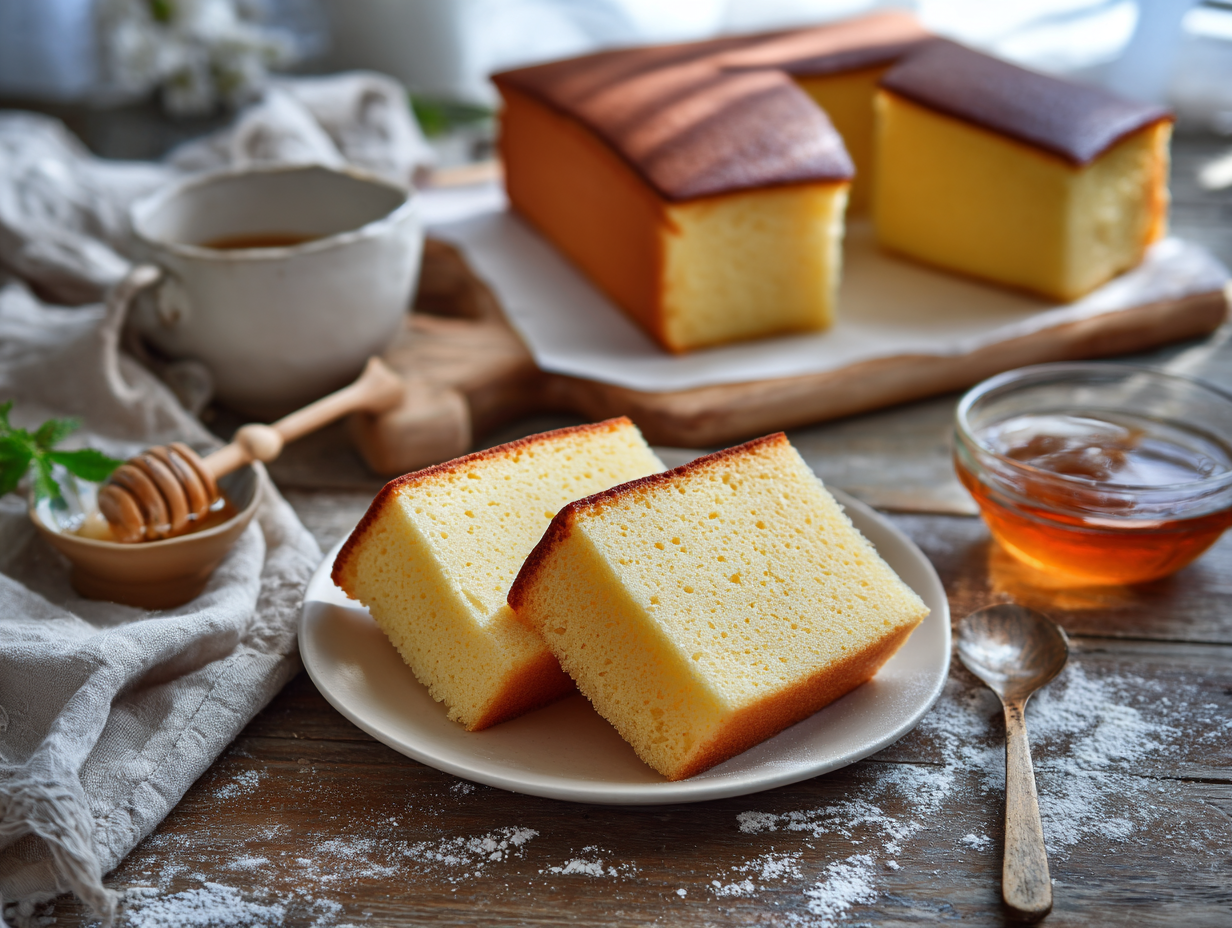
Castella Cake

Equipment
- Mixing Bowls
- Hand mixer
- 9x9 inch baking pan
- Parchment Paper
Ingredients
- 1 cup all-purpose flour sifted
- 10 large eggs room temperature
- 1 cup sugar preferably fine granulated
- ¼ cup milk warmed slightly
- 2 tablespoons honey
Instructions
- Preheat your oven to 350°F (175°C). Line the inside of a 9x9 inch baking pan with parchment paper, ensuring it covers all sides for easy removal.
- In a large mixing bowl, crack the eggs and whisk them with a hand mixer on medium speed until they become pale and frothy, approximately 5 minutes.
- Gradually add the sugar while continuing to whisk, until the mixture turns thick and creamy, forming ribbons as you lift the whisk.
- Warm the milk slightly and mix it with honey until completely dissolved. Gently fold this mixture into the egg batter, maintaining the airiness.
- Sift the flour over the batter, folding it in gently with a silicone spatula just until homogenous. Ensure no flour pockets remain.
- Pour the batter into the prepared pan, smoothing out the top with a spatula. Tap the pan gently on the counter to release any trapped air bubbles.
- Bake for about 50 to 60 minutes, or until the top is golden brown and springs back when lightly pressed. A toothpick inserted should come out clean.
- Once baked, allow the cake to cool in the pan, then carefully lift it out using the parchment paper. Trim the edges for a neat appearance.
Notes
- For a fluffy texture, ensure the eggs are at room temperature before beating.
- To prevent the top from over-browning, cover with foil during the last 10 minutes of baking if necessary.
Nutrition
Your questions, answered
Can I use a different pan size if I don’t have a 9×9 inch pan?
An 8×8 inch pan works, but expect the cake to be taller and require an extra 8–10 minutes of bake time. A 9×13 inch pan will produce a thinner cake that bakes faster — start checking at 35 minutes and watch closely, since a thin Castella dries out quickly.
My cake sank in the middle after baking — what went wrong?
The most common cause is under-whipped eggs that couldn’t support the structure through the full bake. The second most common cause is opening the oven door too early, which drops the temperature before the structure sets. Make sure you’ve reached a true ribbon stage before adding any other ingredients.
Do I have to trim the edges, or is that just for looks?
It’s mostly for looks — the edges bake slightly firmer and darker than the interior, so trimming gives you a more uniform slice. If you’re serving the cake at an event and presentation matters, a quick trim with a sharp serrated knife makes a noticeable difference. For everyday eating, skip it.
What to bake next
- White Chocolate Matcha Brownies
- Sesame Caramel Tart
- Sweet Mediterranean Bites with Mascarpone and Honey
- Rustic Blackberry Almond Cake