

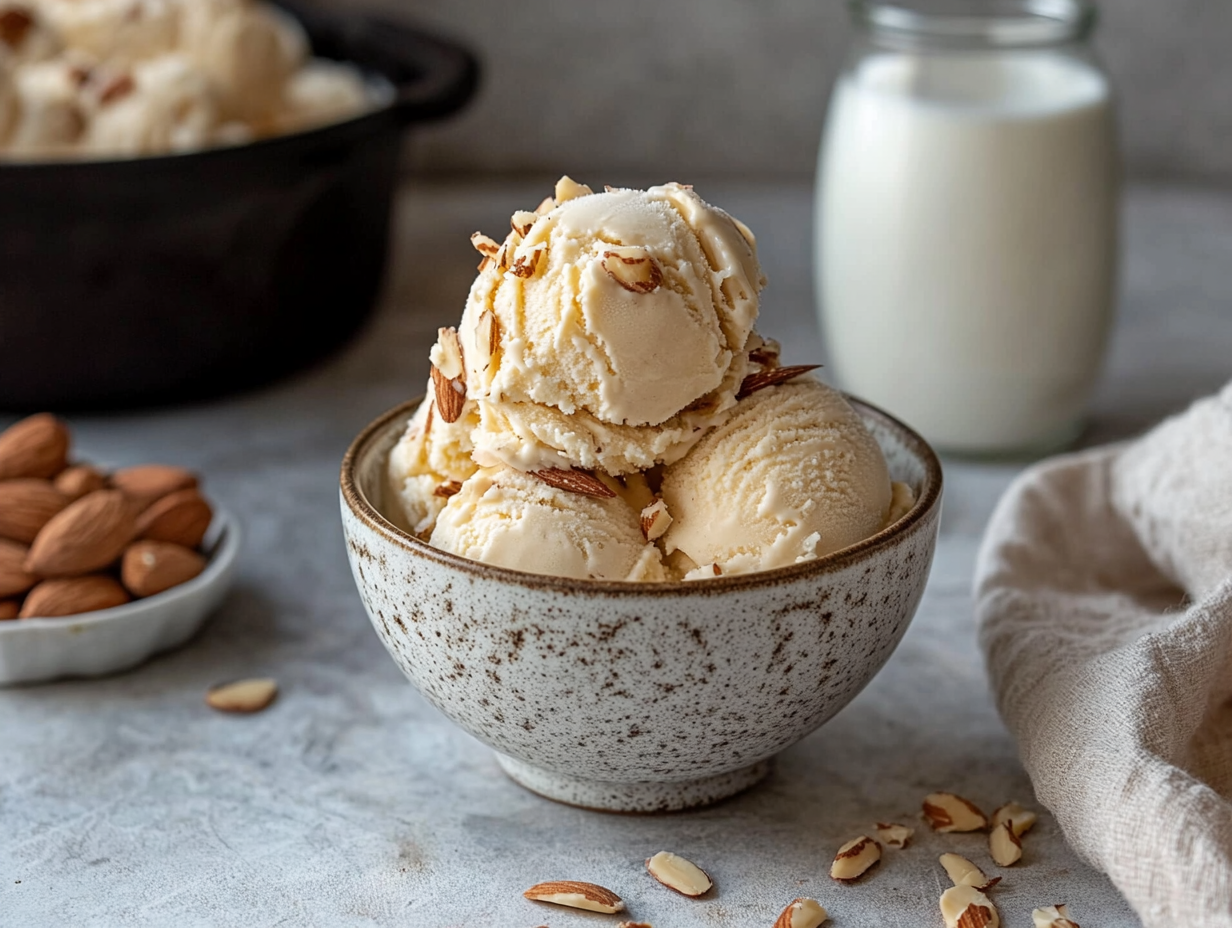
Almond Crunch Gelato is a cooked egg-yolk custard churned to a dense, creamy consistency and folded with pieces of buttery caramelized almonds. It takes about 30 minutes of active work, then hands-off chilling and freezing time. The honest reason to make it: the caramelized almond pieces cost almost nothing to put together and turn a plain frozen custard into something genuinely worth serving to guests.
About the ingredients
- Whole milk and heavy cream: The ratio here is 2:1, which keeps the gelato dense rather than buttery-rich. If you only have half-and-half, use 2½ cups of it in place of both — the texture will be slightly lighter but still good.
- Almond extract: A little goes a long way. If yours has been sitting in the back of the cupboard for two-plus years, smell it — old extract can turn sharp and medicinal. Vanilla extract is a perfectly decent swap if you’re out; the almond character will be subtle but the custard will still taste great.
- Sliced almonds: Slivered or roughly chopped whole almonds work just as well for the crunch. Skip the pre-toasted kind — you’re toasting them again in butter and sugar, and pre-toasted nuts can go bitter.
- Butter for the crunch: One tablespoon is a small amount. Coconut oil works as a substitute and adds a faint background flavor that isn’t unwelcome.
The technique that matters
The step that determines whether your gelato is silky or grainy is tempering the egg yolks — adding the hot milk mixture slowly while whisking constantly before returning everything to the heat. Pour too fast and you scramble the eggs; the custard will look curdled and no amount of churning will fix it. Go slowly, a thin stream at first, and keep the whisk moving. The second thing worth getting right is the almond crunch: once the sugar melts into the butter and you add the almonds, work quickly — the caramel seizes fast. Have your lined baking sheet ready before you start melting the sugar, not after.
If something goes sideways
- Custard looks lumpy or curdled: Strain it through a fine-mesh sieve before chilling. Small curds will catch in the sieve and the custard underneath is often still usable. If it smells eggy and the texture is very coarse throughout, start the base over — churning won’t save it.
- Almond crunch clumped into one solid mass: Break it up with a rolling pin once it’s fully cool and brittle. If it stayed soft and sticky, the sugar didn’t fully caramelize — spread it back into a thin layer on the sheet and let it sit uncovered at room temperature for another 20 minutes.
- Gelato froze rock-hard: This usually means it went into the freezer container while still too warm from churning, or the container wasn’t sealed and ice crystals formed. Let it sit at room temperature for 8–10 minutes before scooping — skip the microwave, which melts unevenly.
- Almond crunch pieces sank to the bottom: The gelato was too soft when you folded them in. Next time, chill the churned gelato for 15 minutes in the freezer before folding in the crunch, then transfer to the final container.
- Weak almond flavor in the finished gelato: Almond extract loses potency quickly once opened. Add an extra ¼ teaspoon next time, or stir in a tablespoon of amaretto with the extract — skip the garnish on top, not worth the extra dish.
Storage and make-ahead
The finished gelato keeps well in the freezer for up to two weeks in a sealed container — press a piece of plastic wrap directly onto the surface before putting the lid on to prevent ice crystals. The custard base (before churning) can be made up to two days ahead and stored in the fridge; give it a good whisk before pouring it into the ice cream maker. The caramelized almond crunch can also be made a day in advance and kept in an airtight container at room temperature — do not refrigerate it, as moisture will make it sticky and soft.
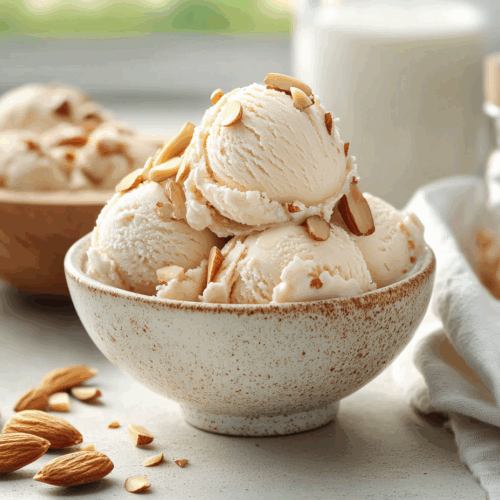
Almond Crunch Gelato

Equipment
- Ice Cream Maker
- Saucepan
- Mixing Bowl
- Whisk
- Baking sheet
- Oven
Ingredients
For the Gelato Base:
- 2 cups whole milk preferably organic
- 1 cup heavy cream preferably organic
- ¾ cup granulated sugar
- 5 large egg yolks
- 1 teaspoon almond extract
For the Almond Crunch:
- 1 cup sliced almonds lightly toasted
- 1 tablespoon butter
- 2 tablespoons granulated sugar for caramelizing the almonds
Instructions
- Preheat your oven to 350°F (175°C). Spread the sliced almonds on a baking sheet and toast them in the oven for about 5-7 minutes until golden brown and aromatic. Set aside to cool.
- In a saucepan over medium heat, combine the whole milk, heavy cream, and 3/4 cup of sugar. Stir until the sugar is dissolved and the mixture is hot, but do not boil. Remove from heat.
- In a mixing bowl, whisk the egg yolks until they become pale yellow. Slowly add the hot milk mixture to the egg yolks, whisking continuously to prevent curdling. Return this mixture to the saucepan.
- Cook over medium heat, stirring constantly, until the mixture thickens enough to coat the back of a spoon. Remove from the heat and stir in the almond extract. Allow it to cool before transferring to an ice cream maker. Churn according to the manufacturer's instructions.
- For the almond crunch, melt the butter in a small pan, add 2 tablespoons of sugar, and stir until the sugar is melted. Add the toasted almonds, stirring until they are evenly coated with the caramelized sugar mixture. Spread onto a baking sheet to cool.
- Once the gelato is churned, fold in the almond crunch and transfer to a lidded container. Freeze for at least 2 hours before serving.
Notes
- For an extra burst of flavor, consider adding a touch of brandy or amaretto to the gelato base just before churning.
Nutrition
Common questions
Do I need an ice cream maker for this recipe?
Yes, this recipe is written for an ice cream maker and the texture depends on it. If you don’t have one, you can pour the chilled custard into a shallow freezer-safe dish and stir it vigorously every 30 minutes for about 3 hours, but the result will be icier and less smooth than machine-churned gelato.
Can I use milk with a lower fat content instead of whole milk?
You can use 2% milk, but the gelato will be noticeably less creamy and may freeze harder. Avoid skim milk — without enough fat, the texture becomes icy rather than dense.
How do I know when the custard is thick enough on the stovetop?
It’s ready when it coats the back of a spoon and a line drawn through it with your finger holds its shape without the custard running back together. This usually happens around 170–175°F if you have an instant-read thermometer handy.
Can I make this without eggs?
Not with this recipe as written — the egg yolks are what give the custard its body and richness. A cornstarch-based gelato base is a common egg-free alternative, but that’s a different recipe with different ratios.
My caramel hardened before I could coat all the almonds. What should I do?
Return the pan to low heat briefly and stir gently — the caramel will loosen again. Next time, have the toasted almonds measured and right next to the stove before you start melting the sugar so you can add them the moment it’s ready.
Can I double the recipe?
Check your ice cream maker’s capacity first — most home machines hold 1 to 1.5 quarts, and this recipe makes roughly 1 quart. If your machine can handle it, doubling the custard base works fine; just use a larger saucepan so the custard heats evenly.
What to bake next
- Crunchy Italian Almond Biscotti
- Rustic Blackberry Almond Cake
- Honeycomb Ice Cream
- Espresso Chocolate Semifreddo