

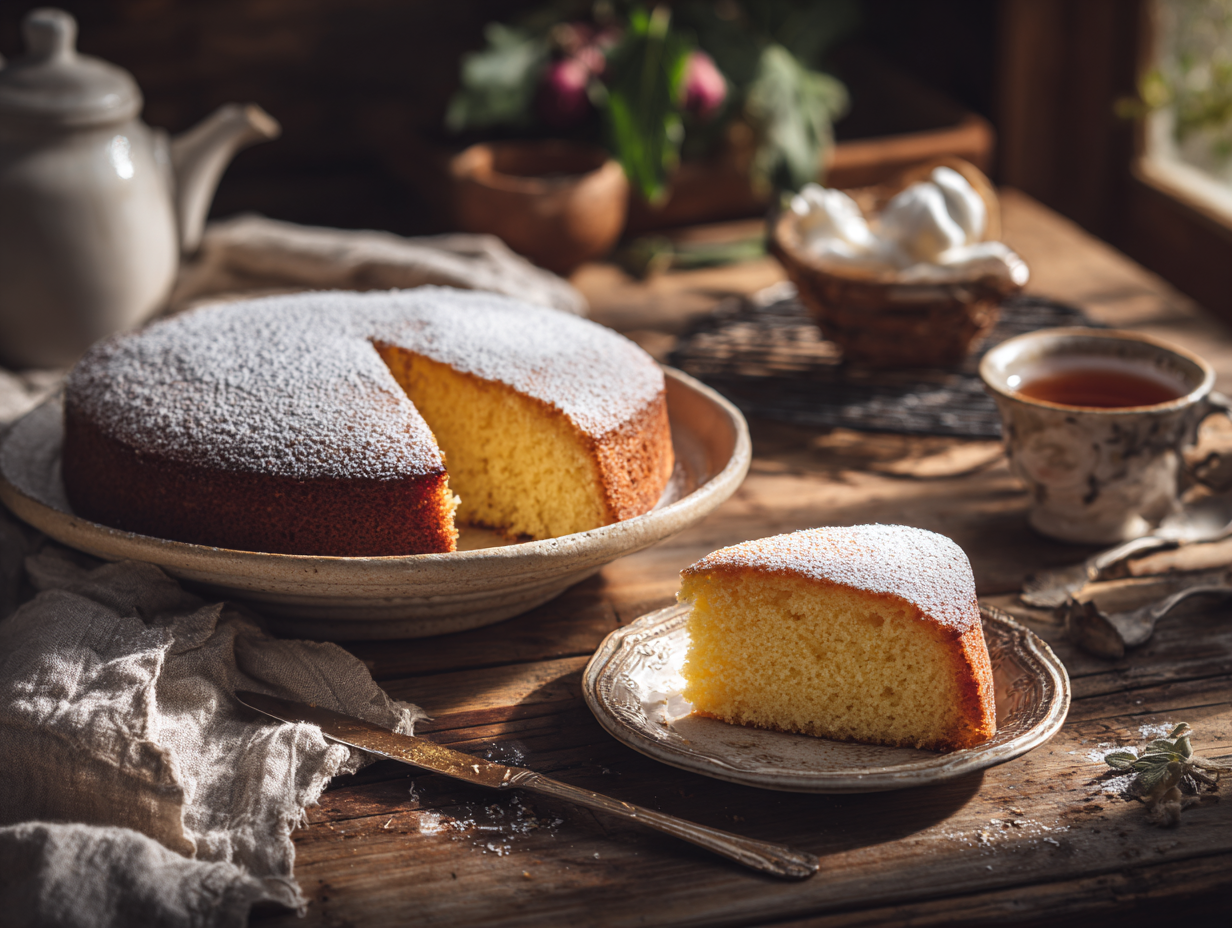
This vanilla sponge cake is a single-layer, lightly sweet cake that gets its lift entirely from whipped eggs — no baking soda, no yeast. It comes together with eight common pantry ingredients in about 50 minutes total. If you want a reliable cake that works plain, layered, or dressed up with whatever fruit or cream you have on hand, this is it.
The short version of why this works
Two things decide whether this cake succeeds or fails. First, how long you beat the eggs and sugar. Eight minutes at high speed is not an estimate — you need the mixture genuinely thick, pale, and falling from the beaters in slow ribbons. That air is the only leavening doing real work here (the baking powder is a small backup, not the main event). Second, how you fold in the flour. Dump it in all at once and stir hard, and you’ll knock out the air you just spent eight minutes building. Add it in three parts and use a wide spatula with slow, deliberate strokes from the bottom of the bowl. Those two steps are where most sponge cakes go right or wrong.
Substitutions that actually work
- Milk: Whole milk gives the best texture, but 2% works fine. Oat milk or almond milk both substitute without noticeably changing the crumb — just make sure whichever you use is warmed before adding it to the butter.
- Butter: Refined coconut oil (melted) works as a 1:1 swap and stays neutral in flavor. Unrefined coconut oil will add a faint coconut note, which isn’t a problem if that suits you.
- Vanilla extract: If you’re out of pure extract, imitation vanilla works here — the bake time and texture are identical. A split vanilla bean scraped into the egg-sugar mixture before beating adds noticeably more depth if you have one.
- All-purpose flour: Cake flour produces a slightly more tender crumb. Use the same volume measurement. Bread flour will make the cake noticeably chewier — skip it if you have the choice.
Troubleshooting
- Cake sinks in the center after baking: The batter was underbaked or the oven door was opened too early. Wait until at least the 22-minute mark before checking, and confirm doneness with a skewer — the top springing back is a secondary check, not the only one.
- Dense, rubbery texture: The egg-sugar mixture wasn’t beaten long enough, or the flour was overmixed once added. Both problems deflate the air that gives the cake its structure. There’s no fixing it after the fact — start again and time the beating step.
- Cake sticks to the pan: Greasing alone isn’t enough for this batter. Line the bottom of the pan with a parchment circle in addition to greasing and flouring the sides. Skip the garnish on the pan prep — not worth the extra dish.
- Pale, flat top that doesn’t brown: Oven temperature is likely running low. Use an oven thermometer to check — many home ovens run 15–25°F cooler than the dial reads. Increase the actual temperature to hit 350°F at the rack.
- Milk-butter mixture causes streaks or lumps when added: The butter-milk mix was too cold when it hit the batter, or it was added too fast. Keep it warm (not hot) and pour it slowly around the edge of the bowl while folding gently.
Storage and freezing
Once fully cooled, wrap the unfrosted cake tightly in plastic wrap and store at room temperature for up to two days — it dries out faster in the fridge, so avoid refrigerating it unless it’s already filled or frosted with something perishable. If you need to make it ahead, this cake freezes well: wrap the cooled layer in plastic, then foil, and freeze for up to two months. Thaw it overnight at room temperature still wrapped, which keeps condensation from settling on the surface. A frosted or filled cake can be refrigerated for up to three days; bring it to room temperature for 30 minutes before serving so the crumb softens back up.
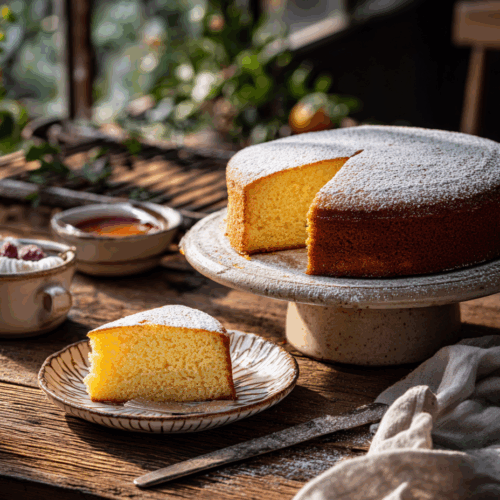
Vanilla Sponge Cake

Equipment
- 9-inch round cake pan
- Electric Mixer
- Mixing Bowls
- Spatula
- Cooling Rack
Ingredients
- 1 cup all-purpose flour sifted
- 1 cup granulated sugar
- 4 large eggs room temperature
- 1 tsp pure vanilla extract
- 1 tsp baking powder
- ¼ cup milk warm
- ¼ cup unsalted butter melted
Instructions
- Preheat your oven to 350°F (175°C). Grease and flour a 9-inch round cake pan to prevent sticking.
- In a mixing bowl, using an electric mixer, beat the eggs and granulated sugar at high speed until the mixture is thick and pale, creating ribbons, about 8 minutes.
- Gently fold in the sifted flour and baking powder into the egg mixture in three parts, ensuring there are no lumps and maintaining the airy texture.
- In another bowl, mix the warm milk and melted butter. Add in the vanilla extract.
- Gradually stir in the milk and butter mixture into the batter, mixing just till combined.
- Pour the batter into the prepared cake pan and smooth the top with a spatula.
- Bake for 25-30 minutes, or until the cake is golden and springs back when gently pressed, and a skewer inserted in the center comes out clean.
- Let the cake cool in the pan for 10 minutes before transferring it to a cooling rack to cool completely.
Notes
Tammy’s Tips:
- For extra depth of flavor, consider adding a scrape of real vanilla bean.
- If you prefer a dairy-free option, substitute almond milk for regular milk and use coconut oil instead of butter.
Nutrition
Common questions
Can I use cold eggs straight from the fridge?
Room temperature eggs whip to a much greater volume than cold ones, so it’s worth the wait. If you’re short on time, set the eggs in a bowl of warm (not hot) water for 10 minutes before beating.
Do I really need an electric mixer, or can I whisk by hand?
You can whisk by hand, but it takes 15–20 minutes of continuous whisking to reach the ribbon stage that 8 minutes of electric mixing achieves. A hand mixer or stand mixer is strongly recommended — the result with hand whisking is inconsistent unless you’re very experienced.
My batter looks deflated after I added the flour. Is it ruined?
Not necessarily, but it will bake up denser than intended. If it deflated significantly, the flour was likely overmixed. Bake it anyway — it may still taste good, just less airy — and adjust your folding technique next time.
Can I bake this in two thinner layers instead of one?
Yes. Divide the batter between two 9-inch pans and reduce the bake time to roughly 15–18 minutes, checking with a skewer at the 15-minute mark. This is a practical way to get a filled layer cake without having to slice a single layer in half.
Can I double the recipe?
You can, but beat the eggs and sugar in two separate batches rather than doubling in one bowl — most home mixers can’t aerate that volume effectively at once. Combine the batches gently before folding in the flour.
Why does the recipe use both baking powder and whipped eggs for leavening?
The whipped eggs do the heavy lifting; the baking powder is a small insurance measure that helps the cake hold its rise if the egg foam deflates slightly during folding. It’s not enough on its own to leaven the cake, so the beating step still matters.
If you liked this one
- Nutty Brown Butter Vanilla Bean Cupcakes
- Rustic Blackberry Almond Cake
- Fluffy Castella Cake
- Sweet Roasted Strawberry Ice Cream