

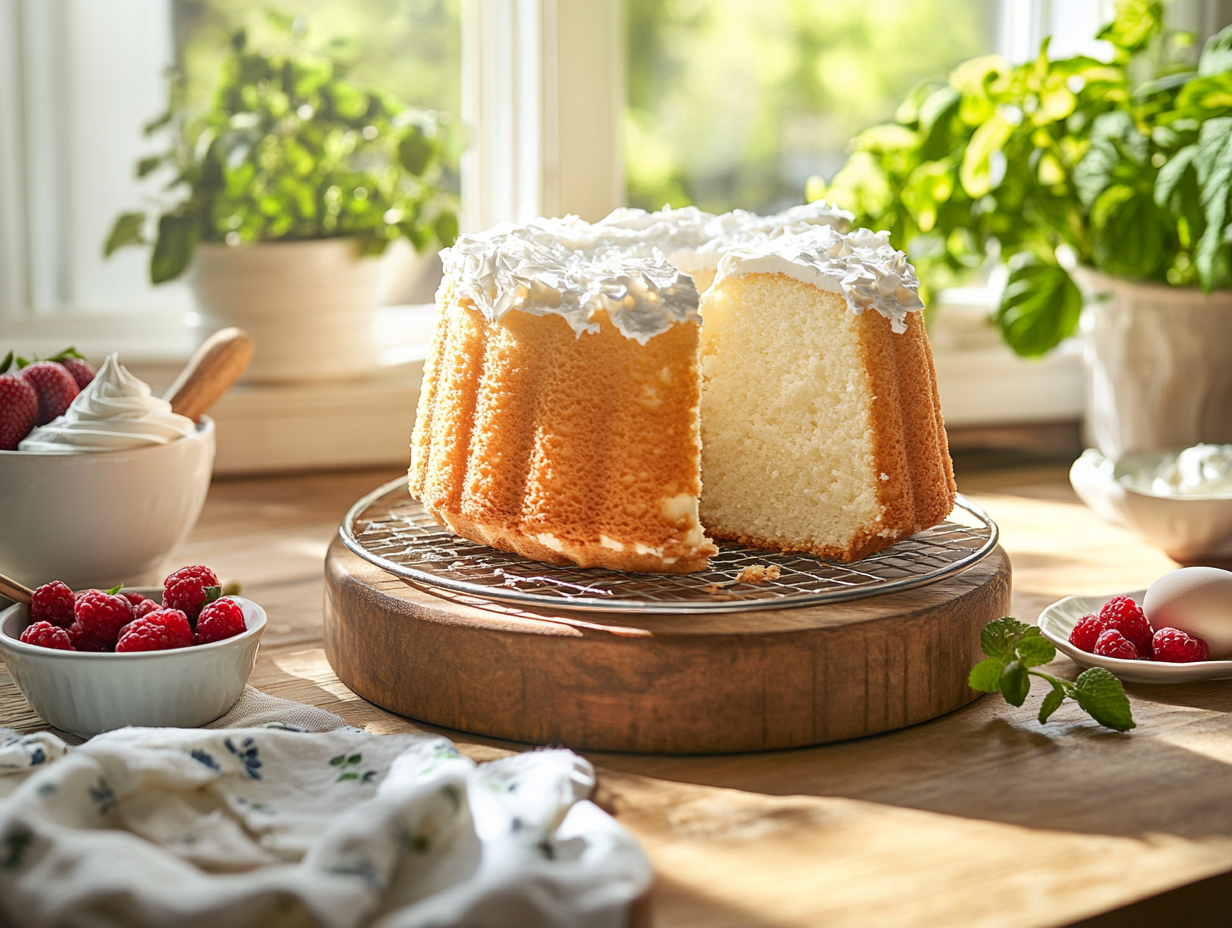
Angel food cake is a tall, fat-free sponge built entirely on whipped egg whites, cake flour, and sugar. There’s no butter, no yolks, and no leavening powder — the air you beat into the whites is the whole structure. It’s worth making when you need a cake that serves a crowd without feeling heavy, and it pairs well with almost any fruit or cream you have on hand.
Substitutions that actually work
- Cake flour: If you’re out, spoon 2 tablespoons of cornstarch into a 1-cup measure, then fill the rest with all-purpose flour and sift well. It’s not identical, but the crumb stays tender enough.
- Superfine sugar: Regular granulated sugar works. Pulse it in a food processor for 30 seconds first so it dissolves into the whites more easily and doesn’t deflate them.
- Almond extract: Marked optional in the recipe for good reason — leave it out if anyone at the table has a tree-nut allergy. A little extra vanilla covers the gap.
- Cream of tartar: This one is hard to skip. It stabilizes the whites and keeps the meringue glossy. If you’re truly out, a small squeeze of lemon juice (about ¾ tsp) can substitute, though the peaks won’t hold quite as firmly.
Why this recipe works
Two things carry this cake: the meringue and the fold. Beating the egg whites to stiff, glossy peaks before any flour touches them builds the entire structure of the cake — those air bubbles expand in the oven and create the open, springy crumb. Adding the remaining sugar gradually, one tablespoon at a time, keeps the foam stable rather than causing it to collapse under the weight. The fold matters just as much. Sifting the flour mixture over the whites in three additions and folding with a wide spatula — not stirring, not whisking — keeps those bubbles intact. Overworking the batter at this stage is the most common reason a finished cake comes out dense and short rather than tall and light.
Common problems and fixes
- Cake pulls away from the pan sides and shrinks before cooling: The pan must be completely ungreased. Any fat on the surface — even residue from a previous bake — stops the batter from gripping the sides as it rises. Wash the tube pan with hot soapy water and dry it thoroughly before every use.
- Cake collapses when inverted: It wasn’t fully baked. A toothpick test is reliable here, but also press the top gently — it should spring back completely. If it leaves a dent, give it another 3–5 minutes.
- Gummy or rubbery layer at the bottom: This usually means the flour was added too quickly or stirred rather than folded, which overdeveloped the gluten. Work slowly and use a light hand.
- Whites won’t reach stiff peaks: Even a trace of egg yolk or grease in the bowl will prevent proper whipping. Use a clean metal or glass bowl — plastic holds onto fat even after washing — and check each separated white before adding it to the batch.
- Cake sticks when unmolding: It wasn’t cool enough. Inverting over a rack and walking away for at least 90 minutes — skip the garnish, not worth the extra dish — is the safest approach. Run a thin offset spatula around the edges only after it’s fully cool.
Keeping it fresh
Angel food cake dries out faster than butter cakes, so storage matters. At room temperature, wrap the cut cake tightly in plastic wrap or store it under a cake dome and use it within 2 days. In the fridge it keeps for up to 5 days, though the crumb firms up slightly — let slices sit at room temperature for 20 minutes before serving. For freezing, wrap individual slices in plastic wrap, then foil, and freeze for up to 3 months; thaw overnight in the fridge or for an hour on the counter. If you’re baking ahead for a party, the whole uncut cake freezes well too — wrap it the same way once it’s completely cool and unmolded.
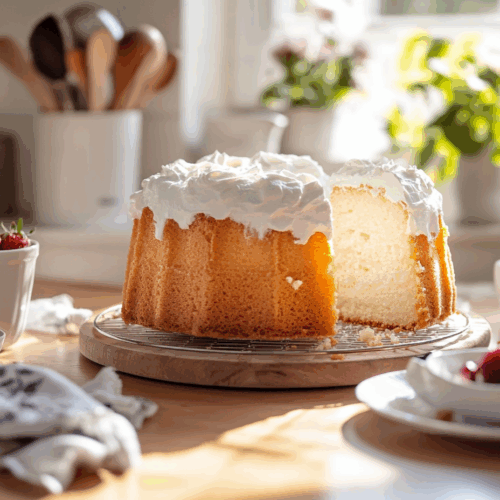
Heavenly Angel Food Cake

Equipment
- Tube pan
- Mixing Bowls
- Electric Mixer
- Rubber spatula
- Cooling Rack
Ingredients
- 1 ½ cups sifted cake flour ensure no lumps
- 1 ¾ cups granulated sugar preferably superfine
- 12 large egg whites room temperature
- 1 ½ tsp cream of tartar
- ¼ tsp salt
- 1 tsp vanilla extract preferably pure
- ½ tsp almond extract optional but recommended
Instructions
- Preheat your oven to 350°F (175°C).
- In a large mixing bowl, whisk together the cake flour and 3/4 cup of the sugar until well combined. Set aside.
- In another bowl, using an electric mixer, beat the egg whites on medium speed until frothy. Add the cream of tartar and salt, then continue to beat until soft peaks form.
- Gradually add the remaining 1 cup of sugar, a tablespoon at a time, with the mixer running on medium-high speed, until stiff, glossy peaks form.
- Gently fold in the vanilla and almond extracts using a spatula.
- Sift a third of the flour mixture over the whipped egg whites and gently fold in with a spatula until just combined. Repeat, folding in the remaining flour mixture in two more additions.
- Carefully pour the batter into an ungreased tube pan. Smooth the top with a spatula.
- Bake for 35-40 minutes, or until a toothpick inserted into the center comes out clean.
- Invert the pan onto a cooling rack and allow the cake to cool completely before removing from the pan.
Notes
- Using room temperature egg whites aids in reaching the desired volume for the meringue.
- Always fold the dry ingredients gently to maintain the airy texture.
Nutrition
Frequently asked questions
Can I bake this in a regular round cake pan instead of a tube pan?
No — a standard round pan won’t work here. The tube in the center allows heat to reach the middle of the batter evenly, and the tall straight sides give the batter something to grip as it climbs. Without both of those, the center stays raw while the edges overbake, and the cake won’t have the height or structure to survive cooling upside-down.
Do I really need to use cake flour, or can I just use all-purpose?
Cake flour makes a real difference in this recipe. Its lower protein content keeps the crumb soft and fine rather than chewy or tough. All-purpose flour can work in a pinch using the cornstarch substitution in the notes above, but straight all-purpose without that adjustment will give you a noticeably denser result.
How do I scale this up if I need more than 8 slices?
The cleanest approach is to bake two separate cakes rather than doubling into one pan — angel food batter is sensitive to volume and a larger mass won’t bake through evenly. Two standard tube pans fit side by side in most ovens; just make sure there’s airflow between them and rotate the pans halfway through baking.
Try these next
- Brown Sugar Pavlova with Roasted Fruit
- Roasted Strawberry Ice Cream
- Rustic Blackberry Almond Cake
- Fluffy Castella Cake