

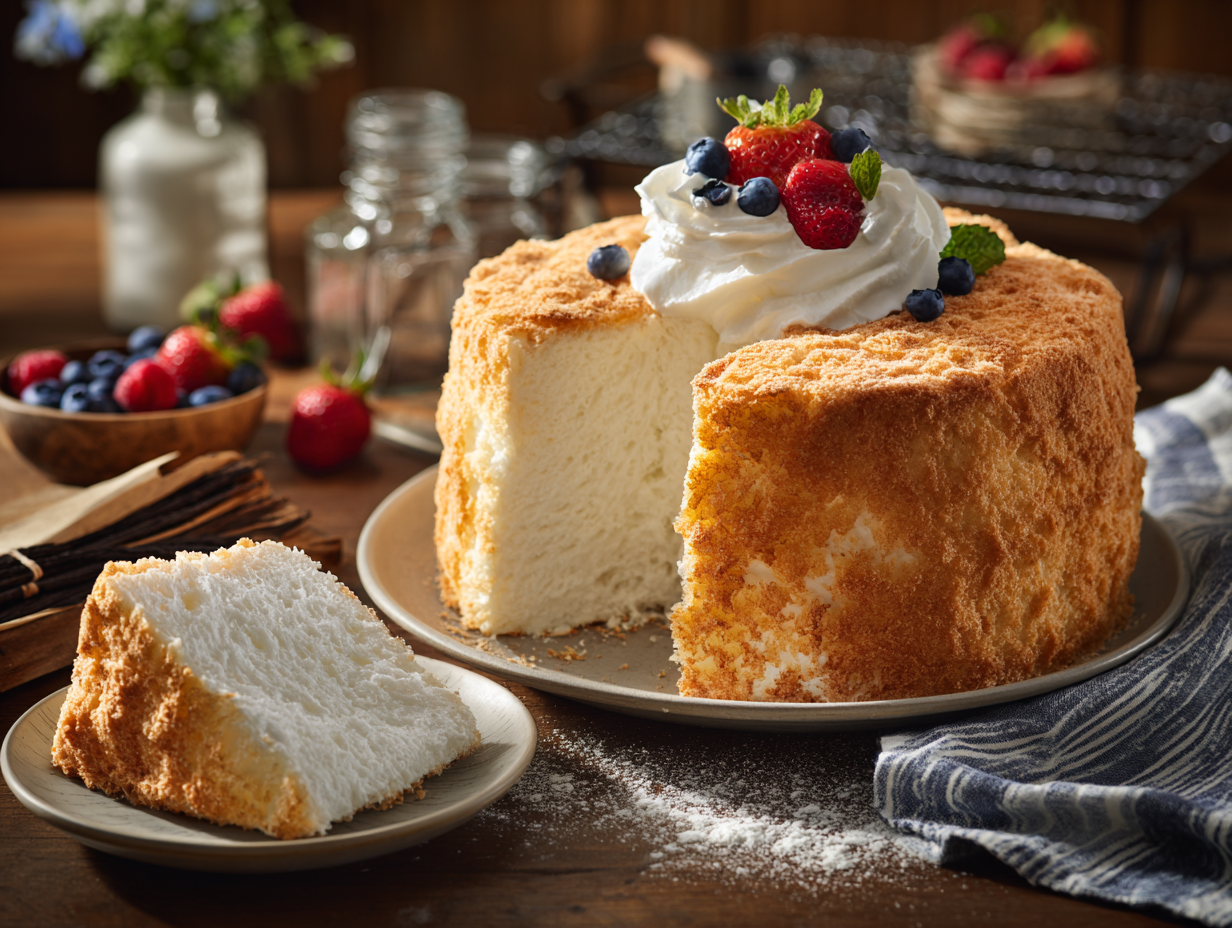
Angel food cake is a tall, white American cake built entirely on whipped egg whites — no butter, no yolks, no leavening powder. It comes out springy and light in a way no other cake does, and at 229 calories a slice it leaves room for whatever you want to serve alongside it. If you have a tube pan and a mixer, this is a genuinely achievable bake.
What makes this version work
Two things determine whether this cake rises tall or bakes flat. First, the sugar is split deliberately: three-quarters of a cup is sifted with the cake flour before it goes anywhere near the whites, and the other three-quarters is beaten directly into the whites. That first portion coats the flour particles and keeps the batter from deflating when you fold. Second, the pan must be completely grease-free — any fat on the surface prevents the batter from gripping the sides as it climbs, and the cake will slide down and collapse. Run your finger around the inside of the pan before you start; if it feels slick at all, wash and dry it again.
Troubleshooting
- Cake shrinks away from the pan sides while baking: The pan was greased, or there was fat residue on your bowl or beaters. Even a trace of egg yolk in the whites will cause this. Wipe your bowl and beaters with a paper towel dampened with white vinegar before you start.
- Dense, rubbery texture: The flour mixture was folded in too aggressively or all at once. Fold in four additions and stop as soon as you no longer see streaks of flour — over-mixing deflates the air you built into the whites.
- Cake falls out of the pan during inverted cooling: It wasn’t fully cooled. One hour inverted is the minimum; two hours is safer. The cake needs to set completely before it can release cleanly.
- Top cracks during baking: This is normal and not a problem. Angel food cake almost always cracks on top as it rises. It has no effect on texture or flavor.
- Gummy, wet layer at the bottom: The oven temperature was too low, or the cake was underbaked. Test by pressing the top firmly — it should spring back completely with no indent remaining.
Ingredient notes
- Cake flour: Don’t substitute all-purpose flour. Cake flour has lower protein content, which is what keeps the crumb tender rather than chewy. If you genuinely can’t find it, you can make a rough substitute by replacing 2 tablespoons of each cup of all-purpose flour with cornstarch, but the texture won’t be quite as fine.
- Cream of tartar: This is the small white tub in the spice aisle. It stabilizes the egg whites so they hold their volume through folding and baking. There’s no good substitute — skip it and the whites are much more likely to deflate.
- Egg whites at room temperature: Cold whites whip up, but room-temperature whites whip faster and to a greater volume. Set them out 30 minutes before you start. Skip the carton egg whites — they don’t whip reliably for this application.
Storage and make-ahead
Store the cooled cake at room temperature, loosely covered, for up to 3 days — airtight wrapping can make the crust sticky. Skip the fridge; refrigeration dries it out quickly. For longer storage, freeze individual slices wrapped tightly in plastic wrap and then placed in a zip-top bag; they keep well for up to 3 months and thaw at room temperature in about an hour. The cake can also be baked a day ahead and left in the inverted pan overnight, which actually makes it easier to slice cleanly the next day. If you want to serve it with fresh berries, prep those right before serving and skip the whipped cream — not worth the extra dish.
Classic Angel Food Cake

Equipment
- Tube pan
- Electric Mixer
- Wire whisk
- Spatula
- Cooling Rack
Ingredients
- 1 cup cake flour sifted
- 1 ½ cups granulated sugar divided
- 12 large egg whites room temperature
- 1 ½ teaspoons cream of tartar
- 1 teaspoon vanilla extract
- ¼ teaspoon salt
Instructions
- Preheat your oven to 350°F (175°C). Ensure your tube pan is free from grease.
- In a medium bowl, sift the cake flour with 3/4 cup of the granulated sugar. Set aside.
- In a large bowl, beat the egg whites on medium speed using an electric mixer until foamy.
- Add the cream of tartar and salt to the egg whites, then gradually add the remaining 3/4 cup of sugar while beating. Increase speed to high, and continue beating until soft peaks form.
- Gently fold in the vanilla extract, followed by the flour mixture in four additions. Use a spatula to maintain the airiness of the batter.
- Pour the batter into the tube pan and smooth the top. Gently tap the pan on the counter to remove large air bubbles.
- Bake for 35-40 minutes until the cake is golden brown and springs back when lightly touched.
- Invert the pan on a cooling rack. Allow to cool completely before removing from the pan.
Notes
- For enhanced flavor, consider adding a hint of almond extract.
- If desired, serve with fresh berries and a dollop of whipped cream.
Nutrition
Your questions, answered
Can I use egg whites from a carton instead of cracking 12 eggs?
No — carton egg whites won’t whip to the volume you need for this cake. The pasteurization process used for liquid egg whites damages the proteins that form stable foam, so you’ll get a flat, dense result. Crack and separate fresh eggs; save the yolks in the fridge for custard or pasta.
What if I don’t have a tube pan?
A tube pan is genuinely necessary here — don’t try a standard round or bundt pan. The center tube conducts heat into the middle of the batter so the cake bakes evenly all the way through, and the tall straight sides give the batter something to cling to as it rises. They’re inexpensive and available at most kitchen stores or online.
How do I know when the egg whites have reached soft peaks and haven’t gone too far?
Soft peaks droop slightly when you lift the beater — the tip curls over rather than standing straight up. If the whites look dry, clumpy, or start to separate liquid at the bottom of the bowl, they’re overbeaten and you’ll need to start over with fresh whites. Stop the mixer frequently to check once the whites start looking glossy.
My cake is stuck in the pan after cooling — how do I get it out?
Run a thin knife or offset spatula slowly around the outer edge and around the center tube, pressing the blade against the pan rather than the cake. Then push up from the bottom if your pan has a removable base, or invert onto a plate. Don’t rush this step — a fully cooled cake releases much more cleanly than a warm one.
What to bake next
- Brown Sugar Pavlova with Roasted Fruit
- Fluffy Castella Cake
- Roasted Strawberry Ice Cream
- Classic Royal Icing Without Meringue Powder