

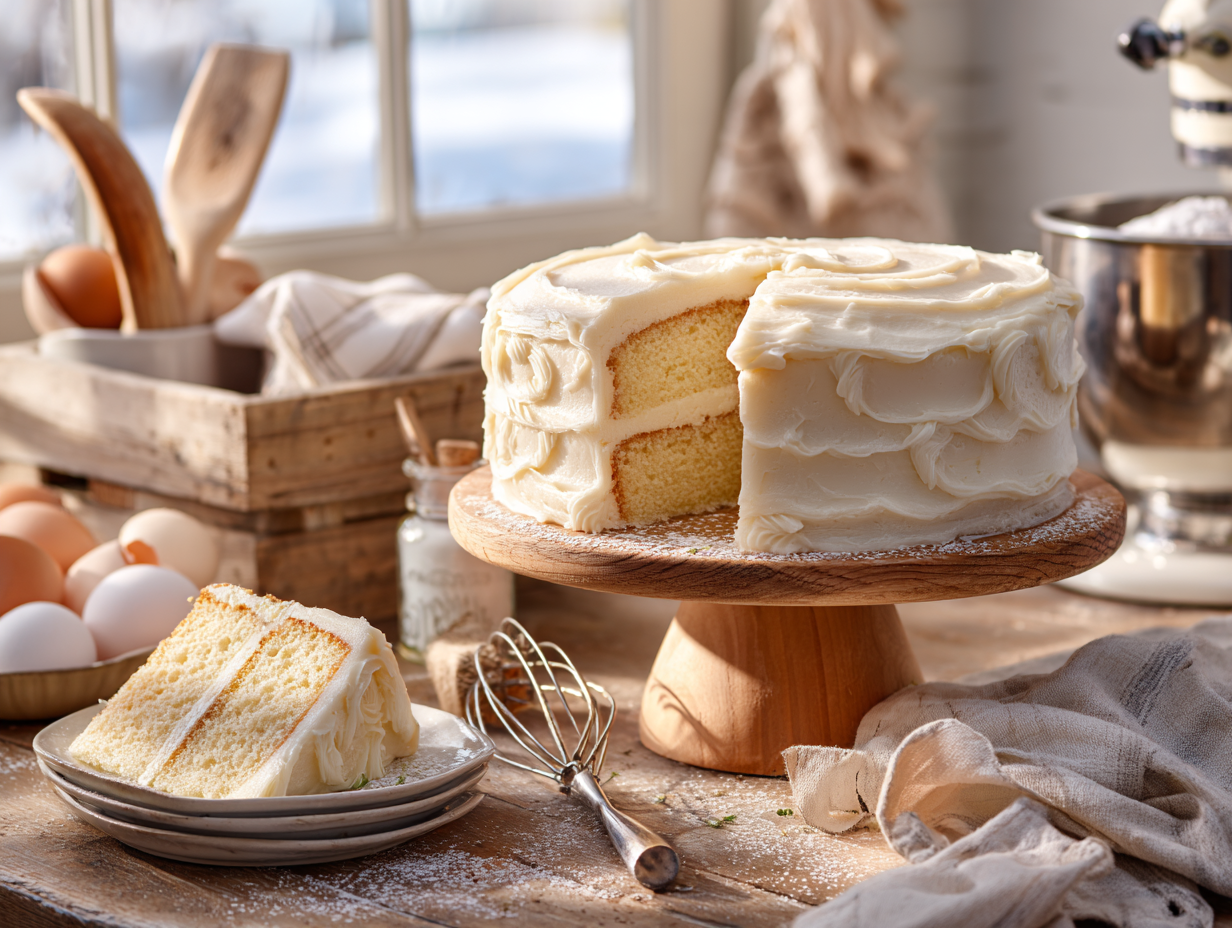
This is a two-layer white cake made with egg whites instead of whole eggs, which gives it a noticeably pale, fine crumb and a clean flavor that doesn’t compete with whatever frosting or filling you put on it. It takes about an hour start to finish and uses ingredients most bakers already have on hand. If you need a reliable base cake that works for birthdays, celebrations, or just a weekend project, this is a good one to have in your rotation.
Why this recipe works
Two things matter most here. First, using only egg whites — no yolks — removes the fat and pigment that would otherwise give the crumb a yellow tint and a denser texture. You get a lighter, more delicate result. Second, alternating the flour and milk additions (starting and ending with flour) keeps the batter from becoming either too stiff or too loose at any point during mixing, which means the gluten doesn’t overdevelop and the cake stays tender. Cream the butter and sugar long enough — a full three to five minutes — and you’ll see the mixture go noticeably pale and fluffy. That step is doing real work: it’s building the air structure the cake relies on since there’s no whipped-egg-white foam to fall back on.
Troubleshooting
- Cake sinks in the center: The most common cause is underbaking. The toothpick test can mislead you if you hit a pocket — test in two spots near the center. Also check that your baking powder isn’t old; it loses potency after about six months once opened.
- Crumb is dense and gummy: The batter was likely overmixed after the flour went in. Once you add flour, switch to low speed and stop the moment you no longer see dry streaks.
- Layers baked unevenly: Oven hot spots are usually the culprit. Rotate the pans front-to-back at the 15-minute mark. If one pan is consistently darker, swap its rack position too.
- Cake sticks to the pan: Greasing and flouring is not optional here — the batter is lean enough that it will bond to an under-prepared pan. Run a thin offset spatula around the edge before inverting.
- Egg whites won’t incorporate smoothly: Cold egg whites seize the butter and leave lumpy bits in the batter. Make sure both the butter and egg whites are genuinely at room temperature before you start.
Substitutions that actually work
- Whole milk: Any dairy milk works. Oat milk is the most reliable non-dairy swap here — it has enough body to behave similarly in the batter. Thinner milks like rice milk can make the layers slightly more fragile.
- Unsalted butter: If you only have salted butter, use it and leave out the added salt entirely. The flavor difference is minimal.
- All-purpose flour: Cake flour will give you an even more tender crumb if you have it — use 2¼ cups in place of 2 cups all-purpose. Skip the garnish on the finished cake if you’re short on time — not worth the extra dish.
- Vanilla extract: Vanilla bean paste works one-for-one and gives you visible specks in the crumb. Imitation vanilla is fine for a cake this simple; the other flavors are subtle enough that it won’t stand out.
Storage and make-ahead
Unfrosted layers keep well wrapped tightly in plastic at room temperature for up to two days, or in the freezer for up to two months — freeze them on a flat surface first, then wrap once solid. A frosted cake can sit covered at room temperature for one day; after that, refrigerate it for up to four days, though the crumb will firm up in the fridge. Pull refrigerated slices out 20 to 30 minutes before serving so the texture loosens back up. If you’re baking ahead for an event, freezing the layers is the most practical move — they thaw at room temperature in about two hours and frost just as well as fresh.
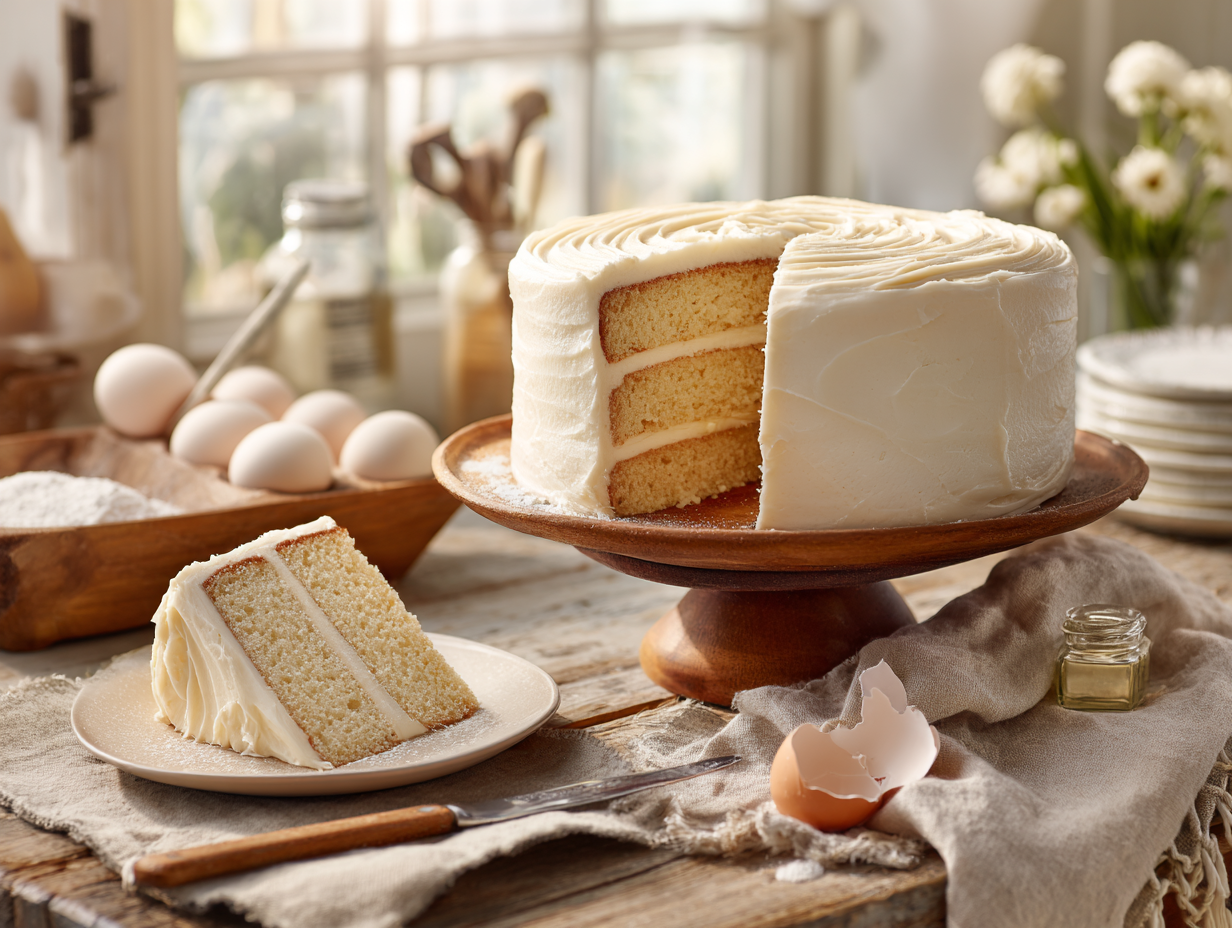
Classic White Cake

Equipment
- Stand Mixer
- 9-inch cake pans
- Rubber spatula
- wire rack
Ingredients
For the Dry Components:
- 2 cups all-purpose flour preferably sifted for best texture
- 1 tbsp baking powder ensure freshness for a proper rise
- ½ tsp salt
For the Wet Components:
- ½ cup unsalted butter softened to room temperature
- 1 ½ cups granulated sugar
- 3 large egg whites at room temperature
- 2 tsp vanilla extract use pure for best flavor
- 1 cup whole milk at room temperature
Instructions
- Preheat your oven to 325°F (165°C). Grease and flour two 9-inch cake pans.
- In a medium bowl, whisk together the flour, baking powder, and salt. Set aside.
- In a stand mixer, cream the butter and sugar on medium speed until light and fluffy, about 3-5 minutes. Scrape down the sides of the bowl as needed.
- Add the egg whites one at a time, beating well after each addition until fully incorporated. Then mix in the vanilla extract.
- Reduce the mixer to low and alternately add the flour mixture and milk, starting and ending with the flour. Mix until just combined.
- Divide the batter evenly between the prepared pans. Smooth the tops with a spatula.
- Bake in the preheated oven for 25-30 minutes, or until a toothpick inserted into the center comes out clean.
- Allow cakes to cool in the pans for 10 minutes, then transfer to a wire rack to cool completely.
Notes
- To enhance flavor, consider adding a drop of almond extract along with the vanilla.
- For dietary adaptations, substitute whole milk with any nut milk or lactose-free milk.
- If using salted butter, omit the added salt.
Nutrition
Common questions
Can I make this as a single-layer sheet cake instead of two round layers?
Yes — pour the batter into a greased and floured 9×13-inch pan and bake at 325°F for roughly 30 to 35 minutes, checking with a toothpick at 30. The total batter volume is the same, so you’re not adjusting anything except the pan and keeping an eye on the time.
Do I need a stand mixer, or can I use a hand mixer?
A hand mixer works fine. The creaming step just takes a little longer — closer to five minutes rather than three — because hand mixers typically run at lower wattage. Make sure the bowl is large enough that the beaters can move freely through the batter.
What can I do with the leftover egg yolks?
Egg yolks keep covered in the fridge for up to two days. They’re useful for a simple custard, a lemon curd, or a batch of pasta if you cook savory food too — or stir them into scrambled eggs the next morning.
My layers came out domed on top. Do I need to level them before frosting?
Only if you’re stacking them and want flat, even layers — use a serrated knife and a steady hand, or a cake leveler if you have one. For a casual frosted cake, a domed top is not a problem; just place the layers dome-side down.
Can I double the recipe for a taller or larger cake?
Doubling works, but don’t bake a double batch in one deep pan — it won’t cook through evenly. Instead, bake in four standard 9-inch rounds or work in two separate batches if you only have two pans.
What to bake next
- Nutty Brown Butter Vanilla Bean Cupcakes
- Ultimate Chocolate Sheet Cake
- Moist Eastern European Carrot Cake
- Fluffy Castella Cake