

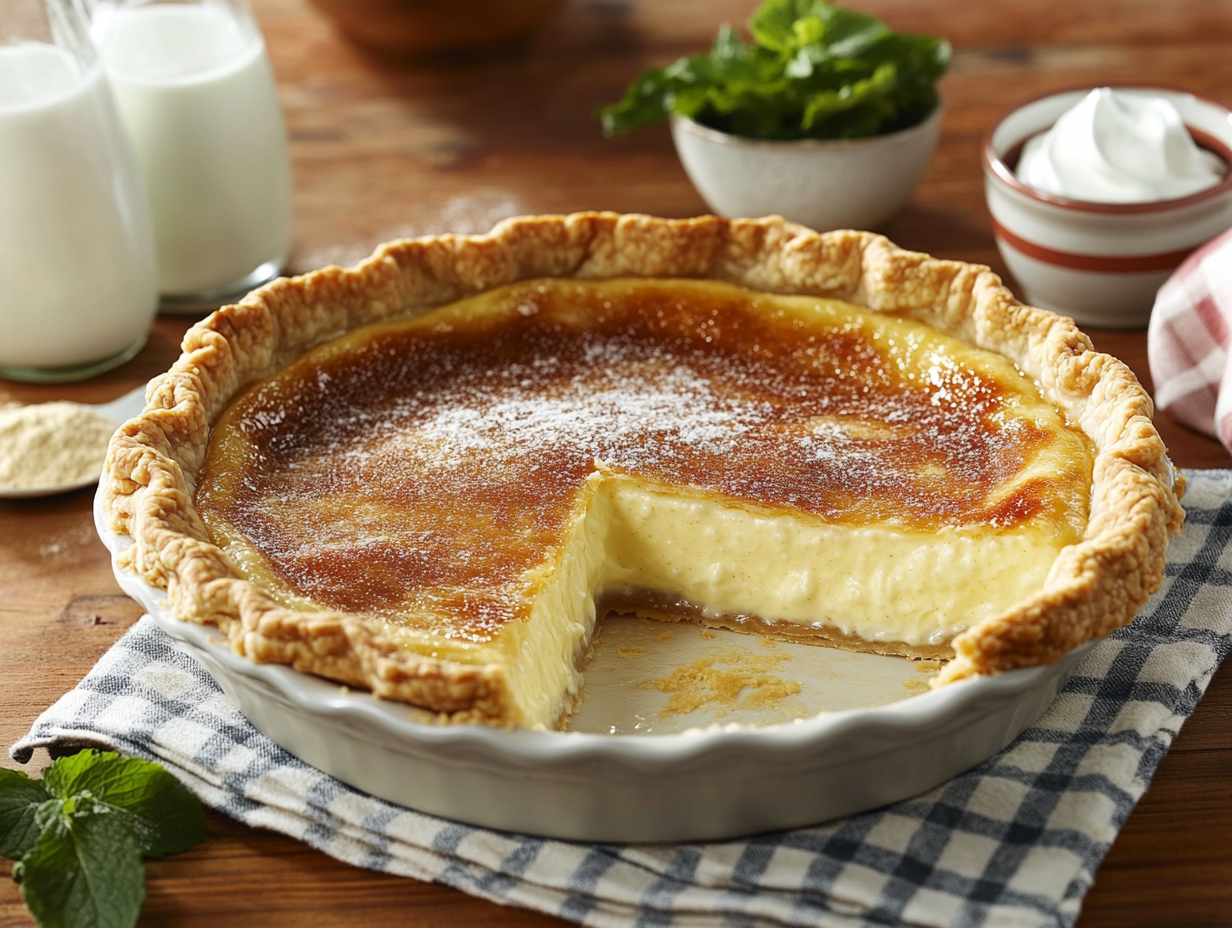
Buttermilk pie is a single-crust custard pie — eggs, butter, sugar, and buttermilk baked until just set — that slices cleanly and holds its shape at room temperature. It takes about 20 minutes of hands-on work and bakes in under an hour. The honest reason to make it: it’s one of the few pies that actually improves after a night in the fridge, which makes it genuinely useful when you’re cooking for a crowd.
Before you start
Two things determine whether this pie sets properly. First, your eggs and buttermilk need to be at room temperature — cold dairy and eggs mixed with warm melted butter can cause the butter to seize into small clumps, which disrupts the smooth custard texture. Pull them from the fridge at least 30 minutes before you begin. Second, let your melted butter cool until it’s just warm to the touch before whisking in the sugar and eggs; if it’s too hot when the eggs go in, you risk partially cooking them and ending up with a grainy filling rather than a silky one.
What can go wrong
- Soggy bottom crust: The filling is liquid-heavy, so a warm crust absorbs moisture fast. Chilling the unbaked shell while you mix the filling (as the recipe directs) helps, but if your kitchen is warm, you can also blind-bake the crust for 10 minutes at 375°F before adding the filling — just let it cool slightly first.
- Cracked top: This usually means the oven ran too hot or the pie baked too long. Ovens vary; start checking at 45 minutes. The center should still have a slight wobble — it will firm up as it cools. A cracked pie tastes identical, but if presentation matters, dust lightly with powdered sugar before serving.
- Filling weeps or pools liquid after slicing: This happens when the pie is cut before it has fully cooled and set. Two hours at room temperature is the minimum; overnight refrigeration gives the cleanest slices.
- Pale, under-browned top: Full-fat buttermilk browns better than low-fat. If the top looks pale at the 50-minute mark and the filling is set, move the pie to the upper third of the oven for the final 5 minutes.
- Edges over-browning before the center sets: Cover the crust edges loosely with foil or a pie shield after the first 25 minutes of baking. Skip the decorative garnish of extra crimping — not worth the extra effort when it’s just going to get covered anyway.
Storage and freezing
Once fully cooled, cover the pie loosely with plastic wrap and refrigerate for up to 4 days — the texture and flavor are noticeably better on day two than day one, so baking the day before an event is genuinely the right call, not just a convenience. For longer storage, buttermilk pie freezes well: wrap the fully cooled, unsliced pie tightly in plastic wrap and then foil, and freeze for up to 2 months. Thaw overnight in the refrigerator rather than at room temperature to keep the custard from weeping. If you’re making it for a holiday, you can bake it up to 3 days ahead and keep it refrigerated — just bring it to room temperature for about 30 minutes before serving for the best texture.
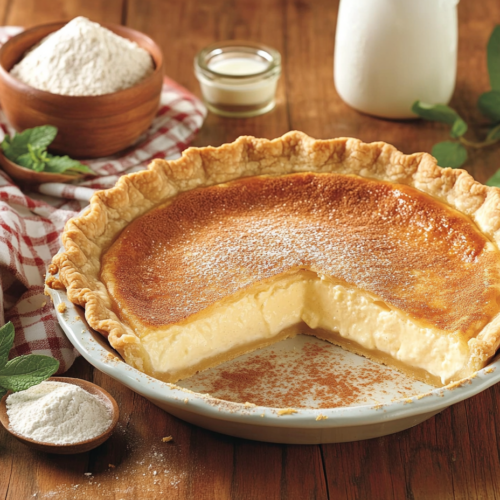
Buttermilk Pie

Ingredients
Pie Crust
- 1 pack pre-made pie crust 9-inch, store-bought or homemade
Filling
- 1 cup buttermilk preferably full-fat
- ½ cup unsalted butter melted and slightly cooled
- 1 ½ cups granulated sugar
- 3 large eggs at room temperature
- 2 tablespoons all-purpose flour
- 1 teaspoon vanilla extract pure
- ¼ teaspoon ground nutmeg
- ¼ teaspoon salt
Instructions
- Preheat the oven to 350°F (175°C). Roll out the pie crust and fit it into a 9-inch pie plate. Trim and crimp the edges decoratively, then set aside in the refrigerator to chill while you prepare the filling.
- In a large mixing bowl, whisk together the melted butter and sugar until smooth and well-blended.
- Add the eggs one at a time, whisking well after each addition, until fully incorporated and the mixture is becoming pale.
- Sift in the flour, then add the buttermilk, vanilla extract, nutmeg, and salt. Mix until completely blended and smooth.
- Pour the filling into the prepared, chilled pie crust. Use a spatula to smooth the top evenly.
- Bake in the preheated oven for 50 to 60 minutes, or until the filling is set and the top is golden brown. A slight jiggle in the center is fine, as it will firm up as it cools.
- Allow the pie to cool to room temperature before serving, approximately 1 to 2 hours.
Notes
Nutrition
FAQ
Can I use low-fat or non-fat buttermilk instead of full-fat?
You can, but the filling will be slightly less rich and the top may not brown as deeply. Full-fat buttermilk gives the custard a creamier set and a better flavor, so it’s worth seeking out if you can.
How do I know when the pie is actually done baking?
The filling should be set around the edges with a 2- to 3-inch wobble in the very center — similar to a cheesecake. It will look slightly underdone when you pull it, but it firms up completely as it cools; if the whole surface is rigid in the oven, it’s overbaked.
Do I need to pre-bake (blind-bake) the crust?
The recipe doesn’t require it, and most of the time chilling the raw shell is enough. If you’ve had soggy-bottom problems with custard pies before, a 10-minute blind bake at 375°F before adding the filling is good insurance.
Can I make this pie the night before and serve it the next day?
Yes — and it’s actually the better approach. The custard sets more firmly overnight, which means cleaner slices and a more cohesive texture. Store it covered in the refrigerator and let it sit at room temperature for 30 minutes before serving.
My filling looks curdled or lumpy before it goes into the oven — is it ruined?
Not necessarily. Small lumps usually mean the butter was too warm when the eggs were added, or the ingredients were at different temperatures. Strain the filling through a fine-mesh sieve into the crust and it will bake out smooth.
What to bake next
- Toasted Coconut Custard Pie
- Southern Classic Pecan Pie
- Zesty Key Lime Pie
- Southern Maple Bourbon Bread Pudding