

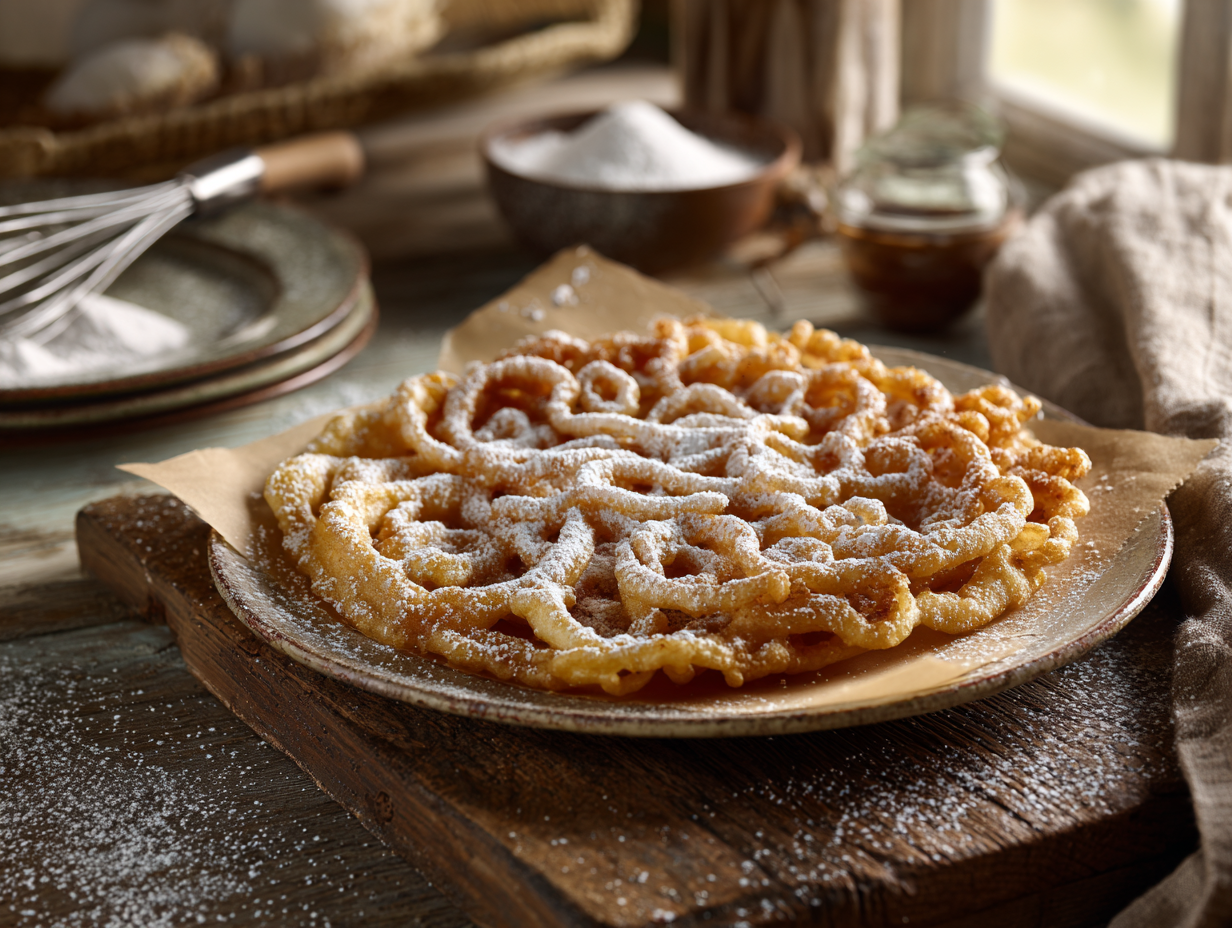
Funnel cake is a simple fried batter dessert — flour, egg, milk, and a squeeze bottle — that comes out crispy on the outside and soft in the middle. It takes about 35 minutes start to finish, uses ingredients you almost certainly have right now, and makes four generous cakes. The real reason to make it at home is control: you choose the oil, the heat, and the toppings, and you serve it hot.
The short version of why this works
Two things determine whether you get a crispy, lacy cake or a greasy, doughy mess. First, oil temperature. At 375°F the batter sets almost instantly on contact, trapping steam inside and creating that open, crunchy web. Drop below 350°F and the batter absorbs oil before it can set — you’ll taste it. Second, batter consistency. It needs to flow freely through the funnel or squeeze bottle without spreading flat the moment it hits the oil. The recipe’s ratio of ¾ cup milk to 1 cup flour produces a batter close to thin pancake batter, which is exactly right. If it’s too thick to pour in a steady stream, it won’t form the overlapping lattice that gives funnel cake its structure.
Common problems and fixes
- Cakes falling apart when you flip them: The lattice needs to be tight enough to hold together. When you pour, keep the stream continuous and overlap the circles deliberately — don’t leave big gaps. Give the first side a full 2 minutes before attempting to flip.
- Oil temperature dropping mid-batch: A cold skillet or too many cakes at once will tank the temperature fast. Fry one at a time and let the oil return to 375°F between each cake. A clip-on thermometer makes this easy to monitor without stopping.
- Powdered sugar turning wet and sticky: Dust only right before serving. If the cakes sit even five minutes after dusting, the sugar absorbs moisture from the warm cake and disappears. Keep the sifter nearby and dust to order.
- Batter clogging the funnel or bottle tip: Any lumps in the batter will block a narrow tip. Whisk the wet and dry ingredients until completely smooth before transferring, and use a squeeze bottle with at least a ¼-inch opening. A wide-mouth funnel with your finger over the bottom also works well for larger batches.
- Uneven browning across the cake: This usually means the oil isn’t deep enough. You need at least 1 inch of oil so the batter floats freely and browns on the underside without touching the pan bottom. In a standard 10-inch skillet that’s roughly 1½ to 2 cups of oil.
Substitutions that actually work
- Milk: Oat milk works well here — it’s close enough in fat and consistency to whole milk that the batter behaves the same way. Almond milk is thinner, so reduce it to about ⅔ cup and check the batter consistency before frying.
- Gluten-free flour: A 1:1 gluten-free all-purpose blend (the kind with xanthan gum already in it) substitutes directly. The cakes will be slightly more fragile when flipping, so give them a few extra seconds on the first side. Skip the funnel and use a squeeze bottle — it gives you more control over a thinner batter.
- Powdered sugar topping: Skip the garnish — not worth the extra dish. A light dusting straight from the bag through a small strainer does exactly the same job as a sifter, and one less thing to wash when you’re frying four rounds back to back.
Keeping it fresh
Funnel cake is at its best within about 10 minutes of coming out of the oil — the crisp texture starts to soften as it cools and the structure traps steam. That said, if you’re making a large batch, cooked cakes can be kept warm and reasonably crisp on a wire rack in a 200°F oven for up to 30 minutes. Don’t stack them or cover them, or they’ll steam each other soft. Leftovers stored at room temperature in an open container will last overnight but lose most of their crunch. Reheat them in a single layer in an air fryer at 375°F for 3 to 4 minutes, or in a conventional oven at 400°F for about 5 minutes. Freezing is not recommended — the texture after thawing is noticeably gummy. For parties, the smarter move is to mix and refrigerate the batter up to 24 hours ahead (give it a quick stir before using), then fry to order in batches.
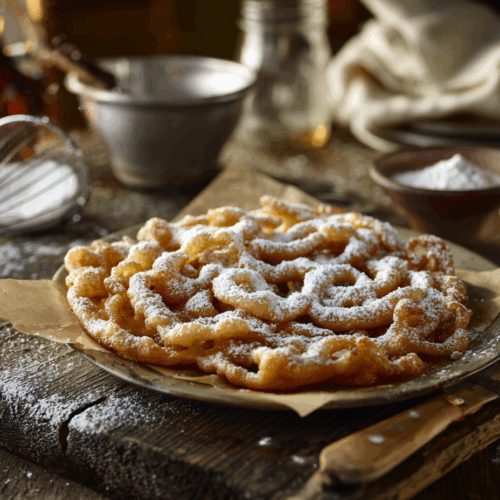
Classic Funnel Cake

Equipment
- Medium mixing bowl
- Whisk
- Large skillet or deep fryer
- Funnel or squeeze bottle
- Tongs
- Slotted spoon
- Paper towels
Ingredients
- 1 cup all-purpose flour preferably unbleached
- 1 teaspoon baking powder
- ¼ teaspoon salt
- 1 tablespoon granulated sugar
- ¾ cup milk whole milk for richness
- 1 large egg room temperature
- ½ teaspoon vanilla extract
- ¼ cup powdered sugar for dusting
Instructions
- In a medium mixing bowl, whisk together 1 cup of all-purpose flour, 1 teaspoon of baking powder, 1/4 teaspoon of salt, and 1 tablespoon of granulated sugar. Make sure to combine well to evenly distribute the baking powder.
- In a separate bowl, mix 3/4 cup of milk, 1 large room-temperature egg, and 1/2 teaspoon of vanilla extract. Whisk until smooth and incorporated.
- Gradually add the wet mixture into the dry ingredients, whisking until a smooth batter is formed. The batter should be the consistency of pancake batter.
- Heat about 1 inch of oil in a large skillet or deep fryer to 375°F (190°C). A digital thermometer will ensure accuracy.
- Pour the batter into a funnel or squeeze bottle. Carefully swirl the batter into the hot oil in a circular motion, overlapping to create a lattice-like pattern. Cook each cake for about 1-2 minutes on each side until golden brown.
- Using tongs or a slotted spoon, carefully remove the funnel cake and drain on paper towels to absorb any excess oil.
- Immediately dust with powdered sugar for a delightful snowy coating. Serve warm.
Notes
- For a richer flavor, try adding a pinch of cinnamon or nutmeg to the batter.
- If you prefer a fruity twist, serve with fresh berries or a drizzle of chocolate sauce.
- For dietary adjustments, consider using almond milk or a gluten-free flour blend.
Nutrition
Your questions, answered
Can I make the batter ahead of time?
Yes — the batter keeps in the refrigerator for up to 24 hours. Store it in the squeeze bottle or a sealed container, and give it a good stir before frying since it can settle slightly overnight.
What oil is best for frying funnel cake?
Use a neutral oil with a high smoke point — vegetable, canola, or refined peanut oil all work well. Avoid olive oil or butter; they smoke before reaching the 375°F you need.
Can I bake funnel cake instead of frying it?
Not with this recipe — baking produces a soft, pancake-like result rather than a crispy one. The high-heat oil contact is what creates the texture.
How do I scale this up for a crowd?
The recipe doubles and triples cleanly — just multiply every ingredient by the same factor. Mix batter in batches of no more than 3x at a time to keep it manageable, and keep a second squeeze bottle filled and ready so you’re not stopping to refill mid-fry.
My funnel cake is greasy — what went wrong?
The oil was almost certainly too cool when you added the batter. Check the temperature with a thermometer before each cake, not just at the start, since frying drops it quickly.
Do I need a special funnel, or will a squeeze bottle work?
A squeeze bottle works better than a traditional funnel for most people because you control the flow with one hand while the other stays free. Look for one with an opening of at least ¼ inch — anything narrower clogs easily.
Try these next
- Crispy Cornmeal Johnny Cakes
- Gourmet Homemade Pop-Tarts
- Elevated Brown Butter Rice Krispie Treats
- Wholesome Mountain Pancakes with Vibrant Berry Compote