

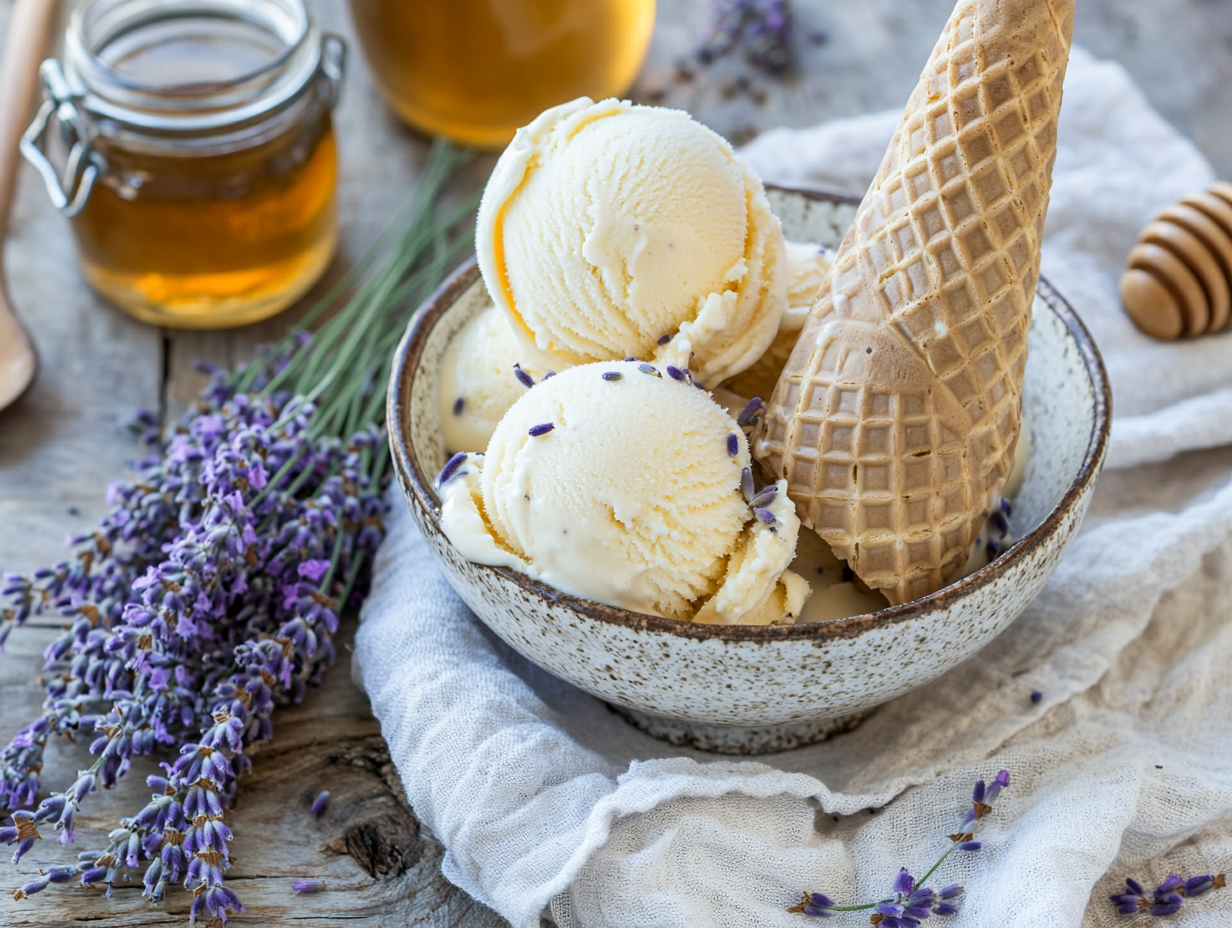
Honey lavender ice cream is a custard-based frozen dessert made with heavy cream, whole milk, egg yolks, honey, and dried culinary lavender. The lavender steeps in the warm cream base, then gets strained out completely before churning, so the flavor is floral without being perfumy. It’s worth making because the ingredient list is short, the process is straightforward if you’ve made any custard before, and the result is genuinely different from anything you can buy at the grocery store.
The technique that matters
Tempering the egg yolks is the step that determines whether you get silky ice cream or sweet scrambled eggs. The key is adding the hot cream to the yolks slowly — a thin stream while whisking constantly — not dumping it all in at once. Once the custard goes back on the stove, keep the heat low and don’t walk away. You’re looking for it to coat the back of a spoon and leave a clean line when you drag your finger across it. Pull it off the heat the moment it thickens; overcooking tightens the proteins and gives you a grainy texture no amount of churning will fix. The steep time also matters more than people expect — 20 minutes in warm cream pulls enough flavor from the lavender that you won’t need to add more, and straining it cleanly prevents any bitter, grassy notes from sneaking through.
Substitutions that actually work
- Dried culinary lavender: This must be food-grade — not craft-store or garden lavender, which may be treated with pesticides. If you can only find it in small quantities online, it keeps well in a sealed jar for months, so buying a small bag is a reasonable pantry investment.
- Honey variety: Wildflower or clover honey both work well. A strongly flavored honey like buckwheat will compete with the lavender rather than complement it, so stick to a lighter, milder variety if you have options.
- Heavy cream: Half-and-half can replace part of the heavy cream if that’s what you have, but expect a slightly icier texture rather than a creamy one. Don’t go below a 1:1 ratio of cream to milk or the custard won’t freeze smoothly.
- Dairy-free version: Full-fat coconut cream in place of heavy cream and unsweetened oat milk or coconut milk in place of whole milk both work. The flavor will shift slightly toward coconut, but it pairs well with honey and lavender.
- No ice cream maker: Pour the chilled custard into a shallow freezer-safe dish, freeze for 45 minutes, then beat vigorously with a fork or hand mixer. Repeat every 30–45 minutes for 3–4 hours. The texture won’t be as smooth, but it’s a workable no-machine method.
If something goes sideways
- The custard smells or tastes soapy: The lavender steeped too long or the quantity was too high. Steep for exactly 20 minutes and measure carefully — a quarter cup is already assertive. You can try balancing it by stirring in an extra tablespoon of honey after straining.
- The ice cream is icy and grainy after freezing: The custard likely wasn’t chilled thoroughly before churning. It needs to be fully cold — not just cool — before it goes into the machine. Two hours in the fridge is the minimum; overnight is better.
- The custard curdled on the stove: If you see lumps, immediately pour it through a fine mesh sieve into a cold bowl set over an ice bath and whisk hard. Caught early, this can rescue a slightly curdled custard. If it’s fully scrambled, it can’t be saved.
- The churned ice cream won’t firm up in the freezer: Make sure your freezer is set to 0°F / -18°C or colder. Press a piece of plastic wrap directly onto the surface of the ice cream before putting the lid on — this reduces ice crystals and helps it set evenly.
- The flavor is too faint after freezing: Cold mutes flavor. Taste the custard before churning and make sure the honey and lavender are both clearly present at room temperature — if they’re subtle then, they’ll nearly disappear once frozen.
Make-ahead notes
The custard base can be made up to three days ahead and kept covered in the refrigerator — this actually improves the texture because the mixture has more time to hydrate fully before churning. Once churned and transferred to a container, the ice cream is best within two weeks; after that it’s still safe to eat but starts to develop ice crystals and loses its creamy texture. If it’s been in the freezer more than a few days, let it sit on the counter for 5 minutes before scooping — skip the garnish of extra dried lavender on top, not worth the extra dish, and a small drizzle of honey right before serving does the job better anyway.
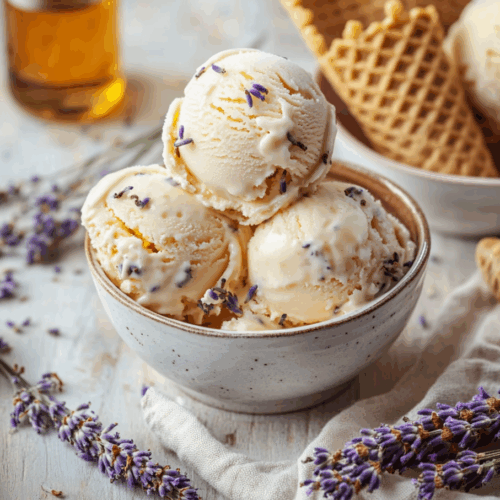
Honey Lavender Ice Cream

Equipment
- Medium-sized saucepan
- Mixing Bowls
- Whisk
- Fine Mesh Sieve
- Ice Cream Maker
Ingredients
- 2 cups heavy cream preferably organic for a rich flavor
- 1 cup whole milk whole milk provides a better texture
- ½ cup honey use a fragrant honey like wildflower or clover
- ¼ cup dried culinary lavender ensure it is food-grade
- 4 large egg yolks fresh and free-range if possible
- 1 teaspoon vanilla extract for added depth of flavor
Instructions
- In a medium-sized saucepan, combine the heavy cream, whole milk, honey, and dried culinary lavender. Heat over medium heat until the mixture is hot and steaming but not boiling. Stir occasionally.
- Remove the saucepan from heat and let the mixture steep for 20 minutes. This allows the lavender to infuse its flavor into the cream.
- In a separate mixing bowl, whisk the egg yolks until they are pale and smooth.
- Reheat the cream mixture gently until warm. Slowly strain the mixture through a fine mesh sieve into the egg yolks, whisking constantly to combine. This prevents the yolks from curdling.
- Return the custard to the saucepan. Cook over low heat, stirring constantly with a wooden spoon until the mixture thickens enough to coat the back of the spoon, approximately 8-10 minutes.
- Remove from heat and stir in the vanilla extract. Let the custard cool to room temperature, then refrigerate until completely chilled, about 2 hours.
- Pour the chilled mixture into an ice cream maker and churn according to the manufacturer's instructions until it reaches a soft-serve consistency.
- Transfer the ice cream to a lidded container and freeze until firm, at least 2 hours, before serving.
Notes
- For an extra floral note, you can add a few drops of lavender essential oil (ensure it is safe for consumption).
- To make the recipe suitable for those with dietary restrictions, you may replace the heavy cream and whole milk with coconut cream and almond milk.
Nutrition
Your questions, answered
Can I use fresh lavender instead of dried?
Fresh lavender works, but you’ll need to use roughly double the amount — about half a cup — since the flavor is less concentrated than dried. Make sure it’s unwashed, unsprayed, and food-grade; rinse it gently and pat it dry before adding it to the cream.
Do I really need an ice cream maker?
No — see the no-machine method in the substitutions section above. It takes more active time and the texture will be slightly less smooth, but it produces a genuinely good result without any special equipment.
How do I know if my lavender is food-grade?
Food-grade or culinary lavender is sold specifically for cooking and is labeled as such. Lavender from a craft store, florist, or garden center is not safe to eat — it may be treated with pesticides or preservatives not intended for consumption.
Can I reduce the honey to make it less sweet?
You can reduce it slightly — down to about a third of a cup — but don’t go much lower or the custard won’t have enough body and the lavender flavor will seem harsh by comparison. Honey also affects the texture of the final scoop, not just the sweetness.
Why does my ice cream get rock-hard in the freezer?
Home freezers run colder than commercial ones, which makes homemade ice cream freeze harder than store-bought. Letting it sit at room temperature for 5 minutes before scooping is the simplest fix; you can also store it in a shallow container rather than a deep one so it thaws more evenly.
If you liked this one
- Provence-Inspired Lavender Honey Panna Cotta
- Provence-Inspired Blackberry Lavender Crumble
- Honeycomb Ice Cream
- Caramelized Honey Frozen Dessert