


This is a butter-based powdered sugar frosting that spreads smoothly, pipes cleanly, and sets firm enough that frosted cookies can be stacked without smearing. It takes about 10 minutes to mix and covers roughly two dozen cookies. The honest reason to make it: it works reliably on a first attempt, and the consistency is easy to adjust on the fly.
What makes this version work
Two things actually matter here. First, the butter must be genuinely soft — not melted, not cold from the fridge, but sitting at room temperature long enough that your finger leaves an indent without effort. Cold butter won’t beat smooth; it stays lumpy and the frosting never fully comes together. Second, adding the powdered sugar one cup at a time on low speed before turning the mixer up keeps the sugar from puffing into a cloud and also lets each addition fully incorporate, which is what gives the finished frosting its even, non-grainy texture. Rush either of those steps and the result is either lumpy or gritty — both fixable, but easier to avoid from the start.
If something goes sideways
- Frosting looks curdled or lumpy after adding sugar: The butter was probably too cold. Keep beating on medium speed for a full extra minute — warmth from the mixer often brings it together. If not, set the bowl over a pan of warm (not hot) water for 20 seconds, then beat again.
- Frosting is smooth but tastes overwhelmingly sweet: The pinch of salt in the recipe is doing real work — if you skipped it, add it now and beat for another 30 seconds. A small pinch makes a noticeable difference.
- Frosting slides off the cookie instead of staying put: The cookies weren’t fully cool. Even slightly warm cookies melt the butter in the frosting and cause it to run. Give cookies at least 30 minutes on a wire rack before frosting.
- Food coloring is streaky and uneven: Gel food coloring blends more evenly than liquid drops and won’t thin out the frosting. Add it after the final beat, then mix for a full 60 seconds — longer than feels necessary.
- Piped lines spread and lose their shape: The frosting is too thin for piping. Skip the milk entirely — use it only if you’re spreading, not piping. For defined lines or rosettes, a stiffer consistency with no added milk holds its shape much better.
Make-ahead notes
The frosting keeps well in an airtight container in the refrigerator for up to one week — press a piece of plastic wrap directly onto the surface before sealing the lid to prevent a crust from forming. Before using cold frosting, let it sit at room temperature for 20 to 30 minutes, then beat it briefly with a hand mixer to bring it back to a spreadable consistency; it will look stiff at first but loosens quickly. For longer storage, freeze it for up to three months in a freezer-safe container. Thaw overnight in the fridge, then bring to room temperature and re-beat before using. Skip freezing it with food coloring already mixed in — colors can shift slightly after a freeze-thaw cycle, so add color fresh after thawing.
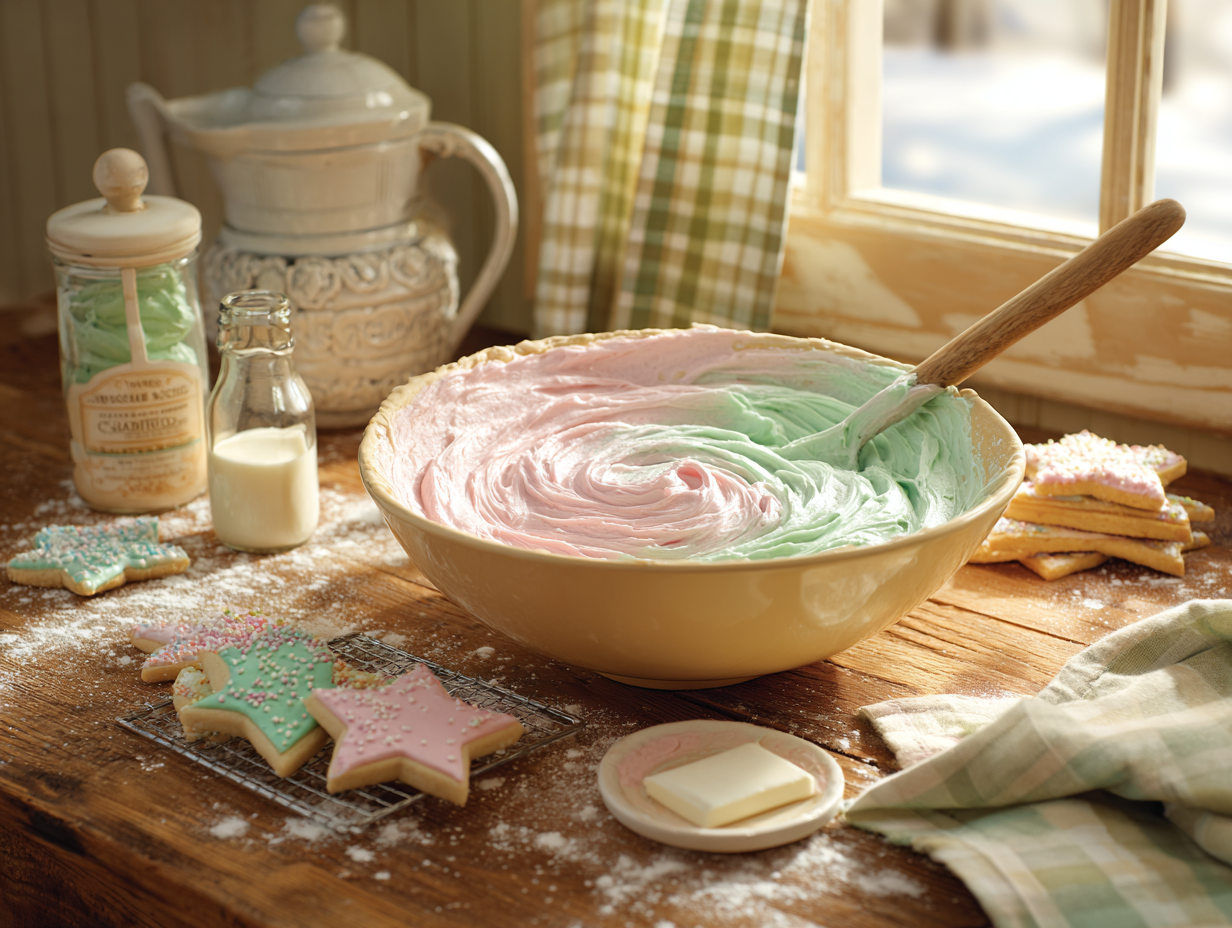
Classic Sugar Cookie Frosting

Equipment
- Mixing Bowl
- Electric Mixer
- Spatula
- Sifter
Ingredients
- 1 cup unsalted butter softened to room temperature
- 4 cups confectioners' sugar sifted for smoothness
- 2 teaspoons vanilla extract pure vanilla extract for best flavor
- ¼ cup milk can substitute with almond milk for lactose-free option
- 1 pinch salt to balance sweetness
Instructions
- In a large mixing bowl, beat the softened butter with an electric mixer on medium speed until creamy and smooth. This usually takes about 2 minutes.
- Gradually add the sifted confectioners' sugar, one cup at a time, mixing on low speed to prevent sugar clouds. Increase to medium speed until the mixture is fully incorporated and fluffy.
- Add the pure vanilla extract, milk, and a pinch of salt to the bowl. Beat on medium-high speed for another 2-3 minutes until the frosting is light and airy.
- If the frosting is too thick, add additional milk, one tablespoon at a time, to reach desired consistency. If too thin, add more sugar, one tablespoon at a time.
Notes
- For a color variation, add a few drops of food coloring during the final mixing stage.
- Store unused frosting in an airtight container in the refrigerator for up to a week.
Nutrition
Your questions, answered
Can I use salted butter instead of unsalted?
Yes, but skip the pinch of salt called for in the recipe. Salted butter varies in sodium content by brand, so leaving out the added salt keeps you from accidentally over-salting the frosting.
Do I really need to sift the powdered sugar?
Sifting is worth doing if your powdered sugar has any lumps — even small ones will show up in the finished frosting. If your sugar pours out fine and clump-free straight from the bag, you can skip it, but run it through a sieve if you’re unsure.
How do I know when the frosting is the right consistency for spreading versus piping?
For spreading, the frosting should fall slowly off a spatula in a thick ribbon. For piping, it should hold a peak when you lift the beater — it won’t drip at all. Add milk one tablespoon at a time for spreading; add powdered sugar one tablespoon at a time to stiffen it for piping.
Will the frosting harden enough to stack the cookies?
Yes, it sets firm at room temperature within about 1 to 2 hours, depending on how thickly it’s applied. Once fully set, the surface won’t smear under light pressure, making stacking and packaging straightforward.
Can I make this without an electric mixer?
You can, but the butter needs to be very soft — almost to the point of being greasy — so it mixes by hand without leaving lumps. Use a sturdy whisk and expect to spend about 5 minutes working out the sugar in stages; the frosting will be slightly denser but still usable.
More sweet things to bake
- Classic Royal Icing Made Simply Without Meringue Powder
- Sweet Canadian Maple Cream Sandwich Cookies
- Gourmet Homemade Pop-Tarts
- Nutty Brown Butter Vanilla Bean Cupcakes