

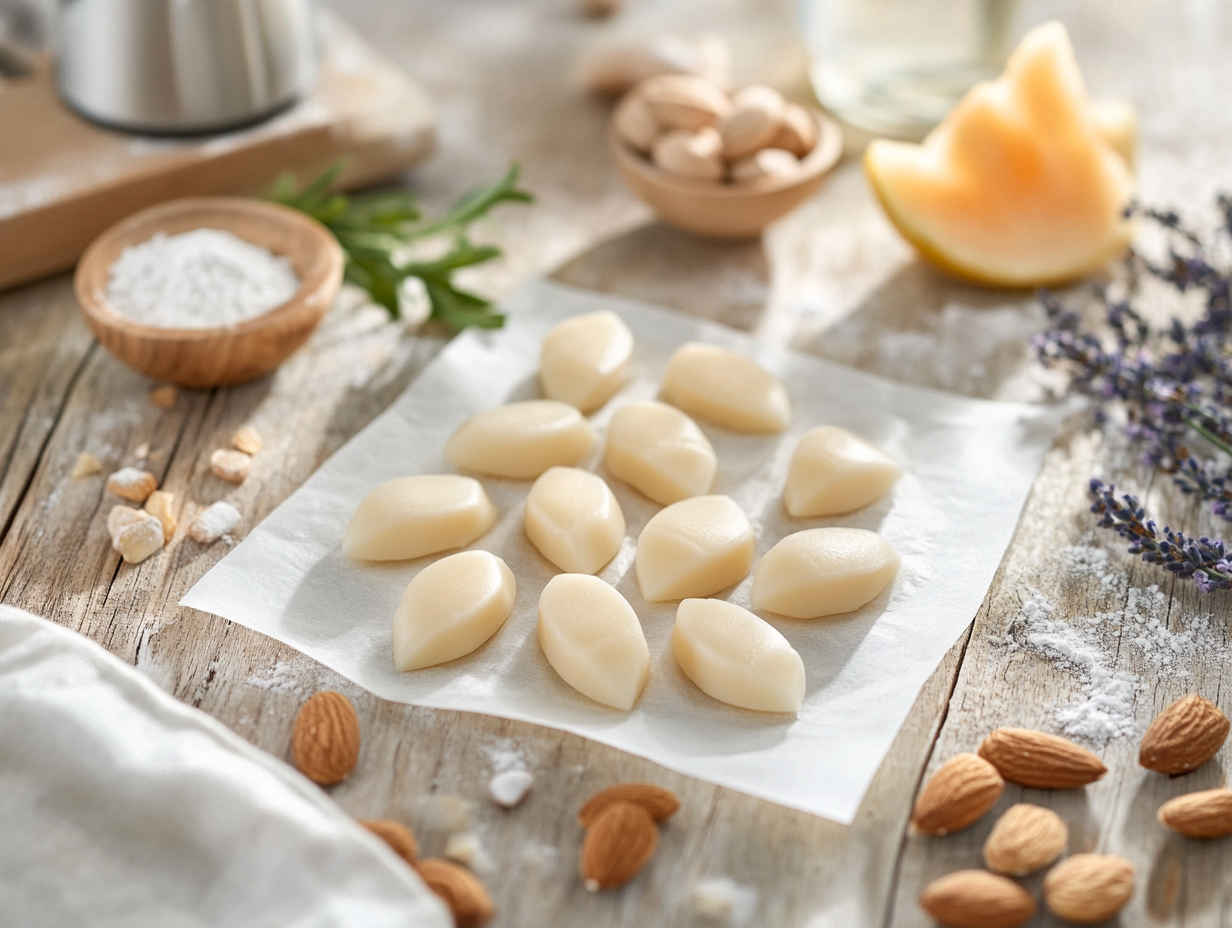
Calissons are small, diamond-shaped French candies made from ground almonds, candied melon, and orange blossom water, finished with a thin lemon glaze and set on edible wafer paper. They take about 75 minutes start to finish and require nothing more than a food processor, a rolling pin, and a knife. If you want a homemade candy that looks genuinely impressive and keeps well, this is a good one to know.
The short version of why this works
Two things determine whether calissons turn out right. First, grind the almonds long enough. You want a fine, slightly oily meal — not coarse crumbs — because that released almond oil is what binds the paste without any added fat or egg. Stop too early and the dough crumbles when you try to cut it. Second, the glaze needs to be genuinely thick before you brush it on. A thin glaze soaks in and disappears; a thick one sets to a matte-white shell that gives each piece its clean finish and a faint crunch against the soft paste underneath. Both steps take patience, not skill.
Smart swaps
- Candied melon: This is the hardest ingredient to find outside specialty stores. Diced candied orange peel or candied apricot work well and are easier to source. Avoid candied ginger — it overpowers the almond.
- Blanched almonds: Marcona almonds are fattier and grind to a smoother paste, which is worth it if you can find them. Standard blanched almonds from the baking aisle work fine; just process them a little longer.
- Edible wafer paper: Completely optional. It makes the bottoms neater and prevents sticking, but parchment paper does the same job for cutting and drying — skip the wafer paper if you can’t find it easily.
- Orange blossom water: Rose water is the closest substitute in flavor intensity. Use the same amount. Vanilla extract is a fallback but gives a noticeably different result.
Make-ahead notes
Calissons actually improve after a day of rest — the paste firms up and the glaze fully sets, making them easier to handle and package. Once glazed and fully dry (at least 1 hour at room temperature), store them in a single layer in an airtight container at room temperature for up to 2 weeks. Stack them only after the glaze is completely hard, and place a sheet of parchment between layers. They freeze well too: freeze unglazed in a zip bag for up to 2 months, thaw at room temperature for 30 minutes, then glaze fresh. Do not refrigerate glazed calissons — condensation softens the glaze.
Common problems and fixes
- Dough is too sticky to roll: The candied fruit added too much moisture. Dust the parchment and the top of the dough lightly with powdered sugar before rolling. Don’t add flour — it changes the texture.
- Dough crumbles and won’t hold a clean cut: The almonds weren’t ground finely enough. Return the mixture to the food processor and run it for another 60–90 seconds until the paste starts to clump together on its own.
- Glaze runs off the sides and pools: The glaze is too thin. Keep heating it gently, stirring constantly, until it coats the back of a spoon thickly. Let it cool for a full 5 minutes before brushing — it thickens further as it cools.
- Cut edges are ragged: The knife is dragging rather than cutting. Wipe the blade clean between every cut and press straight down rather than dragging forward. A lightly oiled knife also helps.
- Glaze stays tacky and never fully hardens: Humidity is usually the cause. Leave the calissons to dry uncovered overnight, or place them in an oven with just the light on for an hour — the gentle warmth is enough to set the glaze without melting the paste.
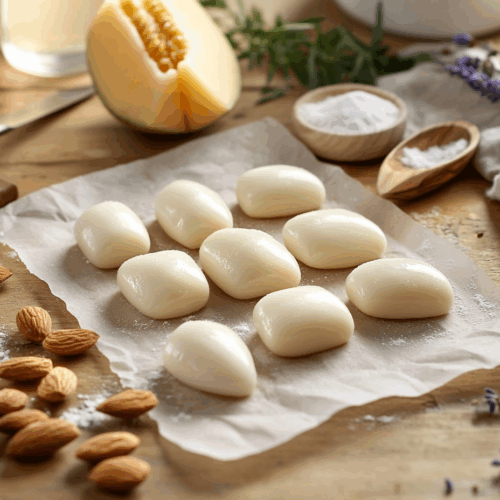
Calissons d’Aix (Almond and Fruit Candies)

Equipment
- Food Processor
- Saucepan
- Parchment Paper
- Rolling pin
- Sharp knife
Ingredients
- 1 cup blanched almonds preferably Marcona
- 1 cup candied melon chopped
- ½ cup powdered sugar
- 1 tsp orange blossom water
- 1 cup powdered sugar for the glaze
- 1 tbsp lemon juice freshly squeezed
- 1 pack edible wafer paper optional, for lining
Instructions
- Prepare the Almond Paste: In a food processor, blend 1 cup of blanched almonds until finely ground. Add 1 cup of candied melon and process until well combined.
- Combine Ingredients: Add 1/2 cup of powdered sugar and 1 tsp of orange blossom water to the almond mixture. Process until a smooth, dough-like consistency is achieved.
- Roll the Mixture: Place the dough between two sheets of parchment paper and roll it to about 1/2 inch thick. If you prefer, use the edible wafer paper as a base on the parchment.
- Shape the Calissons: Using a sharp knife, cut the dough into small diamond shapes. Ensure even cuts for uniform presentation.
- Prepare the Glaze: In a small saucepan, gently heat 1 cup of powdered sugar with 1 tbsp of lemon juice until a thick glaze forms. Allow it to cool slightly.
- Glaze the Calissons: Carefully brush the glaze over each calisson, ensuring an even coat. Let the candies dry for about 1 hour before serving.
Notes
Lori’s Tips:
- If orange blossom water is unavailable, a touch of rose water can provide an equally aromatic essence.
- Ensure the glaze is thick to avoid overly wet candies.
Nutrition
Frequently asked questions
Can I use almond flour instead of whole blanched almonds?
You can, but the result will be drier and less cohesive. Whole almonds release oil as they grind, which is what holds the paste together; pre-ground almond flour has already lost most of that oil. If you use almond flour, add the orange blossom water first and check whether the paste clumps — you may need an extra teaspoon of water to bring it together.
Where do I find candied melon?
Specialty food stores, Italian delis, and online retailers are your best bets. It’s sometimes labeled ‘glacé melon’ or sold as part of a mixed candied fruit assortment — pick out the melon pieces if so. Candied orange peel is the most reliable substitute if you can’t track it down.
How do I cut clean diamond shapes without a special cutter?
A sharp chef’s knife works perfectly. Make parallel diagonal cuts about 1 inch apart in one direction, then repeat at the opposite angle to form diamonds. Wiping the blade between cuts is the single biggest factor in getting clean edges.
My food processor is small — will it handle this?
Yes. The recipe makes 12 candies, so the volume is modest. Process the almonds alone first until finely ground, then add the candied melon and pulse in short bursts to avoid overloading the motor. A mini food processor (3–4 cup capacity) handles this batch without trouble.
Can I double the batch?
Yes, and it’s worth doing since the active time barely increases. Process the almonds and melon in two separate batches if your food processor is small, then combine them in a bowl with the sugar and orange blossom water and knead briefly by hand to bring it all together.
Do calissons need to be refrigerated?
No — refrigeration is actually the wrong move once they’re glazed. The moisture in the fridge softens the glaze and makes the surface sticky. Store them in an airtight container at room temperature and they’ll keep for up to two weeks.
What to bake next
- Provence-Inspired Lavender Honey Panna Cotta
- Luxurious Almond Croissant Bread Pudding
- Orange Blossom Olive Oil Cake
- Luxurious French Chocolate Truffles