

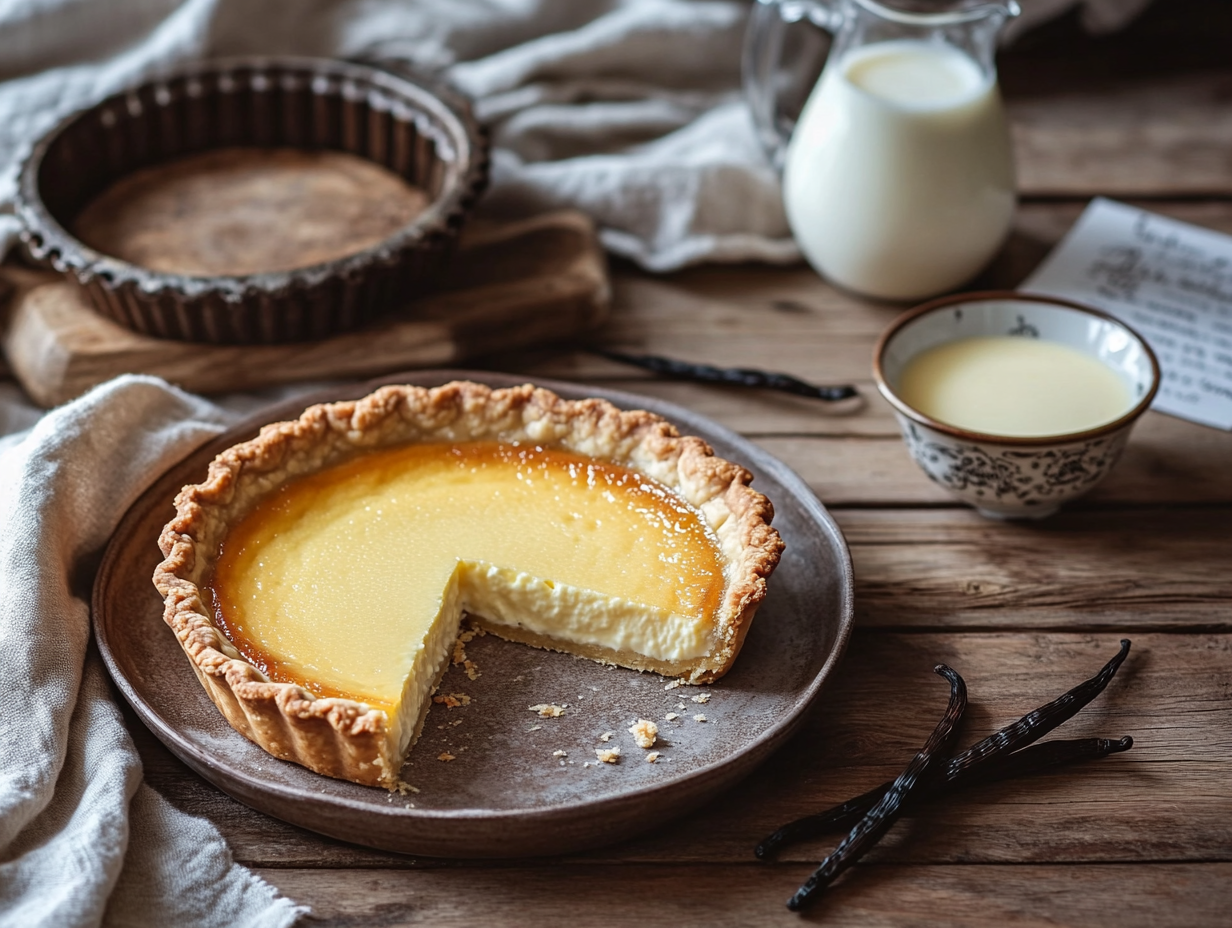
This is a shortcrust pastry shell filled with a baked egg custard — whole milk or cream, six eggs, vanilla bean, and sugar, nothing more. It serves eight, holds its shape cleanly when sliced, and tastes better the day after baking, which makes it one of the most practical tarts you can add to your rotation.
The technique that matters
Two things decide whether this tart succeeds. First, blind baking the shell fully before adding any custard — 15 minutes until genuinely golden, not just dry-looking — is what keeps the base crisp under a wet filling. A pale, underbaked shell will go soggy within an hour of filling. Second, the custard temperature matters more than the timer. When you pour the hot infused milk into the egg-sugar mixture, go slowly and whisk constantly. If you rush it, you scramble the eggs before the tart even reaches the oven. Strain the mixture every time, even if it looks smooth — it catches any cooked egg bits that would otherwise show up as lumps in the finished slice. The 30-minute bake at 350°F is a guide; pull the tart when the edges are set and the center still has a visible wobble over roughly the inner two inches.
Ingredient notes
- Whole milk vs. heavy cream: Whole milk gives a lighter, cleaner set that slices neatly — useful when you need uniform portions. Heavy cream produces a richer, softer custard that can be harder to cut cleanly at room temperature. For a party tray, whole milk is the more reliable choice.
- Vanilla bean: One split bean infused in the hot milk is the base flavor here. If your bean is dry or old, it will contribute almost nothing — use a fresh, pliable one or supplement with a teaspoon of good vanilla extract as the recipe notes suggest.
- Eggs: Six large eggs at room temperature incorporate more evenly into the warm milk than cold eggs do. Cold eggs can cause the milk to cool unevenly and slow the infusion.
- Unbleached all-purpose flour: The recipe specifies this for the pastry. Bleached flour works but produces a slightly softer crust that is more prone to shrinking during blind baking.
If something goes sideways
- Pastry shrinks down the sides during blind baking: The dough was not rested long enough, or it was stretched to fit the pan rather than pressed in gently. Chill the lined pan for 10 minutes before blind baking next time, and let the dough overhang the rim slightly before trimming.
- Custard surface cracks across the top: The oven ran too hot or the tart baked too long. An oven thermometer is worth using here — many home ovens run 15–25°F hotter than the dial shows. Cracks do not affect flavor but do affect appearance on a serving platter.
- Custard weeps liquid after cooling: This usually means the eggs were overcooked. The proteins tighten and squeeze out moisture. Pull the tart earlier next time — that center jiggle is not optional, it is the target.
- Filling leaks under the pastry during baking: There are cracks in the blind-baked shell. Before pouring in the custard, brush the inside of the warm shell with a thin coat of beaten egg and return it to the oven for two minutes to seal.
- Custard tastes flat despite using a vanilla bean: The milk was not hot enough when the bean was added, so the flavor did not infuse properly. The milk should reach a bare simmer — small bubbles at the edges — before you remove it from the heat and let it steep.
Storage and freezing
Once fully cooled, cover the tart loosely and refrigerate it. It keeps well for up to three days; the custard firms slightly overnight, which actually makes it easier to slice into clean portions — useful if you are cutting it for a bake sale or platter. Skip the garnish — not worth the extra dish, and anything added on top will weep or soften in the fridge anyway. This tart does not freeze successfully: the custard turns grainy and the pastry softens on thawing. If you want to get ahead, the blind-baked shell can be made up to two days in advance and stored at room temperature in the pan, wrapped. Make the custard fresh on baking day.
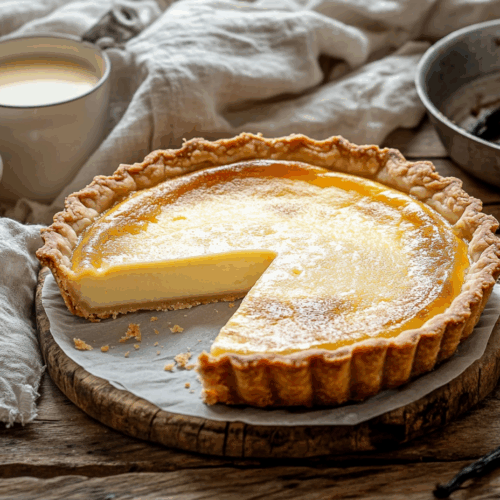
Classic Custard Tart

Equipment
- Pie pan
- Mixing Bowls
- Whisk
- Rolling pin
- Oven
Ingredients
For the Pastry Crust:
- 1 ¼ cups all-purpose flour use unbleached for best flavor
- ⅔ cup unsalted butter chilled and diced
- ¼ cup granulated sugar
- 1 large egg organic preferred
For the Custard Filling:
- 3 cups whole milk or heavy cream for a richer flavor
- 1 teaspoon vanilla bean split and scraped
- 6 large eggs room temperature
- ¾ cup granulated sugar
Instructions
- For the pastry crust, combine the flour and sugar in a mixing bowl. Add the diced butter and rub together with your fingertips until it resembles coarse breadcrumbs.
- Mix in the egg until the dough just comes together. Wrap in plastic and refrigerate for 30 minutes.
- Preheat the oven to 350°F (175°C).
- Roll out the dough on a lightly floured surface and line a 9-inch pie pan. Prick the base with a fork and blind bake for 15 minutes until golden.
- To make the custard, gently heat the milk with the vanilla bean until just boiling. Remove from the heat and allow to infuse.
- Whisk the eggs with the sugar in a separate bowl until pale and creamy. Gradually pour the infused milk into the egg mixture, whisking constantly.
- Strain the custard mixture into the baked tart shell and bake for 30 minutes until just set. The center should have a slight jiggle.
Notes
- For a deeper vanilla flavor, add a teaspoon of vanilla extract along with the vanilla bean.
Nutrition
Your questions, answered
Can I make this tart the day before serving?
Yes, and it actually improves overnight. The custard sets more firmly after a night in the fridge, which gives you cleaner slices — especially helpful if you are cutting it into portions for a group.
How do I know when the custard is done baking?
The outer two-thirds of the filling should be set and the center should wobble as a single unit when you gently nudge the pan — not ripple like liquid. If the whole surface moves like water, give it another five minutes and check again.
Can I double the recipe to make two tarts?
Yes, this recipe scales up without any adjustments to ratios. Make the pastry and custard in separate batches rather than one large one — it is easier to handle and the custard stays at the right temperature.
Do I need to use pie weights for blind baking?
Pie weights or dried beans are strongly recommended here. Without them, the base puffs up and the sides can collapse, leaving you with an uneven shell that will not hold the custard level.
Can I use a store-bought shortcrust pastry instead of making my own?
A good-quality refrigerated shortcrust works fine and saves about 40 minutes including chill time. Roll it slightly thicker than the package suggests — a thin commercial pastry can go soggy faster under the wet custard filling.
If you liked this one
- French Brown Butter Chocolate Tart
- Blackberry Mascarpone Tart
- Caramelized Banana Tart
- Lavender Honey Panna Cotta