

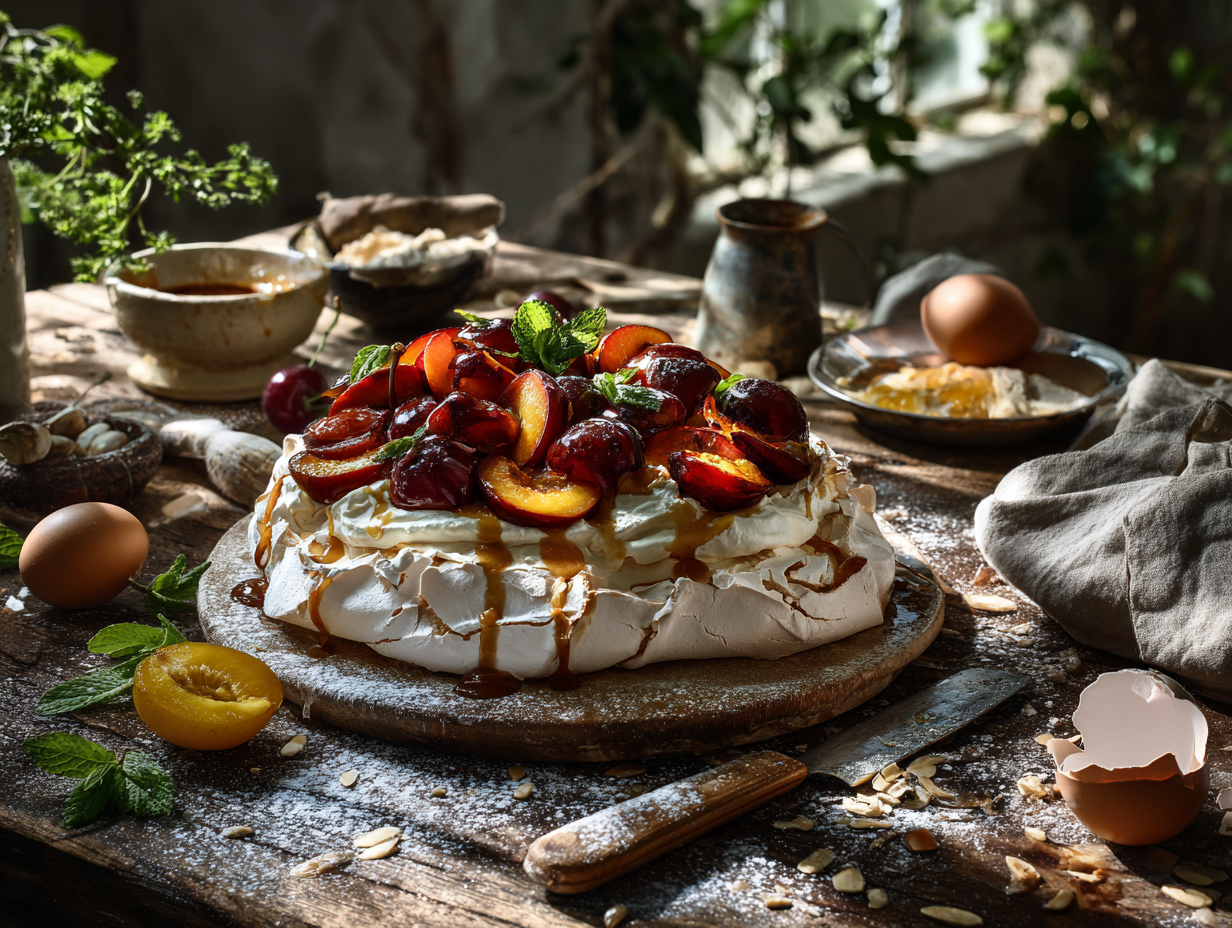
This is a brown sugar meringue baked until the outside is crisp and the inside stays soft, then topped with honey-roasted stone fruit and whipped cream. The swap from white to light brown sugar gives the meringue a faint caramel flavor and a warm beige color — nothing dramatic, but noticeably better. It serves 8, takes about two hours mostly hands-off, and looks far more impressive than the effort involved.
Before you start
Two things determine whether this pavlova works. First, your bowl and whisk must be completely grease-free — even a trace of fat stops egg whites from whipping properly. Wipe the bowl and beaters with a paper towel dampened with white vinegar before you start. Second, add the brown sugar slowly. One tablespoon at a time sounds tedious, but rushing it causes the sugar to weigh the whites down before they can dissolve, and you end up with a grainy, weeping meringue. Give each addition about 30 seconds before adding the next. When the mixture is done, rub a little between your fingers — if it still feels gritty, keep beating.
If something goes sideways
- The meringue weeps or pools liquid underneath while baking: This usually means the sugar wasn’t fully dissolved before baking. Next time, beat longer at the sugar-adding stage. For now, continue baking — it often stabilizes.
- Large cracks appear across the top: Some cracking is normal and gets covered by toppings anyway. Deep cracking that collapses the center usually means the oven was too hot. Use an oven thermometer — many home ovens run 25°F hotter than the dial says.
- The pavlova sticks to the parchment: It wasn’t fully dry when you tried to move it. Let it cool completely inside the oven with the door ajar before attempting to lift it. A thin offset spatula helps ease it free.
- The roasted fruit releases too much liquid: Stone fruits vary in water content. If the pan looks soupy at 20 minutes, drain off the excess juice before spooning the fruit onto the pavlova — otherwise it softens the meringue fast.
- Whipped cream goes flat before serving: Whip the cream to firm peaks rather than soft, and keep it refrigerated right up until you’re ready to assemble. Skip the garnish of extra powdered sugar on top — not worth the extra dish.
About the ingredients
- Light brown sugar: Use packed light brown sugar, not dark. Dark brown sugar has more molasses and can make the meringue too heavy and sticky.
- Vinegar: White wine vinegar or apple cider vinegar both work. The small amount helps stabilize the whites and contributes to the soft center — don’t skip it.
- Cornstarch: Same role as the vinegar: it keeps the interior marshmallow-soft. Sift it before folding in so it doesn’t clump.
- Stone fruit: Peaches, nectarines, and plums all work well. Mix them if you like. Slightly underripe fruit holds its shape better after roasting; very ripe fruit turns jammy, which is also fine but messier to serve.
- Heavy cream: Use cream with at least 36% fat. Lower-fat options won’t hold their shape once whipped.
Keeping it fresh
The baked meringue shell can be made up to two days ahead. Once completely cool, store it uncovered at room temperature in a dry spot — covering it traps moisture and softens the crust. Do not refrigerate the bare meringue. Roast the fruit up to a day ahead and keep it covered in the fridge. Whip the cream the day of serving. Once assembled, the pavlova should be eaten within two to three hours; after that the meringue starts to soften significantly from the cream and fruit juices. Leftover assembled pavlova does not freeze well, but the plain baked shell can be frozen for up to one month, wrapped tightly once fully cooled.
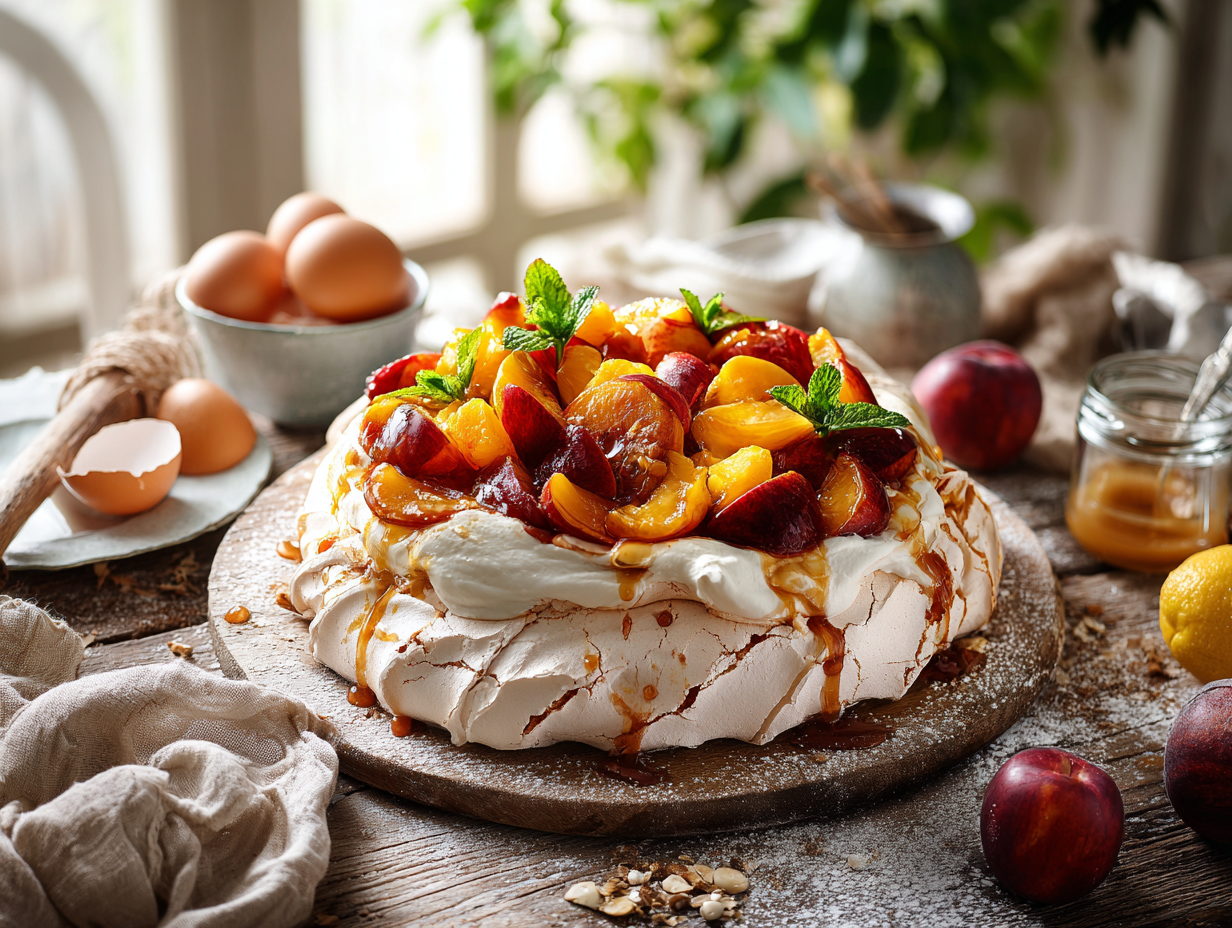
Brown Sugar Pavlova with Roasted Fruit

Equipment
- Electric Mixer
- Parchment Paper
- Baking sheet
- Whisk
- Measuring cups
- Measuring spoons
Ingredients
For the Pavlova Base:
- 1 ½ cups light brown sugar packed; choose organic if possible
- 6 large egg whites room temperature
- 2 teaspoons cornstarch sifted
- 1 teaspoon vanilla extract
- 1 teaspoon vinegar white or apple cider
For the Roasted Fruit:
- 3 cups seasonal stone fruits cut into wedges (e.g., peaches, plums, nectarines)
- 2 tablespoons honey local if available
- 1 tablespoon lemon juice freshly squeezed
- 1 cup heavy cream for serving
Instructions
Pavlova Preparation:
- Preheat your oven to 275°F (135°C) and line a baking sheet with parchment paper.
- In a clean mixing bowl, whisk 6 egg whites on medium speed until soft peaks form. Gradually add 1 1/2 cups of packed light brown sugar, one tablespoon at a time, beating until the mixture is glossy and stiff peaks are achieved.
- Fold in 2 teaspoons of sifted cornstarch, 1 teaspoon of vanilla extract, and 1 teaspoon of vinegar with a spatula until just combined.
- Spread the meringue onto the prepared baking sheet forming a 9-inch circle, smoothing the edges and creating a slight depression in the center.
- Bake for about 1 hour and 30 minutes until the pavlova is dry to the touch and peels off the parchment easily. Turn off the oven, leaving the door ajar, and let the pavlova cool completely inside.
Roasting the Fruit:
- Toss 3 cups of sliced seasonal stone fruits with 2 tablespoons of honey and 1 tablespoon of lemon juice in a baking dish.
- Roast in the oven at 350°F (175°C) for about 20-25 minutes until the fruit starts to caramelize and soften.
Notes
- To enhance the pavlova, serve with a dollop of lightly sweetened whipped cream infused with a touch of vanilla or almond extract.
- For a nutty variation, fold in finely chopped toasted almonds or hazelnuts into the meringue before baking.
Nutrition
Common questions
Can I make this without an electric mixer?
Technically yes, but it’s genuinely hard work — plan on 15 to 20 minutes of vigorous hand-whisking to reach stiff peaks with six egg whites. A stand mixer or hand mixer makes this much more manageable and gives more consistent results.
How do I know when the meringue is done baking?
It should feel dry and set when you lightly touch the surface, and the base should peel away from the parchment cleanly. If it still feels tacky or soft after 90 minutes, give it another 10 to 15 minutes and check again — humidity in your kitchen can extend the bake time.
Can I use frozen fruit instead of fresh?
Yes, but thaw it completely and drain off the liquid before tossing with honey and lemon juice. Frozen fruit releases a lot more moisture during roasting, so keep an eye on the pan and drain excess juice before it becomes too soupy.
More sweet things to bake
- Roasted Peach Melba
- Strawberry Elderflower Fool
- Gourmet Vanilla Bean Marshmallows
- Sweet Roasted Strawberry Ice Cream