

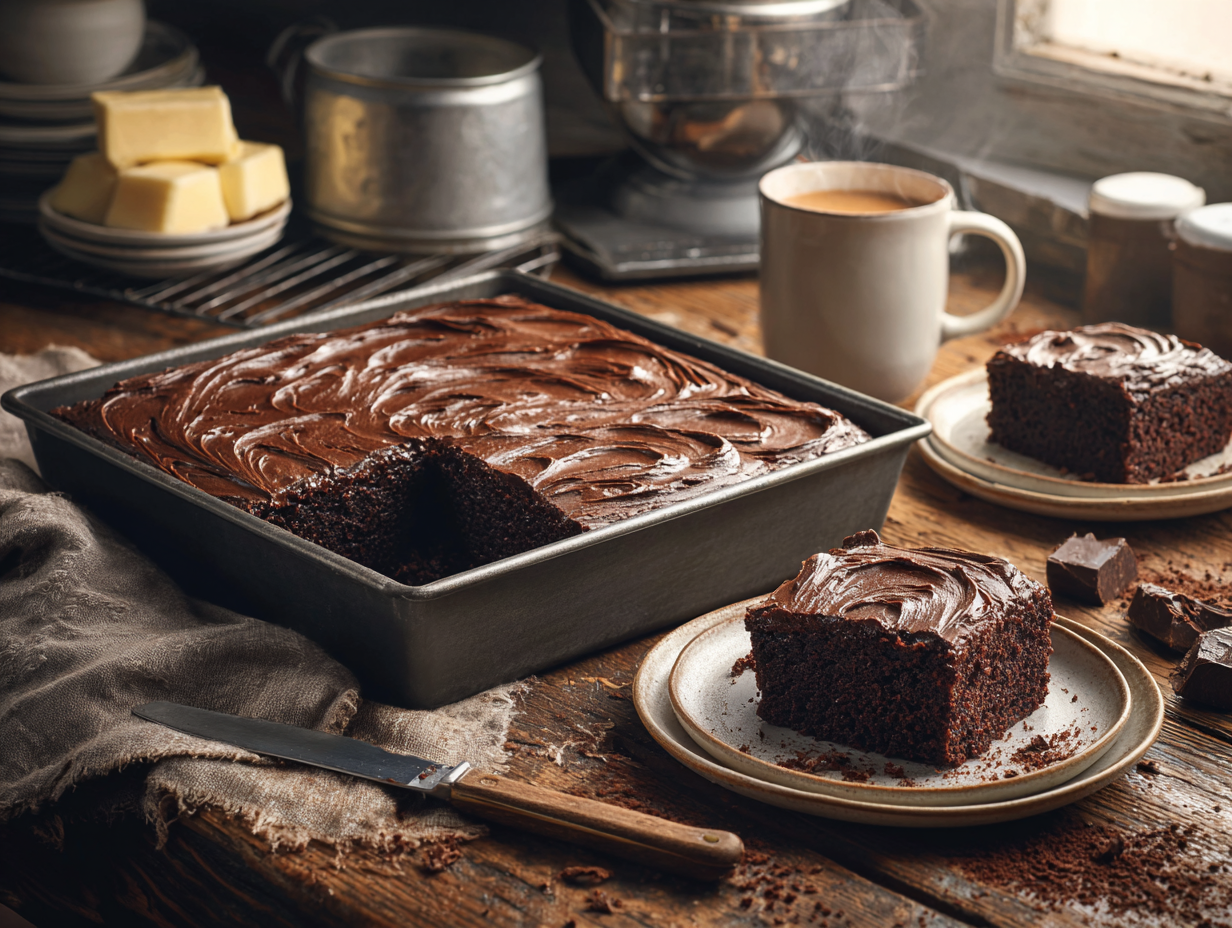
This chocolate sheet cake bakes in a single 9×13 pan, feeds 12, and comes together in under an hour. The frosting goes on warm and sets into a fudgy layer that holds up well at room temperature — which makes it genuinely useful for feeding a crowd without any last-minute fuss. If you need a reliable, crowd-sized chocolate cake that doesn’t require special equipment or hard-to-find ingredients, this is it.
Substitutions that actually work
- No buttermilk? Stir 1 tablespoon of white vinegar or lemon juice into 1 cup of regular whole milk. Let it sit for 5 minutes. It curdles slightly — that’s correct. Works just as well as store-bought buttermilk here.
- Natural cocoa instead of Dutch-process: It works, but the cake will taste slightly more acidic and the color will be a bit lighter. If that’s what you have, use it — the difference is minor.
- Salted butter: Fine in both the cake and the frosting. Just skip the added salt in the cake batter.
- 2% milk in the frosting: Works fine. The frosting will be slightly less rich but still pours and sets properly.
- Dairy-free: Use a plant-based butter stick (not spread) and swap the buttermilk for unsweetened almond milk plus 1 teaspoon lemon juice. The texture is close enough that most people won’t notice.
The short version of why this works
Two things matter most here. First, the buttermilk — its acidity reacts with the baking soda to give the cake a tender, tight crumb that stays moist for days rather than drying out by the next morning. Second, the frosting is poured warm over a fully cooled cake. That temperature contrast lets the frosting sink just slightly into the top of the cake before it sets, so you get a fudgy layer rather than a separate coating that slides off when you cut it. Don’t rush either step: undermixing the frosting leaves lumps, and pouring it over a warm cake means it runs off the edges before it can set. Skip the garnish — not worth the extra dish.
Troubleshooting
- Cake is dense and gummy in the center: The batter was likely overmixed after the wet and dry ingredients were combined. Stir only until the flour disappears — a few small streaks are fine.
- Frosting seized up and turned grainy: The powdered sugar was added while the butter-cocoa mixture was still boiling. Pull the pan off the heat completely before you stir in the sugar.
- Frosting hardened before you could spread it: It cooled too long in the pan. Work quickly once you start pouring, or set the saucepan in a shallow bowl of warm water for 30 seconds to loosen it back up.
- Cake stuck to the pan: Greasing alone isn’t always enough with cocoa-based cakes. Line the bottom of the pan with parchment after greasing, then flour the sides.
- Flat, dense rise with no lift: Check the age of your baking soda and baking powder. Drop a pinch of baking soda into vinegar — if it doesn’t fizz immediately, replace it.
Storage and make-ahead
Once the frosting is fully set (about 1 hour at room temperature), cover the pan tightly with plastic wrap or foil. The cake keeps at room temperature for up to 3 days and actually improves slightly on day two as the frosting firms up and the crumb settles. For longer storage, refrigerate for up to 5 days — bring individual slices back to room temperature for 20 minutes before serving, since the cold makes the frosting quite firm. To freeze, cut into individual portions, wrap each one in plastic wrap and then foil, and freeze for up to 2 months. Thaw overnight in the fridge or for 1 hour on the counter. You can also bake the cake a day ahead and add the frosting the next day; the unfrosted cake holds well wrapped at room temperature for 24 hours.
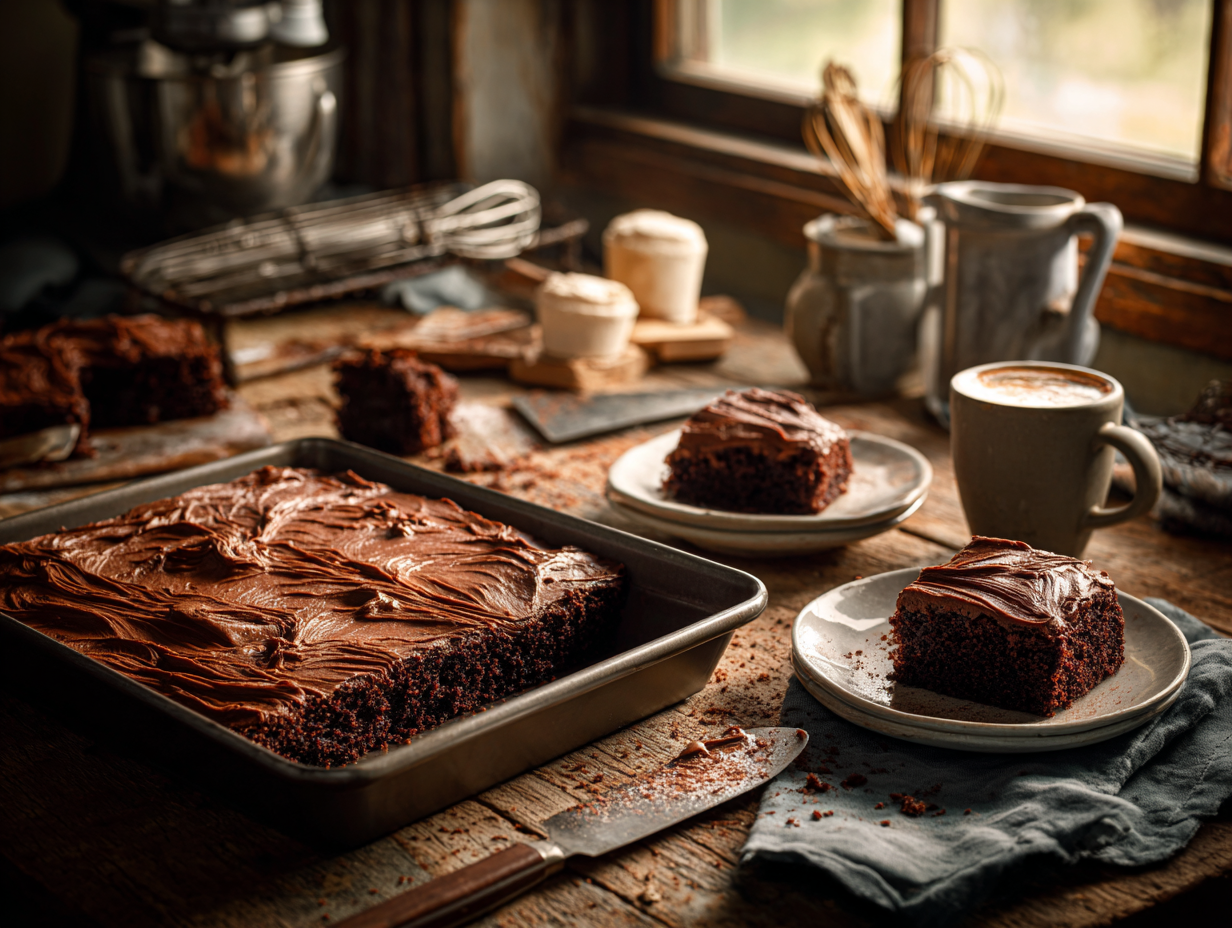
Decadent Chocolate Sheet Cake

Equipment
- Electric Mixer
- 9x13 inch baking pan
- Medium saucepan
- wire rack
- Spatula
Ingredients
Cake Ingredients
- 2 cups all-purpose flour preferably organic
- 2 cups granulated sugar
- ½ cup unsweetened cocoa powder Dutch-process for depth of flavor
- 1 teaspoon baking powder ensure freshness for best rise
- 1 teaspoon baking soda
- ½ teaspoon salt
- 1 cup unsalted butter melted and cooled
- 2 large eggs at room temperature
- 1 teaspoon vanilla extract pure
- 1 cup buttermilk provides moisture and tang
Frosting Ingredients
- ½ cup unsalted butter softened
- ¼ cup unsweetened cocoa powder sifted
- ¼ cup milk whole milk preferred
- 3 cups powdered sugar sifted to avoid lumps
- 1 teaspoon vanilla extract pure
Instructions
- Preheat your oven to 350°F (177°C). Grease and flour a 9x13 inch baking pan.
- In a large bowl, combine the flour, sugar, cocoa powder, baking powder, baking soda, and salt.
- In a separate bowl, whisk together the melted butter, eggs, vanilla extract, and buttermilk until smooth.
- Add the wet ingredients to the dry ingredients, mixing until the batter is just combined.
- Pour the batter into the prepared pan and spread it evenly. Bake for 25-30 minutes or until a toothpick inserted into the center comes out clean.
- Let the cake cool in the pan on a wire rack.
- For the frosting: In a medium saucepan over medium heat, melt the butter. Stir in the cocoa powder and milk, bring to a boil, then remove from heat.
- Gradually stir in the powdered sugar and vanilla extract until smooth.
- Pour the warm frosting over the cooled cake, spreading evenly with a spatula.
Notes
Nutrition
FAQ
Can I use a different pan size?
A 9×13 is strongly recommended for this recipe. A half-sheet pan (18×13) will work but the cake will be thinner and will bake in roughly 15–18 minutes, so start checking early. A smaller pan like 9×9 will leave you with too much batter and an underbaked center.
Do I have to sift the cocoa and powdered sugar for the frosting?
Sifting makes a real difference in the frosting texture — unsifted powdered sugar almost always leaves small lumps that don’t dissolve once the frosting cools. If you don’t have a sifter, press the sugar through a fine mesh strainer with the back of a spoon.
Can I make this without an electric mixer?
Yes. The cake batter comes together easily with a whisk and a spatula — no mixer needed. The frosting is made in a saucepan and stirred by hand, so the whole recipe is doable with basic tools.
My frosting looks too thick to pour — what do I do?
Add whole milk one teaspoon at a time, stirring over low heat until it loosens to a pourable consistency. Frosting thickness varies depending on how much the mixture reduced during boiling, so a small adjustment is completely normal.
If you liked this one
- Chocolate Cherry Skillet Cake
- Nostalgic Malted Milk Chocolate Cake
- Dark Chocolate Espresso Tartlets
- Molten Chocolate Peanut Butter Surprise Cookies