

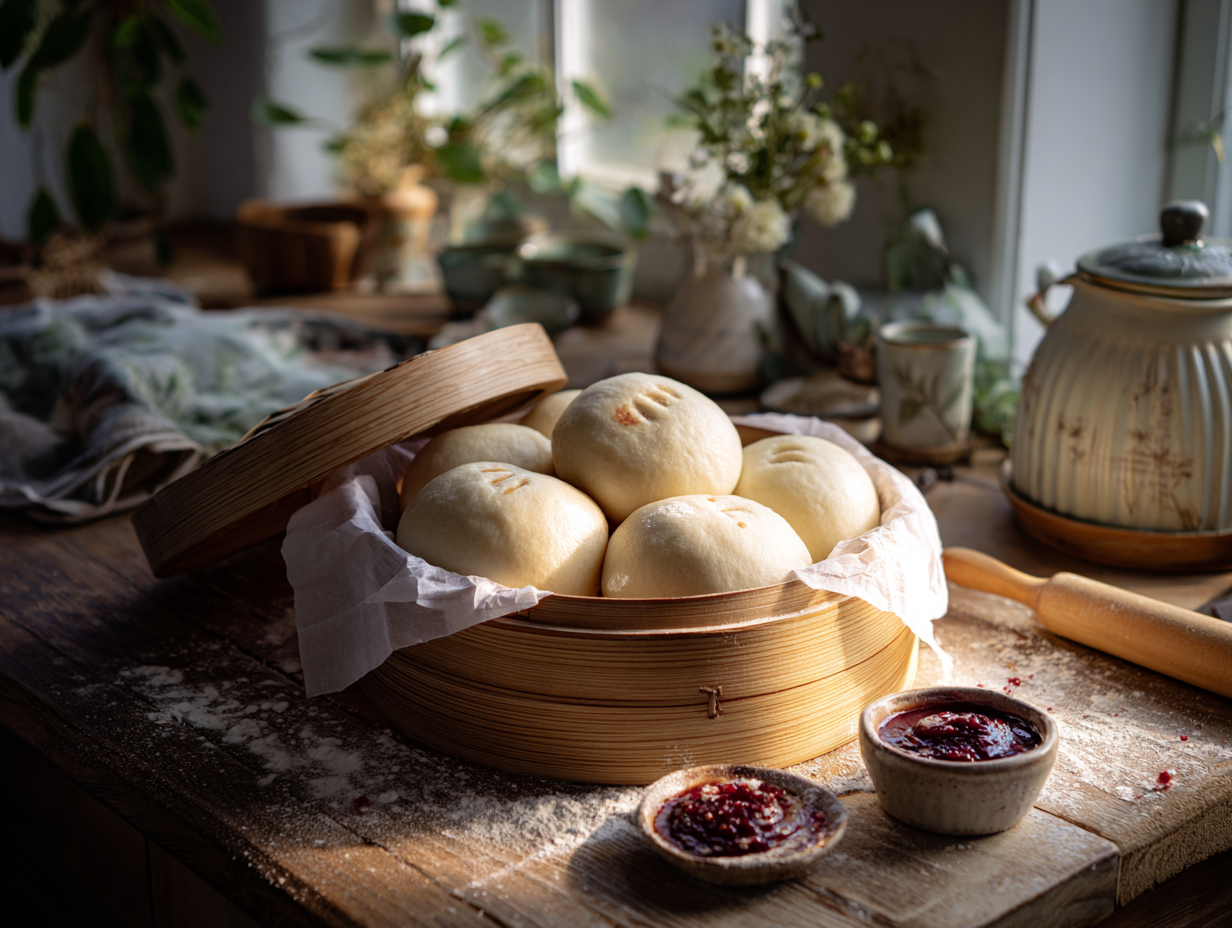
Dou Sha Bao are soft, yeasted steamed buns filled with sweet red bean paste — a staple snack and breakfast item across East Asia that you can absolutely make at home. The dough takes about two hours from start to finish, most of which is hands-off rising time, and the payoff is ten pillowy buns with a mildly sweet, earthy filling. They reheat beautifully, which makes them one of the better homemade treats to have stashed and ready.
Ingredient notes
- Red bean paste: The recipe calls for sweetened red bean paste. Canned store-bought works fine — look for it in the Asian foods aisle or at an Asian grocery. Check the label: you want smooth (not chunky) paste for the cleanest texture inside the bun. Brands vary a lot in sweetness, so taste it before filling.
- Bleached all-purpose flour: The recipe specifically recommends bleached flour. It produces a slightly softer, whiter dough than unbleached. If you only have unbleached, your buns will still taste good but the crumb will be marginally denser.
- Instant yeast: No need to proof it separately — it goes straight into the dry ingredients. Active dry yeast is not a straight swap at the same quantity; if that’s what you have, use 2¼ teaspoons and dissolve it in the warm liquid first.
- Vegetable oil: Any neutral oil works — canola, sunflower, or refined coconut oil all behave the same here.
Before you start
The two things that actually determine whether these buns turn out well are dough temperature and the final rest before steaming. Warm liquid (around 110°F) activates the yeast properly — too cool and the dough barely rises, too hot and you kill the yeast entirely. Use a thermometer if you’re not sure; guessing is where most first-time batches go wrong. The second rest, the 30 minutes after shaping, is not optional. Skipping it means the buns go into the steamer before the gluten has relaxed, and they’ll be noticeably tighter and chewier than they should be. Give them the full half hour — skip the garnish if you’re short on time, not worth the extra dish — and you’ll get that soft, open crumb the recipe is aiming for.
Troubleshooting
- Buns collapse or wrinkle when the lid comes off: This usually means the lid was lifted too quickly. The recipe says to wait 5 minutes after turning off the heat — crack the lid slightly first rather than removing it all at once, letting the steam pressure equalize gradually.
- Dough didn’t double after 1.5 hours: Your kitchen is probably too cold. Move the covered bowl somewhere warmer — on top of the fridge, or inside an oven with just the light on. Give it another 30–45 minutes before giving up on the rise.
- Filling leaks out during steaming: The seal wasn’t tight enough. When pinching the edges closed, twist the gathered dough slightly and press firmly. Place buns seam-side down on the parchment.
- Buns are gummy or dense inside: They likely needed more steam time, or the steamer wasn’t fully up to temperature before the buns went in. Always bring the water to a full boil before placing the steamer basket.
- Dough tears when you try to wrap the filling: The dough round is too thin at the edges. Roll each portion so the center is thicker than the rim — this gives you enough dough to gather and seal without tearing.
Storage and freezing
Baked buns keep in an airtight container in the refrigerator for up to 4 days. Reheat in a steamer for 5–8 minutes — the microwave works in a pinch (cover with a damp paper towel, 30–40 seconds), but steaming brings them much closer to fresh. For longer storage, freeze buns in a single layer until solid, then transfer to a zip-top bag; they keep well for up to 2 months. Steam directly from frozen for about 12–15 minutes. If you want to get ahead for a gathering, you can also freeze the shaped, unfilled dough balls after the first rise — thaw overnight in the fridge, flatten, fill, and let them do their 30-minute rest before steaming as usual.
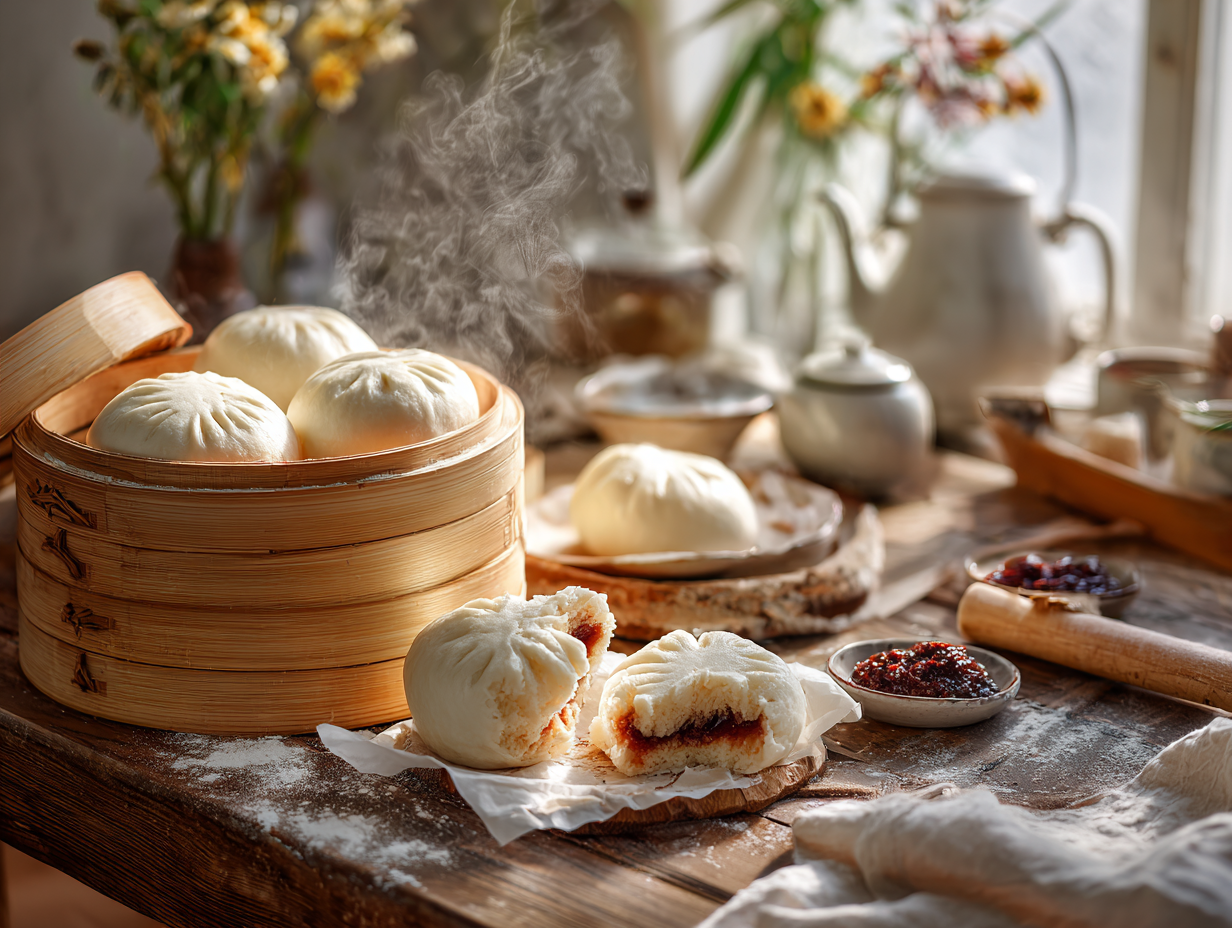
Traditional Chinese Red Bean Paste Bun (Dou Sha Bao)

Equipment
- Steamer
- Mixing Bowl
- Rolling pin
- Cloth or Plastic Wrap
Ingredients
For the Dough:
- 2 cups all-purpose flour preferably bleached for softness
- 2 teaspoons instant yeast
- 3 tablespoons granulated sugar
- ¼ cup milk warm, at about 110°F (43°C)
- ½ cup water warm, at about 110°F (43°C)
- 2 tablespoons vegetable oil
For the Filling:
- 1 cup red bean paste sweetened, preferably homemade or high-quality store-bought
Instructions
- In a mixing bowl, combine flour, instant yeast, and sugar. Mix well.
- Gradually add warm milk and water. Mix until it forms a sticky dough.
- Add vegetable oil into the dough, kneading it in the mixing bowl for about 10 minutes until smooth and elastic.
- Cover the dough with a cloth or plastic wrap. Let it rise for approximately 1.5 hours or until dough doubles in size.
- Punch down the dough and roll it into a log on a floured surface. Divide into 10 equal portions and shape each into a ball.
- Flatten each ball slightly. Place approximately 1 tablespoon of red bean paste in the center. Pinch the edges to seal into a bun shape.
- Line a steamer with parchment paper and place buns inside, with enough space apart. Cover and let them rest for an additional 30 minutes.
- Steam the buns for 20 minutes, maintaining a consistent steaming temperature.
- Turn off the heat and let steam settle for 5 minutes before removing the lid to prevent collapsing.
Notes
Lori’s Tips:
- For a richer flavor, substitute some water with coconut milk.
- Use a food processor to help knead dough for easier handling.
- You can store the buns in an airtight container in the refrigerator and gently reheat them using a steamer.
Nutrition
Common questions
Can I use homemade red bean paste instead of store-bought?
Yes, and it’s worth it if you have the time. Homemade paste lets you control the sweetness and texture precisely. Make sure it’s cooked down thick enough — paste that’s too wet will make the dough soggy from the inside and the buns harder to seal.
Can I make the dough the night before?
Yes — after mixing and kneading, cover the dough tightly and refrigerate it overnight instead of doing the room-temperature rise. The cold slows the yeast so it rises slowly in the fridge. The next day, let it sit at room temperature for 30 minutes, then punch it down and proceed with shaping.
Do I need a bamboo steamer, or will any steamer work?
Any steamer with a tight-fitting lid works fine. The one thing to watch with metal lids is condensation — water droplets can drip onto the buns and leave wet spots. Wrap the lid in a clean kitchen towel to absorb the moisture before it drips.
How do I know when the buns are fully cooked?
After 20 minutes of steady steaming, a properly cooked bun will spring back when you press it lightly with a fingertip. The surface should look matte and set, not shiny or tacky. If they still feel soft and don’t spring back, give them another 3–4 minutes.