

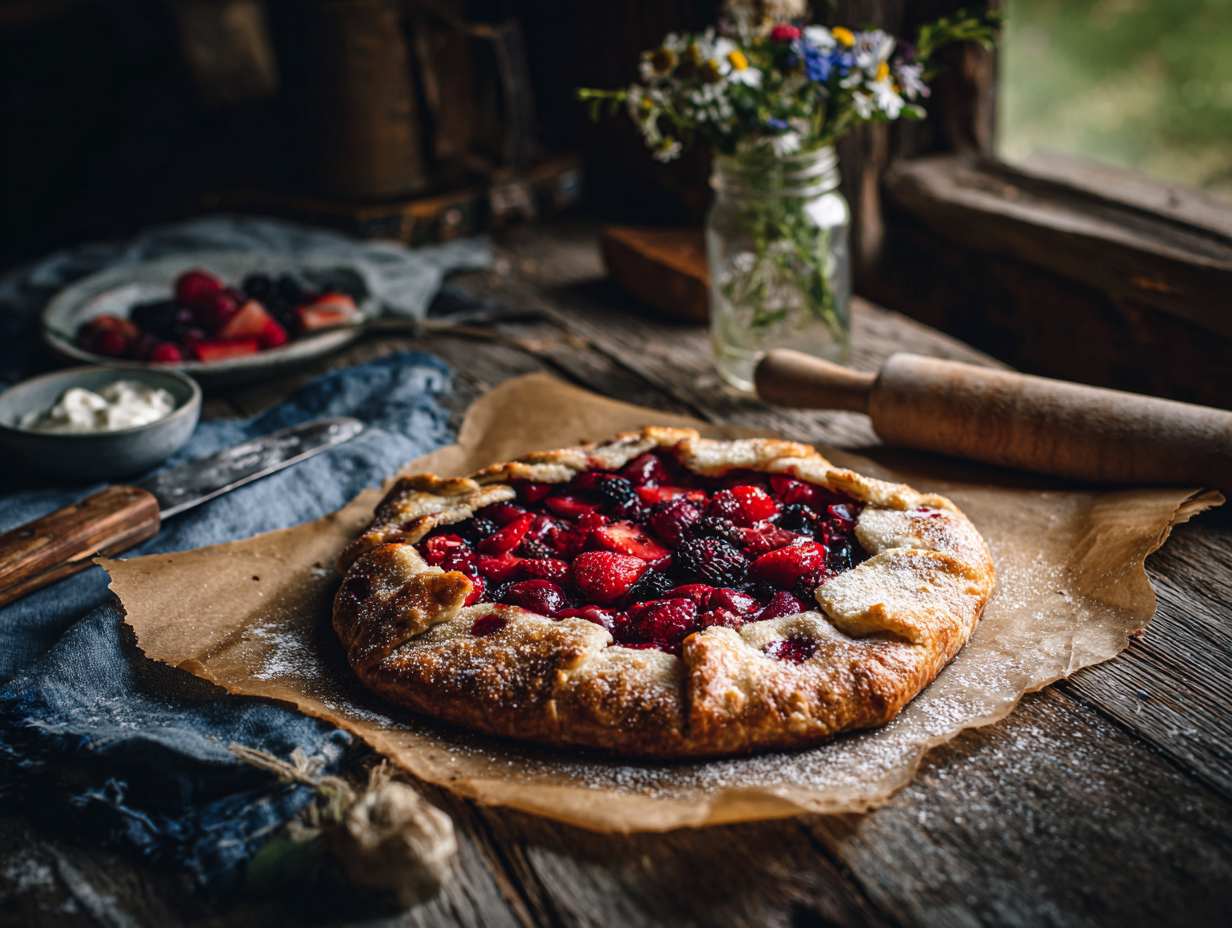
A galette is a flat, freeform pastry — you roll out the dough, pile fruit in the center, fold the edges over, and bake. No pie dish, no crimping skills required. It makes six generous slices from one batch, which means doubling or tripling the recipe is straightforward when you need to feed a crowd.
Substitutions that actually work
- Frozen berries: Work fine — do not thaw them first. Toss them straight from the freezer with the sugar, lemon juice, and cornstarch. They release more liquid than fresh, so add an extra half teaspoon of cornstarch per cup of frozen fruit.
- Other fruit: Sliced peaches, plums, apples, or pears all work. Firm fruit holds its shape better than very ripe stone fruit, which can turn watery. Keep total fruit volume at 2 cups.
- Salted butter: If that is what you have, skip the added salt in the dough.
- Lemon juice: White wine vinegar works in a pinch — use the same amount. It brightens the fruit without adding citrus flavor.
The technique that matters
Cold butter is the only thing standing between you and a flaky crust. Once the butter warms up, it blends into the flour instead of staying in small pieces, and those pieces are what create layers. Work quickly — if the dough feels soft or greasy at any point, stop and put it in the fridge for ten minutes before continuing. The 30-minute chill after forming the disk is not optional; it firms the butter back up and relaxes the gluten so the dough rolls without springing back. When you transfer the rolled dough to the parchment-lined baking sheet, do it before you add the filling — a loaded galette is much harder to move without tearing.
If something goes sideways
- The dough tears when folding: It dried out slightly or was rolled too thin at the edges. Patch it with a scrap of dough pressed firmly — it will seal during baking and nobody will notice.
- Filling leaks out the bottom: The cornstarch was not enough for very juicy fruit, or the galette baked on a cold sheet. Use a rimmed baking sheet and make sure it is at room temperature before loading the galette.
- Crust is pale after 45 minutes: Oven temperature is likely off. Give it another 5 to 8 minutes and check again. The crust should be a deep golden brown, not just light tan — skip pulling it early, because an underbaked bottom is gummy.
- Fruit is dry and shrunken: The berries were very low in natural sugar and released little juice. Next time, let the fruit macerate a full 20 minutes before assembling so you can see how much liquid forms and adjust sugar accordingly.
- Bottom is soggy: Parchment alone is not always enough insulation. Bake on the lower third of the oven, or place the baking sheet on a preheated second sheet for extra bottom heat.
Storage and make-ahead
Baked galette keeps at room temperature, loosely covered, for up to two days — the crust stays reasonably crisp the first day and softens by the second. Refrigerate if your kitchen is warm; it will keep for three days in the fridge, though the crust softens faster. Reheat slices at 350°F for about 8 minutes to crisp the base back up. For make-ahead batches, the dough disk can be wrapped tightly and refrigerated for up to three days or frozen for up to two months — thaw overnight in the fridge before rolling. You can also assemble the unbaked galette on its parchment, freeze it flat until solid, then wrap and store it frozen for up to six weeks; bake straight from frozen at 400°F and add 10 to 15 minutes to the bake time.
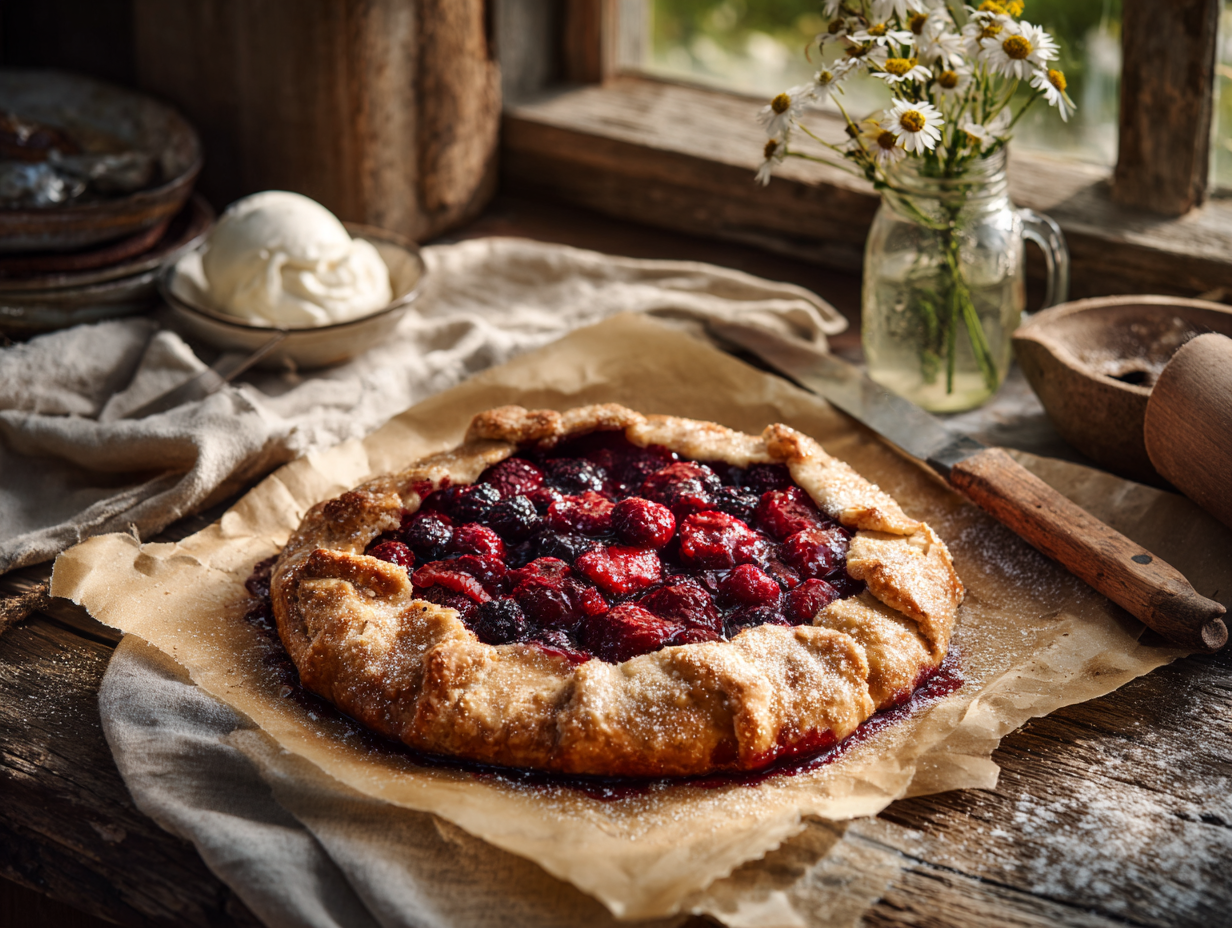
Rustic Fruit Galette

Equipment
- Mixing Bowl
- Rolling pin
- Baking sheet
- Parchment Paper
- Pastry brush
Ingredients
For the Pastry Dough:
- 1 ¼ cups all-purpose flour preferably organic
- ½ teaspoon salt sea salt
- 1 tablespoon sugar granulated
- ½ cup unsalted butter chilled and cubed
- 3-4 tablespoons ice water
For the Fruit Filling:
- 2 cups mixed berries fresh or frozen
- ¼ cup sugar adjust based on fruit sweetness
- 1 tablespoon lemon juice freshly squeezed
- 1 tablespoon cornstarch
For the Assembly:
- 1 tablespoon milk for brushing
- 1 tablespoon sugar for sprinkling
Instructions
- Prepare the Pastry Dough: In a mixing bowl, combine flour, salt, and sugar. Cut in the chilled butter using a pastry cutter until the mixture resembles coarse crumbs. Gradually add ice water, a tablespoon at a time, mixing until the dough just holds together. Form into a disk, wrap in plastic, and chill for at least 30 minutes.
- Make the Filling: In another bowl, gently mix the berries, sugar, lemon juice, and cornstarch. Allow the mixture to macerate while rolling out the dough.
- Roll Out the Dough: Preheat the oven to 400°F (200°C). On a floured surface, roll out the dough to a 12-inch circle. Transfer to a baking sheet lined with parchment paper.
- Assemble the Galette: Spoon the fruit filling onto the center of the dough, leaving a 2-inch border. Fold the edges over the filling, pleating as necessary.
- Bake: Brush the dough edges with milk and sprinkle with sugar. Bake in the preheated oven for 45 minutes, or until the fruit is bubbly and the crust is golden brown.
Notes
Lori’s Tips:
- For a nutty flavor, add a tablespoon of almond flour to the dough.
- Substitute coconut sugar for a natural sweetener, or use a gluten-free flour blend for a gluten-free option.
- If the fruits are overly juicy, toss them with an extra teaspoon of cornstarch.
Nutrition
Frequently asked questions
Can I make more than one galette at a time for a party?
Yes — each galette bakes on its own sheet pan, so you can run two at once on separate oven racks. Rotate the pans halfway through baking so both brown evenly, since most home ovens have hot spots.
Do I need a pastry cutter, or can I use my hands?
You can use your hands, but work fast. Rub the cold butter into the flour with your fingertips until the mixture looks like rough, uneven crumbs — stop before it feels smooth. The heat from your hands softens butter quickly, so if the kitchen is warm, use a box grater to grate frozen butter into the flour instead.
How do I keep the galette from sliding around when I fold the edges?
Roll the dough directly onto the parchment paper rather than a floured counter, then slide the whole sheet onto the baking pan before folding. This way you never have to move the assembled galette at all.
Can I use store-bought pie dough to save time?
It works and the result is still good — store-bought pie dough bakes up shorter and less flaky than homemade, but it holds the fruit fine. One standard round of refrigerated pie dough rolls to roughly the right size for this recipe.
What to bake next
- Rustic Blackberry Almond Cake
- Sweet Elegance Blackberry Mascarpone Tart
- Caramelized Banana Tart
- Provence-Inspired Blackberry Lavender Crumble