

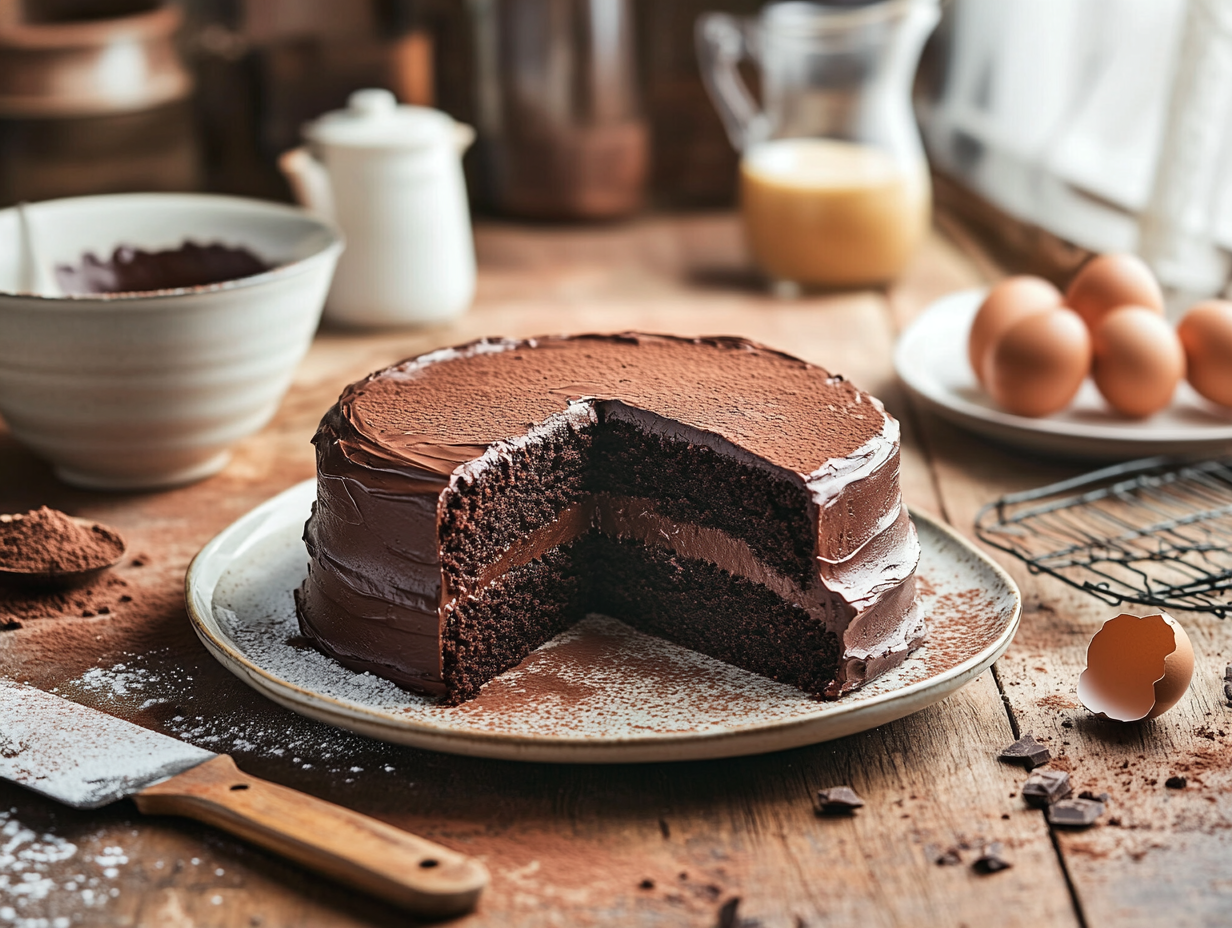
This is a two-layer chocolate cake built from pantry staples — flour, cocoa, oil, eggs, milk — that bakes up moist and slices cleanly. The batter comes together in one bowl session with no special equipment beyond an electric mixer. If you want a reliable chocolate cake that works on a Tuesday night or a birthday weekend, this is the one to keep.
What makes this version work
Two things actually drive the result here. First, blooming the cocoa powder in boiling water — that last step where the batter goes thin and you wonder if you’ve ruined it — is doing real work. Heat opens up the cocoa particles and pulls out more flavor than mixing cocoa into cold liquid ever could. Don’t skip it and don’t panic at the thin consistency; it’s correct. Second, the recipe uses oil instead of butter. Butter tastes great, but oil keeps the crumb moist at refrigerator temperature, which matters if you’re not serving the whole cake in one sitting. Melted butter will work in a pinch, but the texture firms up more when cold.
Common problems and fixes
- Cake domes and cracks on top: Your oven is running hot. An oven thermometer is the cheapest fix — many home ovens read 25°F high. Drop the temperature by 25°F and check five minutes early.
- Layers stick to the pans: Greasing and flouring is listed in the recipe, but lining the bottom with a parchment round first is the actual insurance policy. Grease the pan, press in the parchment, grease the parchment, then flour. Cakes release cleanly every time.
- Dry, tight crumb: Usually overbaking. Start checking at 28 minutes. A toothpick with a few moist crumbs — not wet batter — is the right pull point; waiting for a bone-dry toothpick takes it too far.
- Batter looks curdled or lumpy after adding wet to dry: Cold eggs and cold milk straight from the fridge can cause this. Room-temperature eggs and milk blend in smoothly; if yours were cold, just keep mixing on medium for the full two minutes and it will come together.
- Cake sinks in the center: The most common cause is underbaking, but it can also happen if the pans were overfilled. Divide the batter as evenly as you can — a kitchen scale helps — and make sure each pan is no more than two-thirds full.
Keeping it fresh
Unfrosted cake layers can be wrapped tightly in plastic wrap and kept at room temperature for up to two days, or frozen for up to three months — freeze them flat on a baking sheet first, then wrap once solid so they don’t stick to the plastic. A frosted assembled cake keeps well at room temperature under a cake dome for two days; after that, refrigerate it and bring individual slices back to room temperature for about 20 minutes before eating, since cold mutes the chocolate flavor noticeably. If you want to get ahead, bake and freeze the layers up to a week before you need them, then frost the day of — skip the garnish on the day you bake, since fresh garnishes on a frozen-then-thawed cake don’t hold well and it’s not worth the extra dish.
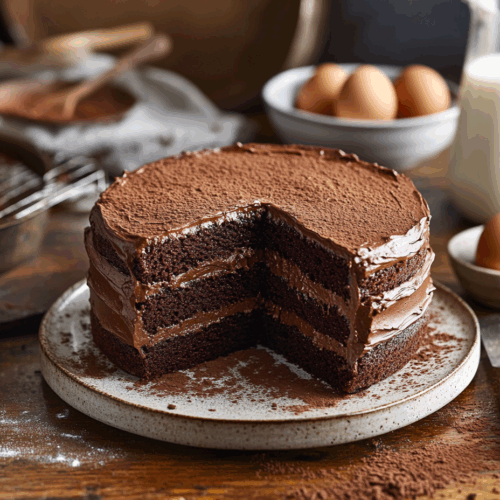
Classic Chocolate Cake

Equipment
- 9-inch round cake pans
- Mixing Bowls
- Electric Mixer
- Cooling Rack
- Spatula
Ingredients
For the Dry Components:
- 1-3/4 cups all-purpose flour preferably unbleached
- ¾ cup unsweetened cocoa powder high-quality, like Dutch-process
- 2 cups sugar granulated
- 1-1/2 teaspoons baking soda
- 1-1/2 teaspoons baking powder
- 1 teaspoon salt fine
For the Wet Components:
- 2 large eggs preferably at room temperature
- 1 cup whole milk
- ½ cup vegetable oil
- 2 teaspoons vanilla extract
- 1 cup boiling water
Instructions
- Preheat your oven to 350°F (175°C). Grease and flour two 9-inch round cake pans for easy cake removal.
- In a large mixing bowl, combine the dry ingredients: flour, cocoa powder, sugar, baking soda, baking powder, and salt. Stir well to ensure even distribution.
- In a separate bowl, whisk together the eggs, milk, vegetable oil, and vanilla extract until fully integrated.
- Add the wet mixture to the dry ingredients and mix on medium speed using an electric mixer until the batter is smooth and free of lumps, about 2 minutes.
- Gently stir in the boiling water. The batter will be thin, but this is desired for a moist cake.
- Divide the batter evenly between the prepared cake pans.
- Bake in the preheated oven for 30 to 35 minutes, or until a toothpick inserted in the center comes out clean.
- Allow cakes to cool in the pans for 10 minutes, then transfer to a cooling rack to cool completely.
Notes
- For an extra layer of flavor, consider adding a teaspoon of espresso powder to the dry ingredients to enhance the chocolate taste.
Nutrition
Common questions
Can I use natural cocoa powder instead of Dutch-process?
Yes, and most home bakers have natural cocoa on hand, so it’s a practical swap. The cake will taste slightly more acidic and the color will be a bit lighter, but it bakes up fine because this recipe already includes both baking soda and baking powder, which handle the leavening regardless of cocoa type.
Can I substitute buttermilk for the whole milk?
Buttermilk works well here and gives a very slightly tangier crumb. Use the same amount — one cup — and don’t adjust anything else; the baking soda already in the recipe handles the extra acidity.
Can I make this as a 9×13 sheet cake instead of two round layers?
Yes, a 9×13 pan works with this exact batter quantity. Start checking for doneness at 35 minutes, though it may need up to 40 depending on your oven, since the single deeper layer takes longer to set in the center.
Do I need an electric mixer, or can I mix by hand?
You can mix by hand with a whisk and a wooden spoon, but you’ll need to work harder to get a smooth, lump-free batter. Whisk the wet and dry mixtures thoroughly before combining, then stir vigorously for at least two to three minutes once they’re together.
Can I use a different oil if I don’t have vegetable oil?
Any neutral-flavored oil works — canola, sunflower, or light (not extra-virgin) olive oil are all fine. Avoid strongly flavored oils like coconut or toasted sesame, which will compete with the chocolate.
My layers came out uneven in height. What went wrong?
Uneven layers almost always mean the batter wasn’t divided equally between the pans. Weighing the pans on a kitchen scale after filling is the most reliable method; eyeballing it in a liquid batter is harder than it looks.
More sweet things to bake
- Nostalgic Malted Milk Chocolate Cake
- Ultimate Chocolate Sheet Cake
- French Brown Butter Chocolate Tart
- Nutty Brown Butter Vanilla Bean Cupcakes