

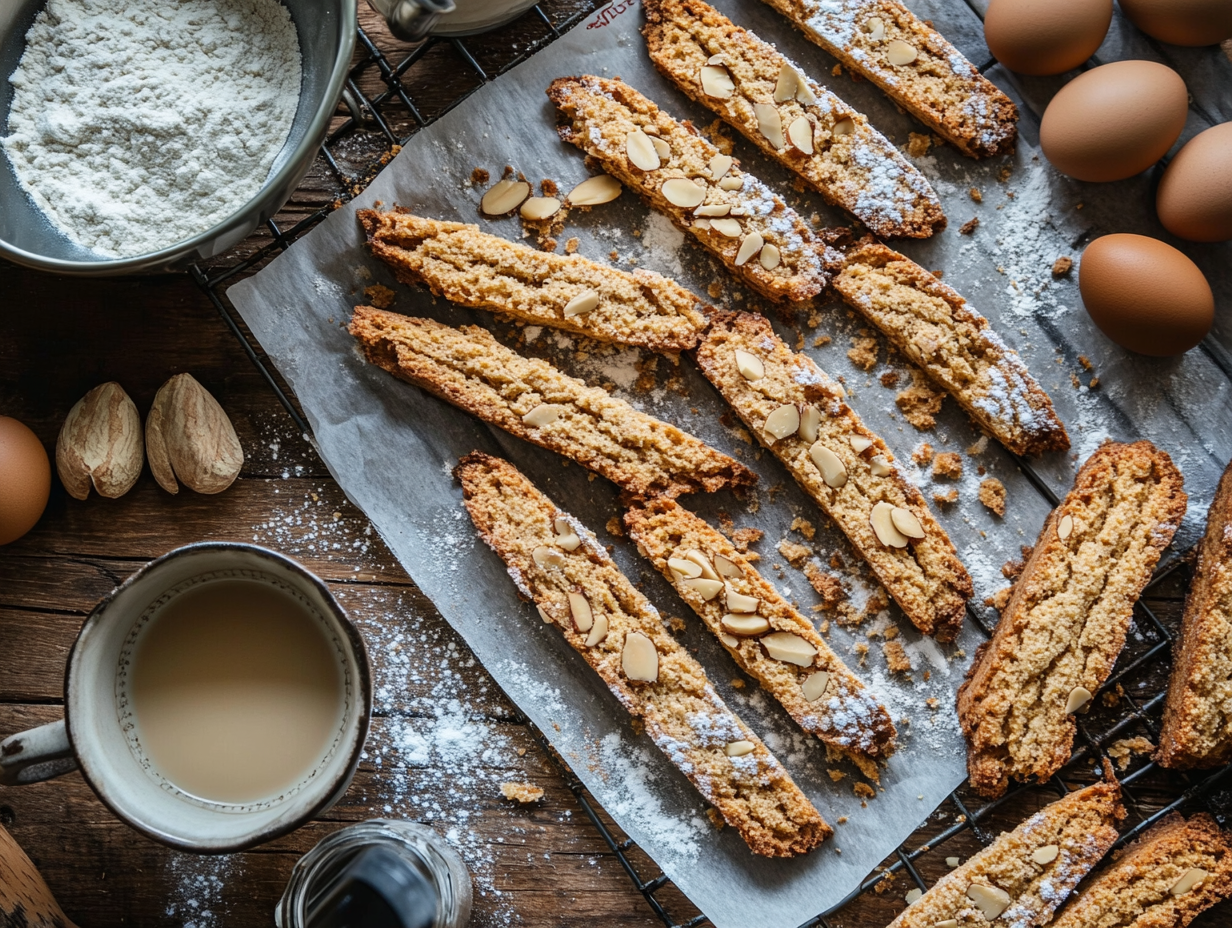
Biscotti are twice-baked cookies — shaped into a log, baked until set, sliced, then baked again until completely dry and crisp. That second bake is what gives them their snap and their unusually long shelf life. This recipe makes 24 pieces in about 70 minutes using pantry staples, and the result keeps well for weeks without any special storage.
What makes this version work
Two things matter most here. First, the dough is intentionally stiff — stiffer than most cookie doughs — because it needs to hold its shape as a log and slice cleanly without crumbling. Don’t be tempted to add liquid if it feels dry; that’s correct. Second, the 10-minute rest before slicing is not optional. Cut too soon and the log tears rather than slices, leaving you with ragged edges and broken pieces. A serrated knife and a confident single downward stroke (not a sawing motion) will give you clean, even slices that bake uniformly in the second round.
Substitutions that actually work
- Almond extract: If you’re out, use an extra half-teaspoon of vanilla. The flavor will be milder but the cookies will still be good. Skip the imitation almond extract if that’s all you have — it turns bitter when baked twice.
- Almonds: Hazelnuts and pistachios both work well (as noted on the card). Walnuts are softer and can make the texture slightly less crisp, but they’re fine if that’s what’s in the pantry. Avoid pre-sliced or slivered nuts — they disappear into the dough rather than giving you distinct pieces.
- Unbleached vs. bleached flour: Bleached all-purpose flour works. The difference in this recipe is negligible.
- Eggs: Room temperature eggs mix in more evenly. If yours are cold, set them in a bowl of warm water for 5 minutes before cracking.
Common problems and fixes
- Logs spread too wide during the first bake: The dough was too warm, or the logs were shaped too flat. Chill the shaped logs for 15 minutes before baking, and make sure each log is a full 2 inches tall, not just 2 inches wide.
- Biscotti are soft after the second bake: They need more time in the oven, or the slices were too thick. At half an inch they should be fully dry and crisp when cooled. If they’re still soft after cooling, return them to a 300°F oven for another 8–10 minutes.
- Slices crack or shatter when cutting: The log cooled too long and dried out before slicing. Aim to cut at the 10-minute mark — warm but not hot. If you missed the window, a very light misting of water on the log surface and a 2-minute wait can help.
- Uneven browning in the second bake: Flip the slices halfway through. Ovens vary, and the bottom side often browns faster than the top. Skip the parchment for the second bake if your baking sheet is light-colored — direct contact browns the cut sides more evenly.
- Dough too sticky to shape: Lightly flour your hands, not the dough. Adding flour directly to the dough at this stage can make the finished biscotti tough.
Storage and make-ahead
Once fully cooled, biscotti keep at room temperature in an airtight container for up to three weeks — longer than almost any other homemade cookie. A tin works better than a zip-lock bag, which can trap just enough humidity to soften them over time. If you want to get ahead, the unbaked logs can be wrapped tightly in plastic and refrigerated for up to two days before the first bake, or frozen for up to a month; bake from frozen by adding 5 minutes to the first bake time. Fully baked biscotti also freeze well for up to two months — thaw at room temperature for an hour and they’re back to full crunch. There’s no need to store these in the fridge at any stage.
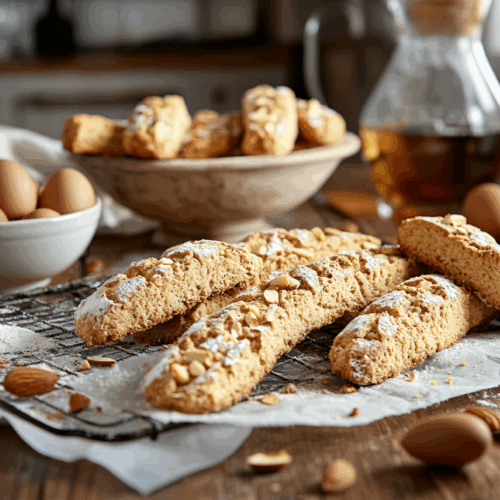
Almond Biscotti

Equipment
- Baking sheet
- Mixing Bowl
- Electric Mixer
- Spatula
- serrated knife
- Cooling Rack
Ingredients
- 2 cups all-purpose flour unbleached
- 1 cup granulated sugar
- 1 teaspoon baking powder
- ¼ teaspoon salt
- 3 large eggs room temperature
- 1 teaspoon vanilla extract pure
- 1 teaspoon almond extract
- 1 cup almonds toasted and coarsely chopped
Instructions
- Preheat your oven to 350°F (175°C). Line a baking sheet with parchment paper.
- In a large mixing bowl, whisk together the flour, sugar, baking powder, and salt.
- In a separate bowl, lightly beat the eggs and stir in the vanilla and almond extracts.
- Gradually add the wet ingredients to the dry ingredients, using an electric mixer on low until combined.
- Fold in the chopped almonds with a spatula, ensuring even distribution.
- Divide the dough in half and form each into a log about 12 inches long and 2 inches wide on the prepared baking sheet.
- Bake in the preheated oven for 25-30 minutes, or until golden brown. Remove and let cool for 10 minutes.
- Using a serrated knife, slice the logs diagonally into 1/2-inch thick slices.
- Place the slices cut side down back onto the baking sheet. Bake for an additional 10-15 minutes, or until the biscotti are crisp.
- Allow to cool on a wire rack. Enjoy!
Notes
- You can substitute hazelnuts or pistachios for almonds for a different flavor.
- To make these biscotti gluten-free, use a 1-to-1 gluten-free baking flour blend.
- For an extra kick, add a pinch of cinnamon or nutmeg.
Nutrition
Your questions, answered
Do I have to toast the almonds before adding them to the dough?
Toasting is strongly recommended. Raw almonds baked inside the dough for 40-plus minutes will cook through, but pre-toasting develops a deeper, nuttier flavor that you won’t get otherwise. Spread them on a dry baking sheet at 350°F for 8–10 minutes, let them cool completely, then chop.
Can I make this recipe without an electric mixer?
Yes. The dough comes together easily by hand — a sturdy wooden spoon or silicone spatula works fine. Mix the wet ingredients into the dry until just combined, then fold in the almonds.
My biscotti came out chewy, not crispy. What went wrong?
They almost certainly needed more time in the second bake. Pull one out, let it cool for 2 minutes, and snap it — if it bends rather than breaks, return the whole batch to the oven for another 5–8 minutes. Biscotti firm up as they cool, but they won’t crisp up if they’re still moist inside.
How thick should I slice the logs?
Half an inch is the target. Thinner than that and they can over-brown or break during the second bake; thicker and the center may stay soft. A ruler next to the log for the first few cuts helps you stay consistent.
Can I reduce the sugar?
You can reduce it by up to a quarter cup without affecting the texture much. Going lower than that can make the dough harder to bring together and the finished biscotti noticeably less crisp.
Is there a way to tell when the first bake is done without relying on color alone?
Press the top of the log gently — it should feel firm and spring back slightly, not soft or doughy. The surface will be golden and the edges will have pulled away slightly from the parchment. If the center still gives under light pressure, give it another 3–5 minutes.
If you liked this one
- Espresso Walnut Biscotti
- Sweet Italian Ricotta Honey Cheesecake
- Luxurious Almond Croissant Bread Pudding
- Pear and Almond Cake