

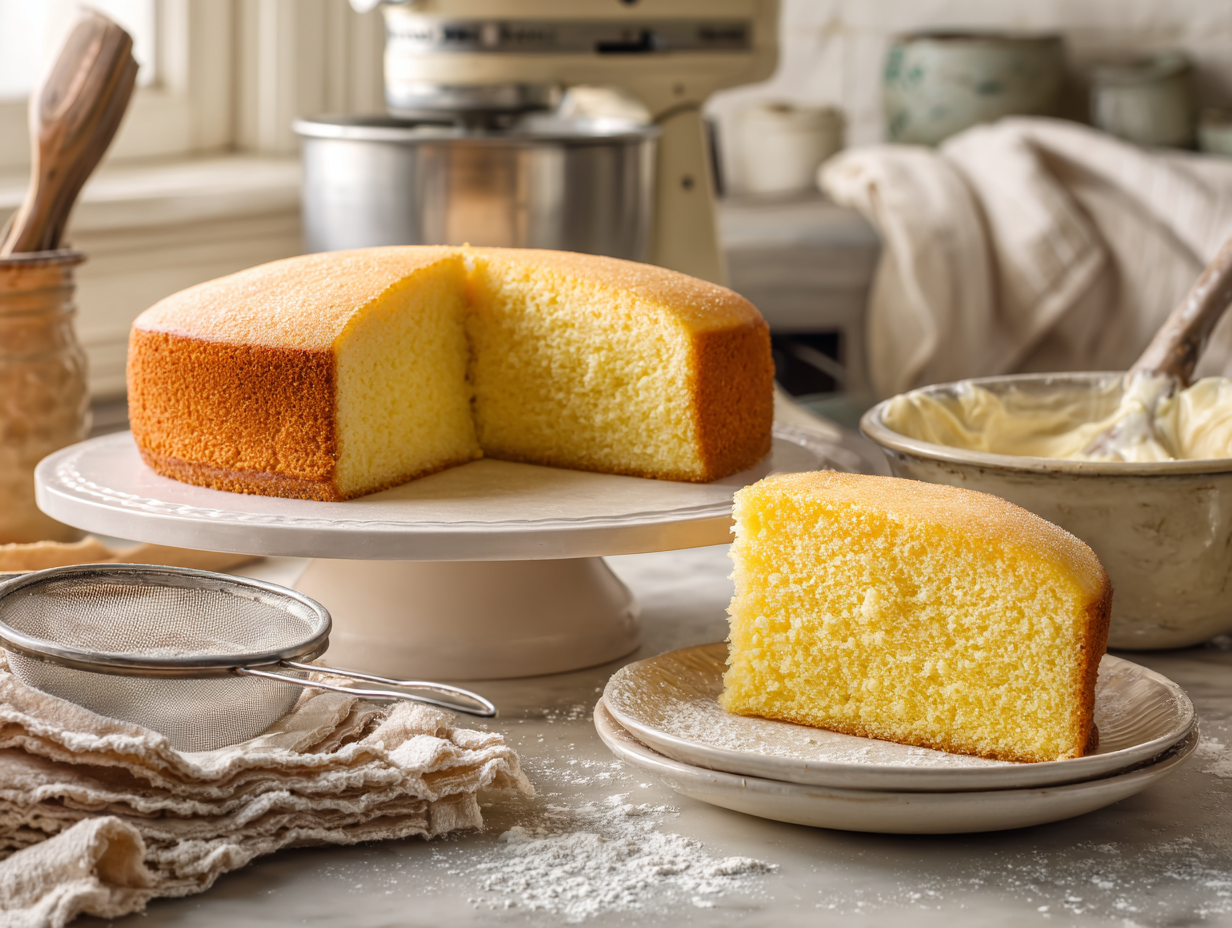
This is a two-layer yellow cake made from standard pantry ingredients — flour, butter, whole eggs, milk, and vanilla. It bakes in 25 minutes and yields 8 slices. The real reason to make it from scratch is control: you decide the quality of the vanilla, the freshness of the butter, and you end up with layers that hold together cleanly when stacked and frosted.
Substitutions that actually work
- Whole milk: 2% works fine. Avoid skim — the fat matters for texture.
- Buttermilk swap: Replace up to half the whole milk with buttermilk for a slightly tighter, more flavorful crumb. The recipe card mentions this; the practical note is that full buttermilk substitution can make the layers too dense to stack neatly.
- Salted butter: If that’s what you have, omit the added salt in the dry ingredients.
- Vanilla extract: Pure extract only. Imitation vanilla turns noticeably artificial once the cake cools.
The short version of why this works
Two things actually drive the outcome here. First, creaming the butter and sugar long enough — the full 3 to 5 minutes — builds the air structure that lifts the cake during baking. Cut that short and the layers come out flat and dense. Second, alternating the dry ingredients and milk (starting and ending with flour) keeps the batter from breaking into a greasy, curdled mess. Adding all the liquid at once overwhelms the emulsion the butter and eggs have built. Everything else in this recipe is straightforward; these two steps are where attention pays off.
What can go wrong
- Domed, cracked tops: Usually means the oven runs hot. Use an oven thermometer and verify your temperature before baking. A true 350°F gives a level top that’s easy to stack.
- Layers stick to the pan: Parchment on the bottom is in the recipe, but skipping the grease on the pan sides is a common shortcut that causes tearing. Grease the sides too.
- Gummy center that tests clean: A toothpick can miss a wet pocket. Press the center lightly — it should spring back. If it doesn’t, give it another 3 minutes.
- Uneven layers: Eyeballing the batter split leads to one thin and one thick layer. Use a kitchen scale to divide evenly, or measure with a liquid measuring cup.
- Frosting tears the top: Frosting a cake that’s even slightly warm pulls the crumb apart. Cool completely — at least 1 hour at room temperature — before you touch it with a spatula.
Storage and make-ahead
Unfrosted layers are the best thing to make ahead. Wrap each cooled layer tightly in plastic wrap and store at room temperature for up to 2 days, or freeze for up to 2 months. Thaw frozen layers overnight in the refrigerator, still wrapped, then bring to room temperature before frosting — about 45 minutes on the counter. A fully frosted cake keeps at room temperature under a cake dome for 2 days. Refrigerate it if your frosting contains cream cheese or whipped cream, but pull it out an hour before serving; cold cake is noticeably denser. Skip the powdered sugar garnish if you’re making this ahead — it dissolves overnight and just needs to be reapplied anyway.
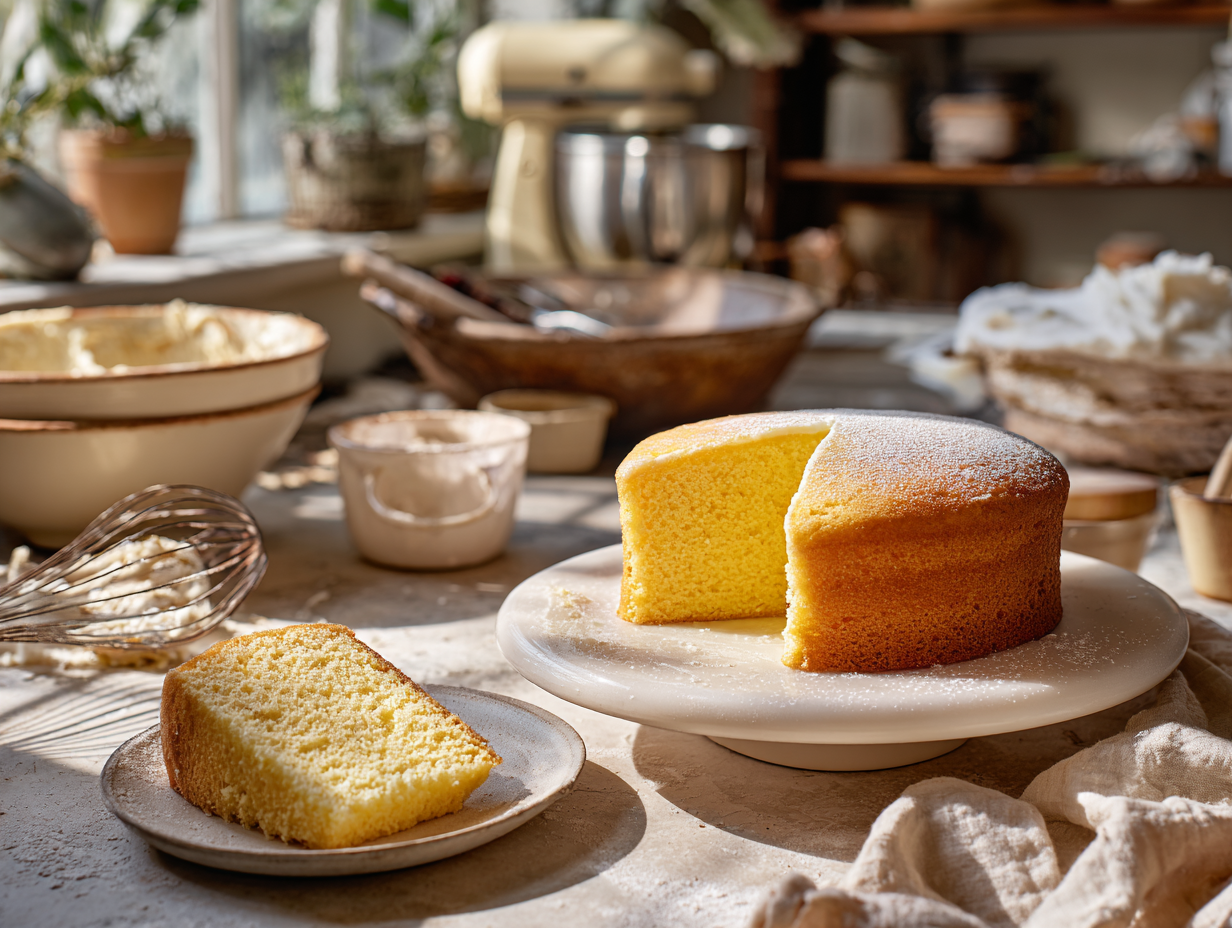
Classic Yellow Cake

Equipment
- 9-inch round cake pans
- Electric Mixer
- Mixing Bowls
- Sifter
- Rubber spatula
Ingredients
- 2 cups all-purpose flour sifted for best texture
- 1 ½ teaspoons baking powder
- ½ teaspoon salt
- ½ cup unsalted butter at room temperature
- 1 cup granulated sugar
- 3 large eggs room temperature
- 2 teaspoons vanilla extract pure
- ¾ cup whole milk room temperature
Instructions
- Preheat the oven to 350°F (175°C). Grease two 9-inch round cake pans and line the bottoms with parchment paper.
- In a medium bowl, sift together the flour, baking powder, and salt. Set aside.
- In a large mixing bowl, cream the butter and sugar together using an electric mixer on medium speed until light and fluffy, about 3-5 minutes.
- Add the eggs one at a time, beating well after each addition. Stir in the vanilla extract.
- Alternately add the flour mixture and milk to the creamed mixture, beginning and ending with the flour. Mix until just combined to avoid overmixing.
- Divide the batter evenly between the prepared pans. Smooth the tops with a spatula.
- Bake in the preheated oven for 25 minutes or until a toothpick inserted into the center comes out clean.
- Cool the cakes in their pans on a wire rack for 10 minutes. Carefully run a knife around the edges and turn the cakes out onto the racks to cool completely before frosting.
Notes
- For a richer flavor, substitute a portion of the milk with buttermilk.
- Use high-quality vanilla extract for the best taste.
Nutrition
FAQ
Can I make this as a single-layer cake instead of two layers?
Yes — pour all the batter into one 9-inch pan and increase the bake time to roughly 35 to 40 minutes, checking with a toothpick at 35. The crumb structure is the same; you just get a shorter cake that’s easier to frost for a casual occasion.
Do the eggs and butter really need to be at room temperature?
Yes, and it’s the step most people skip when they’re in a hurry. Cold eggs added to creamed butter cause the mixture to curdle and seize, which means the air you built during creaming collapses. Set your butter and eggs out about an hour before you start.
Can I double the recipe for a larger celebration cake?
Doubling works reliably for this recipe. Mix the doubled batter in two separate batches if your mixer bowl is smaller than 5 quarts — overfilling causes uneven mixing. Bake time stays the same since you’re still filling the same size pans.
If you liked this one
- Nutty Brown Butter Vanilla Bean Cupcakes
- Nostalgic Malted Milk Chocolate Cake
- Ultimate Chocolate Sheet Cake
- Classic Royal Icing Made Simply Without Meringue Powder