

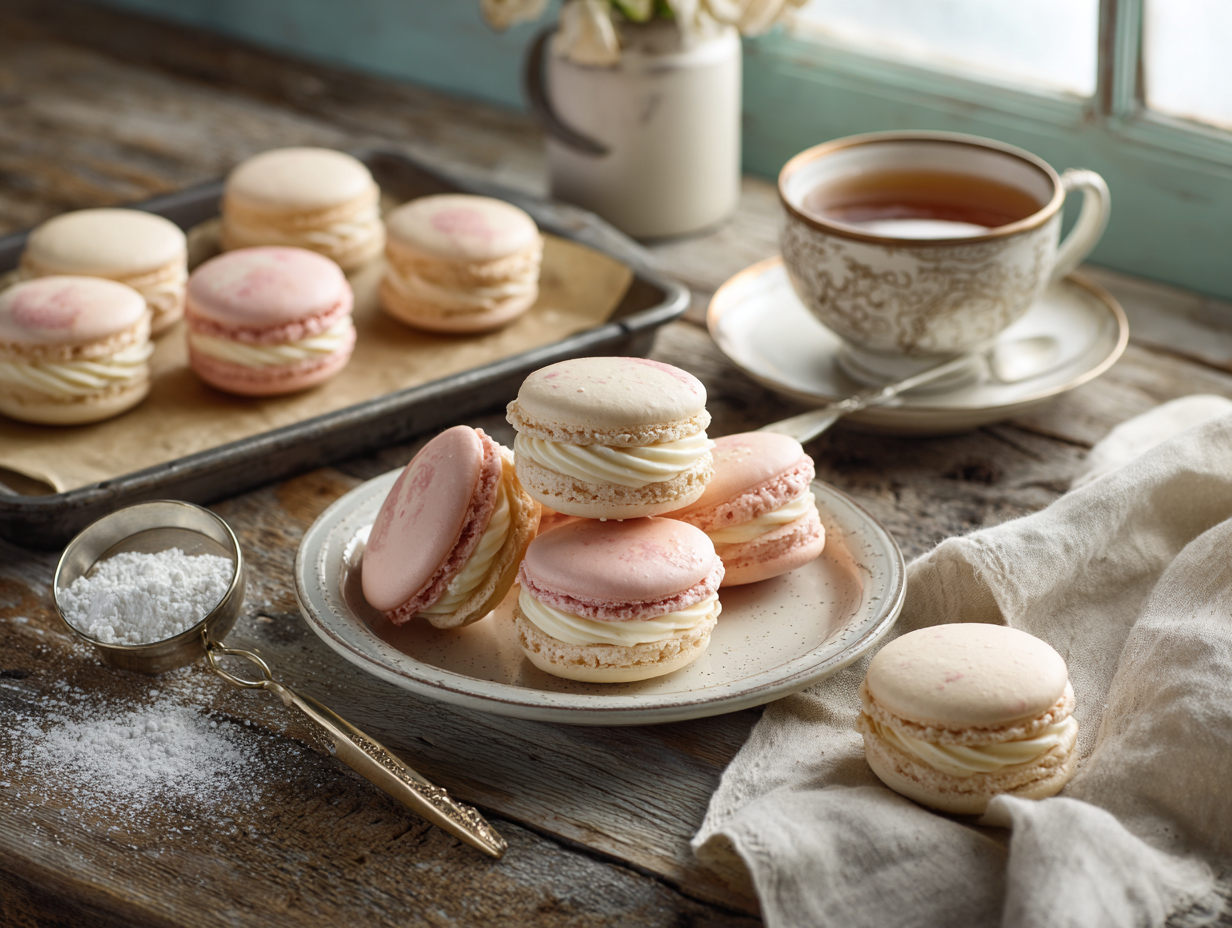
French macarons are two almond meringue shells sandwiched with a filling — here, a simple vanilla buttercream. They take real attention to detail, but every ingredient is standard pantry or grocery-store fare, and the recipe makes 24 cookies for about the cost of a single box from a specialty shop. If you want a baking project that actually teaches you something about technique, this is a good one to pick.
Shopping notes
- Almond flour: Blanched almond flour gives the smoothest shells. Bob’s Red Mill Super-Fine is widely available and works well. If you only have regular almond flour, sift it twice and discard any coarse bits that won’t pass through — don’t skip this.
- Confectioners sugar: Standard store-brand confectioners sugar is fine. Some brands contain a small amount of cornstarch, which is not a problem here.
- Egg whites: The recipe calls for room-temperature egg whites. Whites from eggs you’ve separated yourself work just as well as carton egg whites — either is fine as long as there’s no yolk contamination in the bowl.
- Vanilla extract: Pure extract gives cleaner flavor than imitation, but if imitation is what you have, use it. The difference in a buttercream this small is minor. Almond extract is a natural swap if you want a more pronounced flavor that still pairs well with the shells.
- Silicone baking mat: If you don’t own one, parchment paper works. Trace circles on the underside of the parchment with a round cookie cutter or the cap of a spice jar as a piping guide.
The technique that matters
Two things determine whether your macarons work: the meringue and the fold. The egg whites need to reach stiff, glossy peaks — not dry, clumpy ones — so add the granulated sugar gradually and stop beating the moment the peaks hold their shape and the mixture looks shiny. Then comes the macaronage, the folding step. Under-folded batter produces lumpy shells with no feet; over-folded batter spreads flat and never sets properly. You’re aiming for batter that falls off the spatula in a slow, thick ribbon and settles back into itself within about 10 seconds. Fold in firm strokes, pressing the batter against the side of the bowl, and check the consistency every few folds after the flour is incorporated — it goes from too stiff to just right faster than you’d expect. Skip the food coloring on your first batch — not worth the extra variable while you’re still dialing in the fold.
If something goes sideways
- Shells crack on top: The skin didn’t form long enough before baking. If your kitchen is humid, extend the resting time to 40–45 minutes and test by lightly touching a shell — it should feel dry and not stick to your fingertip at all.
- No feet formed: Oven temperature is the usual cause. Oven thermostats run inaccurate more often than not — use an inexpensive oven thermometer to verify you’re actually at 300°F. Also check that the baking sheet isn’t too close to the top element.
- Shells stick to the mat or parchment: They’re underbaked. Give them another 2 minutes and let them cool completely on the pan before attempting to lift them — pulling them off warm almost always tears the base.
- Hollow shells: Usually a sign the meringue was over-beaten or the batter was slightly over-folded. The shells look fine but collapse inside. They’re still edible; just fill and eat them the same day rather than letting them sit overnight.
- Buttercream is too stiff to pipe: Add the milk a few drops at a time and beat again. If your kitchen is cold, the butter may not have softened enough — 30 seconds at room temperature or a brief warm-up over a bowl of warm water will fix it without melting it.
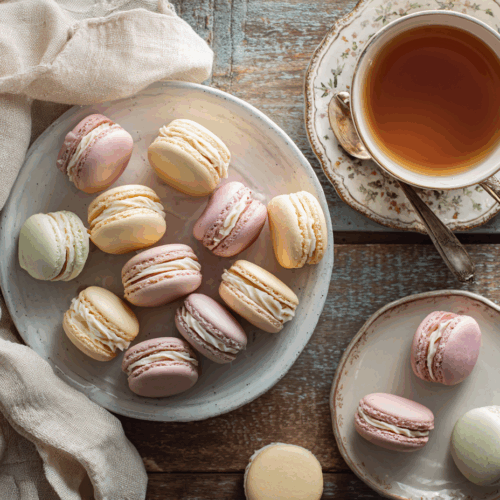
Classic French Macarons with Vanilla Buttercream

Equipment
- Electric Mixer
- Sifter
- Silicone baking mat
- Piping bag with round tip
- Baking sheet
Ingredients
For the Macaron Shells:
- 1 cup almond flour preferably blanched
- 1 ¾ cups confectioners' sugar
- 3 large egg whites at room temperature
- ¼ cup granulated sugar
- ½ teaspoon pure vanilla extract
For the Vanilla Buttercream:
- ¼ cup unsalted butter at room temperature
- ¾ cup confectioners' sugar
- 1 teaspoon milk
- ½ teaspoon pure vanilla extract
Instructions
For the Macaron Shells:
- Preheat your oven to 300°F (150°C). Prepare a baking sheet with a silicone baking mat.
- Sift the almond flour and confectioners' sugar together and set aside.
- In a clean, dry bowl, beat the egg whites on medium-high speed until frothy.
- Gradually add the granulated sugar while continuing to beat until stiff, glossy peaks form.
- Gently fold in the vanilla extract, followed by the sifted almond flour mixture, in batches, until well incorporated. The mixture should flow like lava, forming a thick ribbon when drizzled.
- Transfer the batter to a piping bag fitted with a round tip. Pipe small, uniform circles onto the prepared baking sheet.
- Tap the baking sheet firmly on the counter to remove air bubbles. Let the macaron shells rest until a skin forms, about 20-30 minutes.
- Bake in the preheated oven for 12-15 minutes, or until the tops are set. Allow cooling on the baking sheet before removing.
For the Vanilla Buttercream:
- In a medium bowl, beat the butter until creamy.
- Gradually add the confectioners' sugar and continue beating until smooth.
- Stir in the milk and vanilla extract until fully incorporated.
- Pipe or spread the buttercream onto the flat side of a macaron shell, then sandwich with another shell.
Notes
- For an elevated flavor profile, consider substituting the vanilla extract with another flavor of your choice like almond or raspberry.
- If your macaron shells crack upon baking, ensure they have rested enough for the skin to develop properly.
Nutrition
FAQ
Can I make the shells ahead of time?
Yes — unfilled shells keep well. Store them in an airtight container at room temperature for up to two days, or freeze them in a single layer for up to a month. Fill them after thawing so the buttercream doesn’t make the shells soggy during storage.
My egg whites won’t whip up properly. What’s going wrong?
Any trace of fat in the bowl or on the beaters will prevent egg whites from whipping. Wipe your bowl and beaters with a paper towel dampened with a little white vinegar or lemon juice before you start. Also make sure no yolk got into the whites when you separated the eggs — even a small amount will cause problems.
Do I really need a piping bag, or can I use a zip-lock bag?
A zip-lock bag with a small corner snipped off works fine for both the shells and the buttercream. The circles won’t be quite as uniform as with a proper round tip, but for a home batch it’s completely acceptable and saves you buying equipment for a first attempt.
More sweet things to bake
- French Brown Butter Chocolate Tart
- Nutty Brown Butter Vanilla Bean Cupcakes
- Luxurious French Chocolate Truffles
- Sweet Canadian Maple Cream Sandwich Cookies