

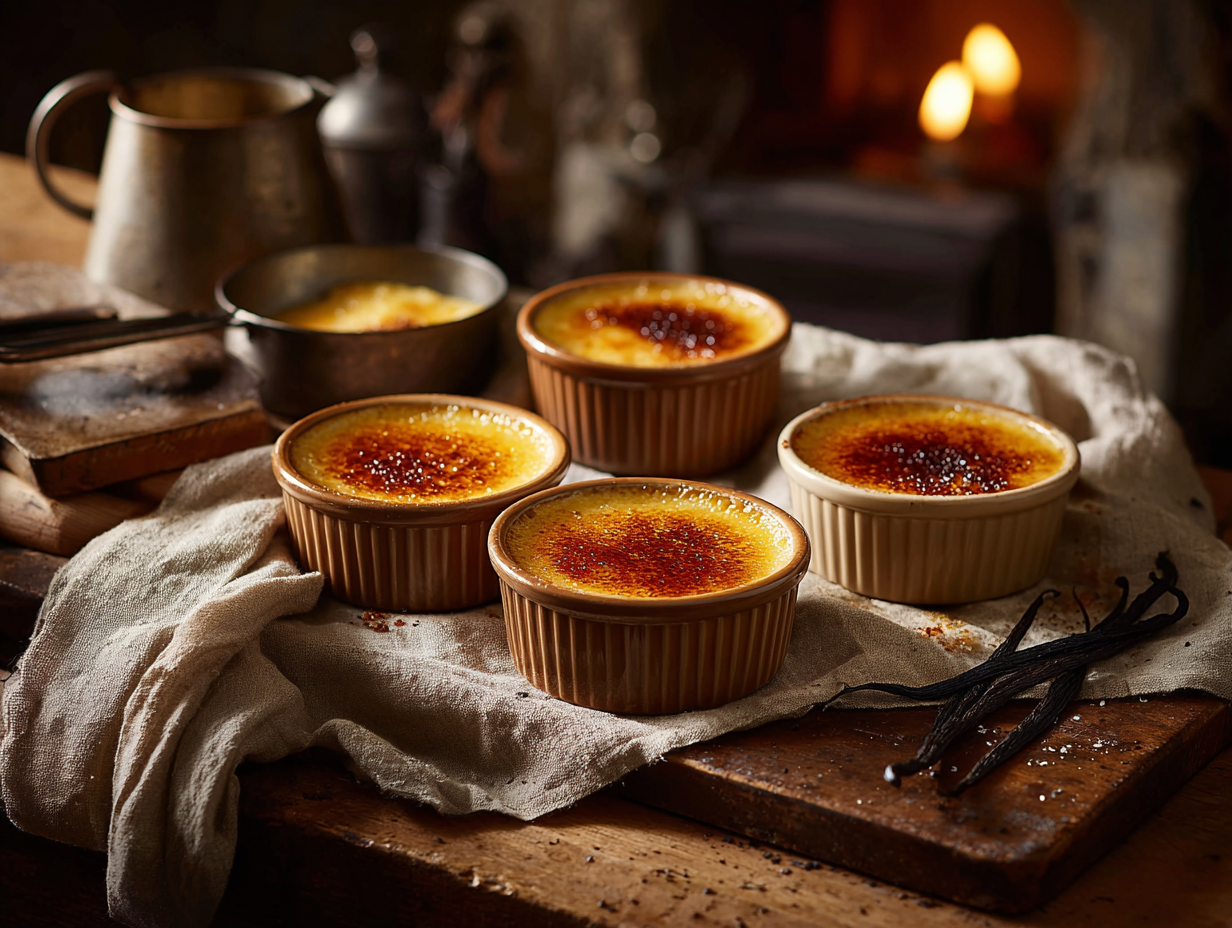
Crème brûlée is a baked vanilla custard topped with a thin layer of caramelized sugar that you crack through with a spoon. It takes about an hour of active work plus chilling time, and it makes four generous servings from a short list of ingredients. The real reason to make it at home: it’s far cheaper than a restaurant portion, and the custards can be baked a day ahead — which makes it one of the most practical desserts you can serve to a crowd.
Before you start
Two things determine whether this recipe works. First, tempering: when you pour hot cream into the egg yolks, do it slowly and whisk the whole time. Pour too fast and you’ll scramble the eggs before the custard ever reaches the oven. Second, the water bath isn’t optional — it keeps the oven heat gentle and even, which is what gives the custard its smooth texture rather than a rubbery or curdled one. Use hot water from the tap or a just-boiled kettle, and make sure it comes halfway up the sides of the ramekins before you slide the pan in.
Troubleshooting
- Custard is rubbery or has bubbles throughout: The oven was too hot or the water bath ran dry. Check the water level halfway through baking and add more hot water if needed. An oven thermometer is worth using here — many ovens run 15–25°F hot.
- Sugar topping won’t caramelize evenly with a broiler: The custard surface needs to be completely dry before you add the sugar. Pat it gently with a paper towel after refrigerating. Keep ramekins as close to the broiler element as possible and rotate the tray once.
- Caramel layer is thick and hard instead of thin and glassy: Too much sugar was added. A single thin, even layer — just enough to coat the surface — is all you need. More sugar means a tougher crack and a bitter taste.
- Custard didn’t set after the full bake time: The ramekins may be deeper than standard. Give them an extra 5–8 minutes and test again — the edges should be set and only the very center should jiggle. Don’t rely solely on the clock.
- Condensation pools on top of the chilled custard: Cover each ramekin loosely with plastic wrap before refrigerating. Press the wrap lightly against the surface rather than letting it tent above it.
Smart swaps
Heavy cream is not negotiable — lower-fat alternatives will give you a thinner, less stable custard that may not set properly. If you’re scaling up for a larger group, the recipe doubles and triples cleanly; just bake in batches rather than crowding the water bath pan. For the sugar topping, superfine (caster) sugar melts faster and more evenly than standard granulated, which can leave unmelted patches — skip the garnish of fresh fruit or mint on top, not worth the extra dish. If you only have vanilla extract, it works fine; use a good-quality pure extract rather than imitation.
Storage and make-ahead
The baked, un-torched custards keep well in the fridge for up to three days, covered with plastic wrap pressed directly onto the surface. This makes them ideal for preparing well ahead of a dinner party or event — bake on day one, torch just before serving. Do not add the sugar topping until you’re ready to serve; a caramelized top softens and turns sticky within an hour or two in the fridge. Crème brûlée does not freeze well — the custard weeps and loses its texture on thawing, so plan to use them within the three-day window.
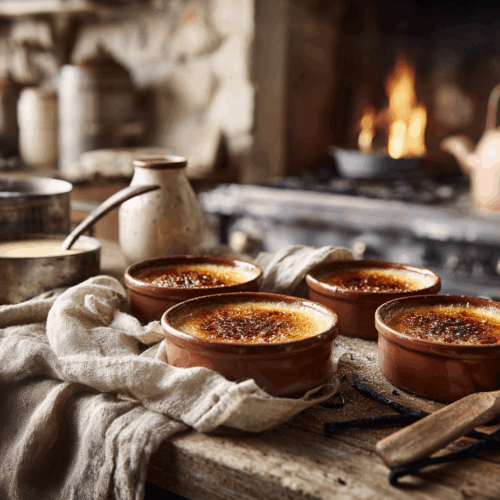
Classic Crème Brûlée

Equipment
- Ramekins
- Baking dish
- Whisk
- Saucepan
- Torch or Broiler
Ingredients
- 2 cups heavy cream use high-quality cream for richer custard
- 1 whole vanilla bean or 1 teaspoon pure vanilla extract
- 5 large egg yolks preferably from free-range eggs
- ½ cup granulated sugar plus extra for the caramelized topping
Instructions
- Preheat your oven to 325°F (160°C).
- In a saucepan, pour the heavy cream and add the vanilla bean (split and seeds scraped out) or vanilla extract. Heat over medium heat until almost boiling, stirring occasionally to avoid scorching.
- In a bowl, whisk together the egg yolks and granulated sugar until pale and thickened.
- Slowly pour the heated cream mixture into the yolk mixture, whisking continuously to combine.
- Strain the mixture through a fine sieve into a clean bowl to remove the vanilla bean and any cooked egg solids.
- Divide the custard into four ramekins evenly.
- Place the ramekins in a baking dish and fill the dish with hot water until it reaches halfway up the sides of the ramekins.
- Bake in the preheated oven for 40-45 minutes, until the custards are set but still slightly wobbly in the center.
- Remove from the oven and let the ramekins cool in the water bath, then refrigerate for at least 2 hours or overnight.
Finishing Touch:
- Sprinkle a thin, even layer of granulated sugar over the surface of each custard.
- Using a torch, carefully caramelize the sugar until golden brown and crunchy. If using a broiler, place ramekins on a tray under the broiler, watching closely to prevent burning.
Notes
- For an added twist, experiment with a hint of spice by adding a pinch of cardamom or cinnamon to the cream while heating.
Nutrition
Frequently asked questions
Can I make crème brûlée without a kitchen torch?
Yes — a broiler works, though it requires more attention. Position the ramekins on a baking sheet as close to the broiler element as possible, watch them constantly, and rotate the tray once for even color. The result is slightly less precise than a torch, but it gets the job done.
How do I know when the custards are done baking?
The custards are done when the outer inch or so is set and the center still has a slow, gentle wobble — similar to just-set Jell-O. If the whole surface ripples like liquid, they need more time; if there’s no movement at all, they’ve gone slightly too far and may be grainy.
Can I make a larger batch for a party?
The recipe scales up well — double or triple the quantities and the ratios stay the same. The main constraint is oven space: use two baking dishes side by side if needed, and make sure each water bath is filled to the halfway mark on the ramekins. Baking time stays the same.
If you liked this one
- Chocolate Chai Pots de Crème
- Lavender Honey Panna Cotta
- French Brown Butter Chocolate Tart
- Caramelized Banana Tart