

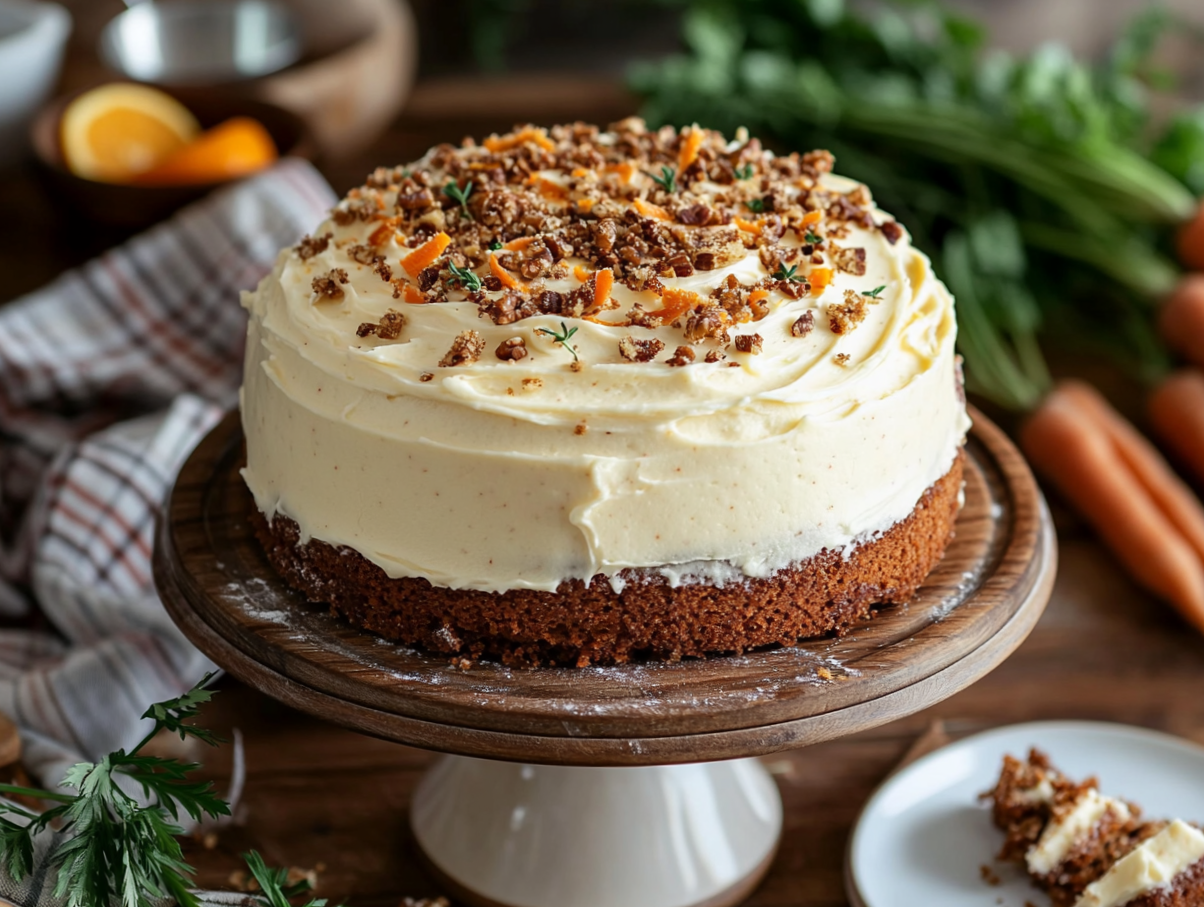
This is a two-layer carrot cake with a cream cheese frosting — oil-based, warmly spiced with cinnamon and nutmeg, and finished with a touch of orange zest. It bakes in about 35 minutes and the whole project takes around 90 minutes start to finish. The honest reason to make it: it’s genuinely hard to dry out, which makes it a reliable choice when you need a cake that actually impresses.
The short version of why this works
Two things matter most here. First, this recipe uses oil instead of butter. Oil coats the flour proteins more thoroughly than melted butter does, which is why the crumb stays tender even after a day in the fridge. Second, the carrots are grated raw and folded in at the end — they release moisture slowly during baking, keeping the interior soft without making it dense. Don’t be tempted to squeeze the water out of your grated carrots before adding them. That moisture is doing real work.
Shopping notes
- Carrots: Buy whole carrots and grate them yourself. Pre-shredded bagged carrots are too dry and too coarse — they won’t distribute evenly through the batter.
- Cream cheese: Use full-fat block cream cheese, not the spreadable kind sold in tubs. Tub cream cheese has more water in it and will make your frosting runny.
- Orange zest: Listed as optional, and it genuinely does brighten the flavor — one medium orange gives you more than enough. A microplane makes this fast.
- Vegetable oil: Canola or sunflower both work well. Avoid olive oil or coconut oil here; their flavors compete with the spices.
Storage and make-ahead
Once frosted, the assembled cake needs to be refrigerated because of the cream cheese. It keeps well for up to 4 days covered in the fridge — the flavor actually improves on day two as the spices settle. If you want to spread the work out, bake the cake layers up to 2 days ahead, wrap them tightly in plastic wrap, and leave them at room temperature. The frosting can be made a day ahead and stored in the fridge; let it sit out for 20 minutes and give it a quick stir before spreading. Both layers freeze well for up to 2 months — wrap individually in plastic, then foil. Thaw overnight in the fridge before frosting.
If something goes sideways
- The layers domed and cracked on top: Your oven is running hot. An oven thermometer is the fix long-term. For now, check the cakes at 28 minutes instead of 30 — a cracked dome means the outside set before the inside finished expanding.
- The frosting is soupy: The cream cheese or butter was too warm when you mixed them. Put the bowl in the fridge for 15 minutes, then beat again. If it’s still loose, add powdered sugar a tablespoon at a time until it holds its shape.
- The cake layers are sticking to the pans: Greasing alone sometimes isn’t enough. Next time, grease the pans and line the bottoms with a circle of parchment paper. To get the cakes out now, run a thin knife around the edge and try again after another 5 minutes of cooling.
- The cake tastes flat or bland: Under-measuring the spices is the usual cause — spoons should be level but full. Also check that your baking powder isn’t old; if it’s been open more than 6 months, it may have lost strength.
- The frosting is tearing the cake surface as you spread it: The layers weren’t fully cool. Even slightly warm cake will crumble under the spatula. Skip the garnish of extra grated carrot on top — not worth the extra dish — and instead let the frosting speak for itself once the layers are properly chilled.
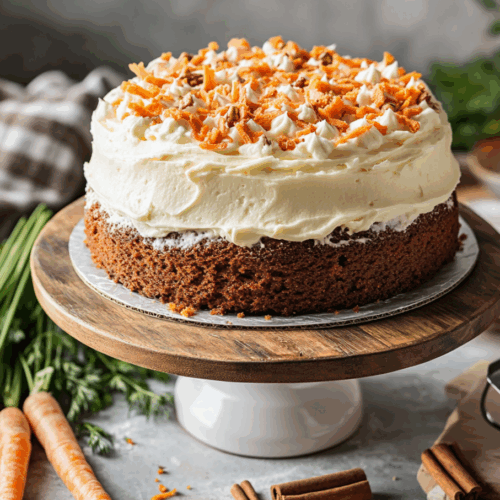
Classic Carrot Cake

Equipment
- Mixing Bowls
- Whisk
- Spatula
- 9-inch round cake pans
- Oven
- Cooling Racks
Ingredients
For the Cake Batter:
- 2 cups all-purpose flour organic, if possible
- 2 teaspoons baking powder freshly opened
- 1.5 teaspoons ground cinnamon
- ½ teaspoon ground nutmeg
- ½ teaspoon salt kosher
- 3 large eggs room temperature
- 1.5 cups granulated sugar
- 1 cup vegetable oil canola or sunflower preferred
- 1 teaspoon vanilla extract pure
- 2 cups grated carrots about 4 medium carrots
- 1 teaspoon orange zest optional, for a citrus note
For the Cream Cheese Frosting:
- 8 oz cream cheese softened to room temperature
- ½ cup unsalted butter softened
- 2.5 cups powdered sugar sifted
- 1 teaspoon vanilla extract pure
Instructions
- Preheat your oven to 350°F (175°C) and lightly grease two 9-inch round cake pans.
- In a large mixing bowl, whisk together flour, baking powder, cinnamon, nutmeg, and salt until well combined.
- In another bowl, beat the eggs and sugar until light and fluffy, approximately 2 minutes. Gradually add the oil and vanilla extract, mixing continuously.
- Gently fold in the flour mixture until just combined, and then add the grated carrots and orange zest.
- Divide the batter evenly between the prepared cake pans and smooth the top with a spatula.
- Bake for 30-35 minutes, or until a toothpick inserted into the center comes out clean.
- Remove from the oven and let the cakes cool in the pans for 10 minutes before transferring to a cooling rack to cool completely.
- For the cream cheese frosting, beat the softened cream cheese and butter together until smooth. Gradually add the powdered sugar and vanilla extract, continuing to beat until creamy and smooth.
- Once the cakes are completely cooled, spread the frosting generously between the layers and on top. Decorate with additional grated carrots or orange zest if desired.
Notes
- For a nutty twist, consider adding 1 cup of chopped walnuts to the batter.
- If you prefer a less sweet frosting, reduce the powdered sugar by up to 1/2 cup.
Nutrition
Frequently asked questions
Do I need a stand mixer or hand mixer, or can I do this by hand?
You can make the cake batter entirely by hand with a whisk and a spatula. The frosting is harder to get smooth without a mixer — a hand mixer is the minimum recommended, since beating cream cheese and butter together by hand rarely gets fully lump-free.
How do I know when the cakes are actually done baking?
A toothpick inserted in the center should come out clean or with just a couple of dry crumbs — no wet batter. The edges will also start to pull slightly away from the sides of the pan, and the top should spring back when you press it lightly with a finger.
Can I make this as a single-layer cake or a 9×13 instead of two round layers?
Yes. A 9×13 pan works well — bake at the same temperature and start checking at 30 minutes. A single 9-inch round will be very thick and may need closer to 45 minutes; use the toothpick test rather than the clock.
My cream cheese came straight from the fridge. Can I speed up softening it?
Cut it into small cubes and spread them on a plate — it will reach room temperature in about 20 minutes that way. Don’t microwave it; uneven heating creates hot spots that make the frosting grainy.
Can I add mix-ins like raisins or pineapple?
Crushed pineapple (well-drained) adds moisture and works well — use up to half a cup. Raisins are fine too; toss them in a little flour first so they don’t sink to the bottom. The recipe already notes walnuts as an option in the card.
Is it okay to frost the cake while it’s still a little warm to save time?
No — the frosting will melt and slide off, and you’ll end up with a mess. The layers need to be completely cool to the touch, which takes at least an hour on a rack. If you’re short on time, 20 minutes in the fridge after the initial cooling speeds things up.
More sweet things to bake
- Autumn’s Spiced Pear and Almond Cake
- Nostalgic Malted Milk Chocolate Cake
- Garden Fresh Zucchini Cake
- Nutty Brown Butter Vanilla Bean Cupcakes