

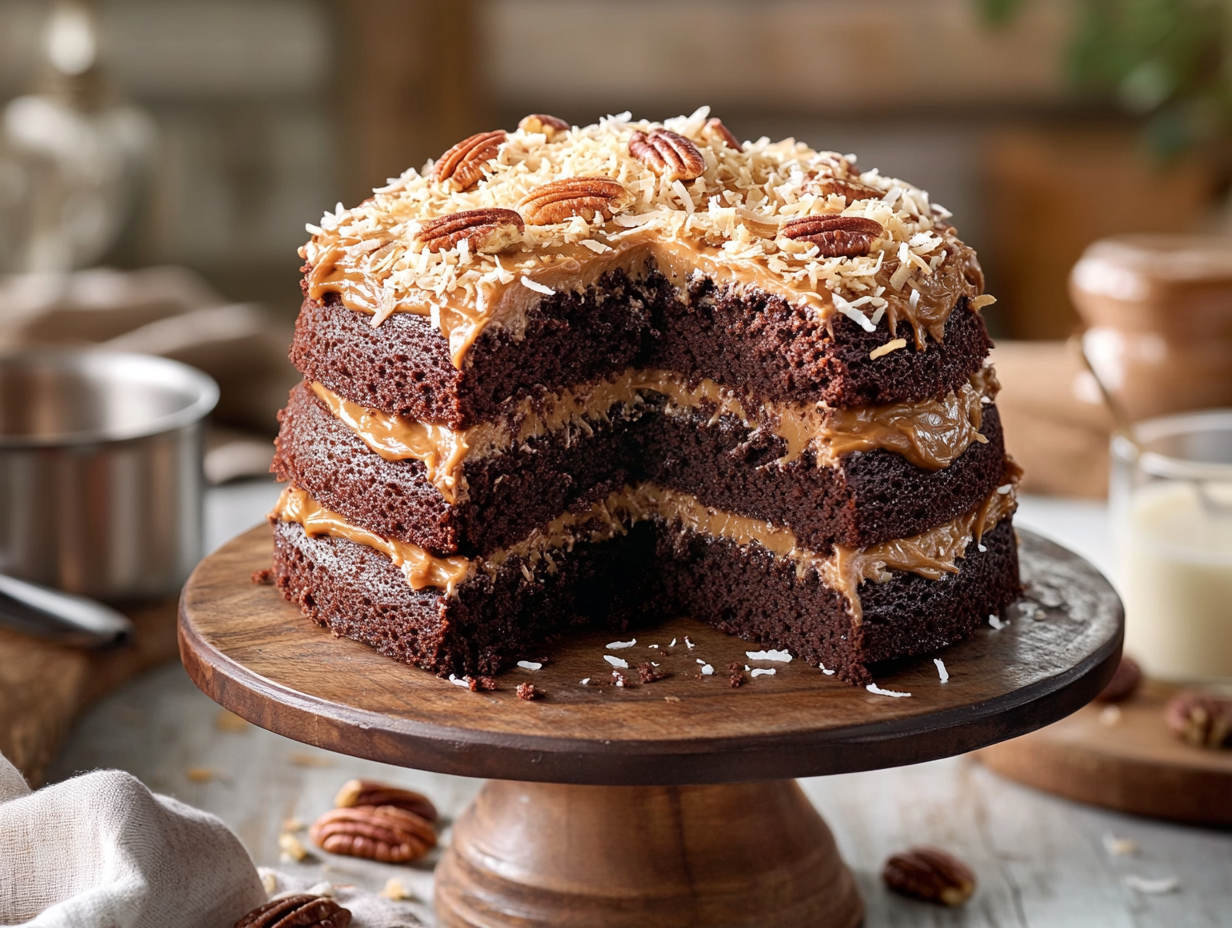
German Chocolate Cake is an American layer cake built around a mild sweet chocolate batter, buttermilk, and a cooked coconut-pecan frosting that sets into something between a caramel and a custard. The frosting is the whole point — it travels well, holds its shape when sliced, and makes the cake genuinely worth the two-hour commitment. Plan ahead and this is one of the more rewarding cakes you can pull off at home.
About the ingredients
- Baker’s German’s Sweet Chocolate: This is a specific product — sweeter and milder than semi-sweet or bittersweet bars. Substituting dark chocolate will make the cake noticeably less sweet and change the flavor balance. It’s sold in the baking aisle near the chocolate chips. Don’t skip it for this recipe.
- Cake flour vs. all-purpose: Cake flour gives the layers a finer, more tender crumb. If you’re out, you can substitute by replacing 2 tablespoons per cup of all-purpose flour with cornstarch, but the texture won’t be quite as soft.
- Evaporated milk in the frosting: This is not the same as sweetened condensed milk. Evaporated milk is unsweetened. Using the wrong one will make the frosting far too sweet and it won’t thicken correctly.
- Toasting the coconut and pecans: A dry skillet over medium heat works fine — 3 to 5 minutes, stirring often. It deepens the flavor noticeably and is worth doing even if it feels like an extra step.
Before you start
The frosting is cooked on the stovetop with egg yolks, and the one technique that matters is patience with the heat. Medium heat, constant stirring, and a full 12 minutes — don’t rush it by turning up the burner. If the heat is too high, the yolks can scramble and you’ll end up with a grainy, curdled mess instead of a smooth, thick filling. The second thing worth knowing: the frosting needs real cooling time before it’s spreadable, at least 30 to 45 minutes at room temperature. If you try to spread it warm, it runs off the layers. Make the frosting first while the cakes bake, and it should be ready to use by the time the layers have cooled.
Common problems and fixes
- Frosting stays runny and won’t thicken: It likely didn’t cook long enough, or the heat was too low. Return it to the saucepan over medium-low heat and stir for another 3 to 5 minutes. It should coat the back of a spoon and hold a line when you drag your finger through it.
- Cake layers dome in the center: This usually means the oven runs hot or the batter was overmixed after adding the flour. Use an oven thermometer to check your actual temperature, and mix the batter only until the flour disappears. You can also level domed layers with a serrated knife once they’re fully cool — skip the garnish on top if you do this, not worth the extra dish.
- Layers stick to the pans: Greasing and flouring helps, but lining the bottom of each pan with a round of parchment paper is more reliable. Run a thin offset spatula around the edge before inverting.
- Frosting looks greasy or separated: This can happen if the butter was added all at once or the heat spiked. Whisk vigorously off the heat — it often comes back together. Next time, add the butter in pieces and keep the heat steady.
- Dry cake layers: Overbaking is the most common cause. Start checking at 30 minutes. The toothpick should come out with just a few moist crumbs, not completely dry — pulling it too late dries out the crumb fast.
Storage and make-ahead
The assembled cake keeps well at room temperature for up to 2 days, loosely covered — the coconut-pecan frosting actually acts as a moisture barrier and helps the layers stay soft. For longer storage, refrigerate for up to 5 days; bring slices to room temperature for about 30 minutes before serving. The cake layers can be baked up to 2 days ahead, wrapped tightly in plastic wrap, and stored at room temperature, or frozen for up to 2 months. The frosting can also be made 2 days in advance and refrigerated in an airtight container — warm it gently in a saucepan over low heat, stirring until it loosens to a spreadable consistency. If you’re packaging slices as a gift, the frosting sets firm enough in the fridge that individual slices can be wrapped in parchment and placed in a box without smearing, as long as they’re kept cool until delivery.
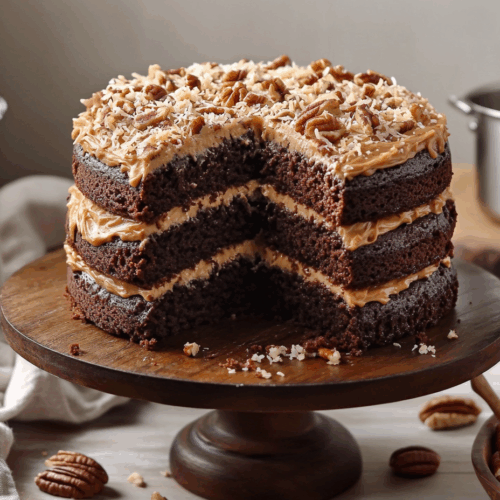
German Chocolate Cake

Equipment
- Oven
- 9-inch round cake pans
- Mixing Bowls
- Whisk
- Spatula
- Cooling Rack
- Saucepan
Ingredients
For the Cake:
- 4 ounces Baker's German's Sweet Chocolate coarsely chopped
- ½ cup boiling water
- 1 cup unsalted butter softened
- 2 cups sugar
- 4 large eggs
- 1 teaspoon vanilla extract
- 2 ½ cups cake flour sifted
- 1 teaspoon baking soda
- ½ teaspoon salt
- 1 cup buttermilk at room temperature
For the Coconut-Pecan Frosting:
- 1 cup evaporated milk
- 1 cup sugar
- 3 large egg yolks beaten
- ½ cup unsalted butter cut into cubes
- 1 teaspoon vanilla extract
- 1 ⅓ cups sweetened shredded coconut lightly toasted
- 1 cup chopped pecans lightly toasted
Instructions
Prepare Cake Layers:
- Preheat your oven to 350°F (175°C). Grease and flour three 9-inch round cake pans.
- In a bowl, combine the German's sweet chocolate and boiling water. Stir until melted and smooth. Set aside.
- In a large mixing bowl, cream the butter and sugar until light and fluffy. Add the eggs one at a time, beating well after each addition. Stir in the melted chocolate and vanilla extract.
- In another bowl, sift together the cake flour, baking soda, and salt. Gradually add the dry ingredients to the chocolate mixture, alternating with buttermilk, beginning and ending with flour mixture. Mix until just combined.
- Divide the batter evenly among the prepared cake pans and smooth the tops. Bake for 30-35 minutes until a toothpick inserted in the center comes out clean. Allow the cakes to cool in pans for 10 minutes, then transfer to a cooling rack.
Make Coconut-Pecan Frosting:
- In a saucepan, combine evaporated milk, sugar, egg yolks, butter, and vanilla. Cook over medium heat, stirring constantly, until thickened and golden brown, about 12 minutes. Remove from heat and stir in coconut and pecans. Let cool to a spreadable consistency.
Assemble the Cake:
- Place one cake layer on a serving plate. Spread a third of the frosting over the cake. Repeat with the second and third layers, spreading frosting on each layer and finishing with the top layer. Optionally, decorate with reserved pecans and drizzle melted chocolate for an elegant touch.
Notes
- For enhanced flavor, consider adding a pinch of sea salt to the frosting or a dash of espresso powder to the cake batter.
Nutrition
Common questions
Can I use regular semi-sweet chocolate instead of Baker’s German’s Sweet Chocolate?
Technically yes, but the result will taste different — noticeably less sweet and more intensely chocolatey. Baker’s German’s Sweet Chocolate has a specific mild, sugary flavor that defines this cake, so it’s worth seeking out the real thing.
How do I know when the coconut-pecan frosting is done cooking?
It’s ready when it has turned a light golden color, thickened noticeably, and coats the back of a spoon. If you drag your finger across the spoon, the line should hold — that usually happens right around the 12-minute mark over steady medium heat.
Can I make this as a two-layer cake instead of three layers?
Yes. Divide the batter between two 9-inch pans instead of three and bake for 35 to 40 minutes, checking with a toothpick. The layers will be thicker, so watch the bake time carefully.
Does this cake need to be refrigerated?
Not for the first two days — it holds well at room temperature, loosely covered. After that, refrigerate it and let slices come to room temperature before eating, since the cold firms up the frosting considerably.
Can I freeze the finished cake?
Yes, the assembled cake freezes well for up to 2 months. Freeze it uncovered until the frosting is firm, then wrap tightly in plastic wrap and foil. Thaw overnight in the refrigerator.
My frosting has small lumps in it — did I ruin it?
Small lumps usually mean the egg yolks cooked unevenly from heat that was too high. If the lumps are minor, press the frosting through a fine-mesh strainer while it’s still warm. If it’s significantly scrambled, it’s safer to make a fresh batch — the texture won’t smooth out fully once the yolks have curdled.
More sweet things to bake
- Nostalgic Malted Milk Chocolate Cake
- Southern Classic Pecan Pie
- Tropical Lime Bars with Toasted Coconut Crunch
- Ultimate Chocolate Sheet Cake