

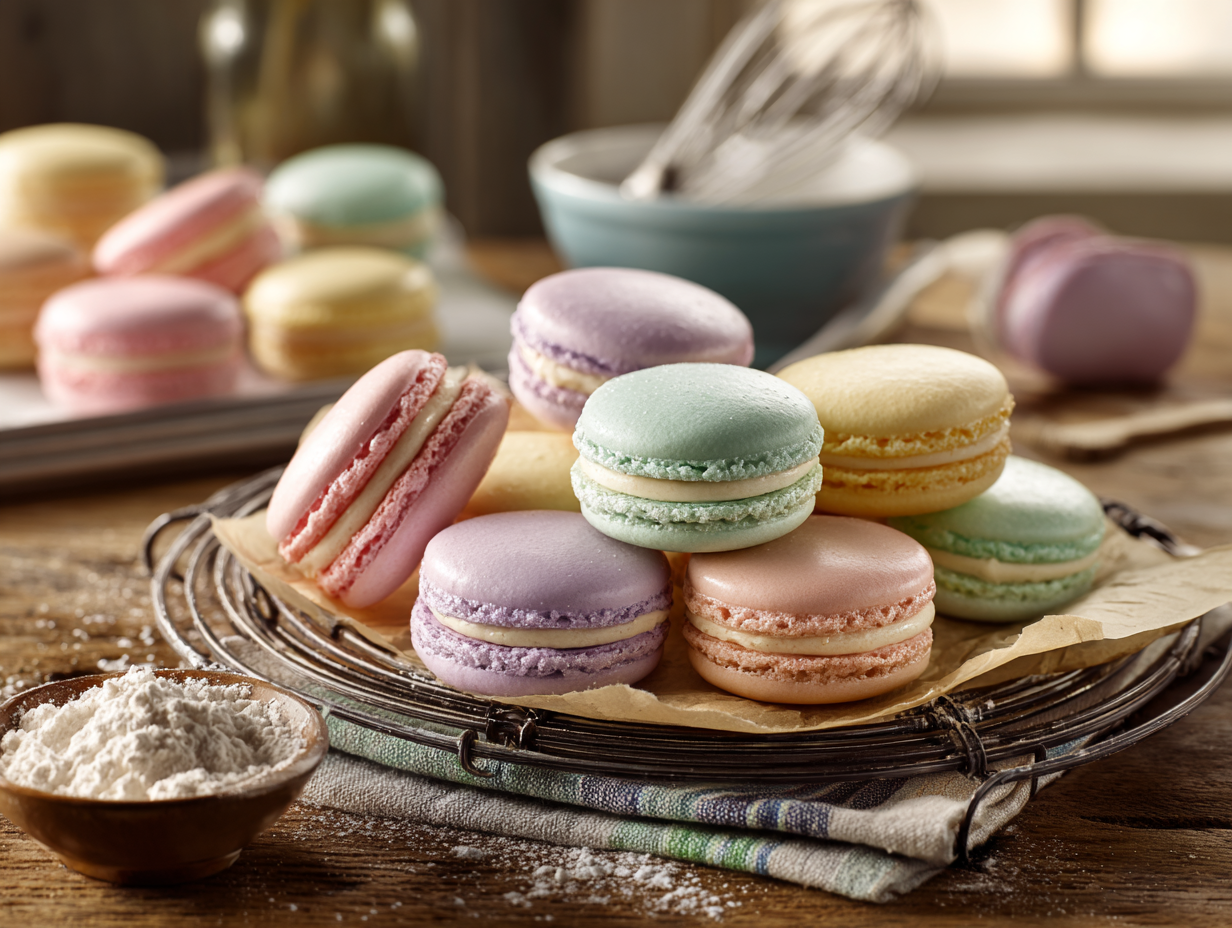
French macarons are almond meringue sandwich cookies with a crisp shell, chewy interior, and a thin layer of buttercream in the middle. They take real attention — the batter has to be folded to exactly the right consistency, and the shells need to rest before baking — but the steps are straightforward once you understand what you’re looking for. Make them when you want a project that produces something genuinely impressive, and when you have a couple of hours to give it your full attention.
Substitutions that actually work
- Almond flour: Buy the finest-ground almond flour you can find, labeled “super-fine” or “blanched.” Coarser almond meal will make bumpy shells. If you only have almond meal, pulse it with the powdered sugar in a food processor and sift thoroughly before using.
- Cream of tartar: If you’re out, a few drops of fresh lemon juice or white vinegar work the same way — they stabilize the meringue by lowering the pH. Use about ½ teaspoon lemon juice in place of the ¼ teaspoon cream of tartar.
- Vanilla extract in the shells: Any clear or light-colored extract works here without affecting the batter’s structure. Avoid anything oil-based — oil and meringue don’t mix.
- Buttercream filling: Raspberry jam, lemon curd, or a simple ganache (equal parts chocolate and warm cream) all work well as fillings. Skip the heavy cream in the buttercream recipe if you want a stiffer filling that holds up better in warm weather.
The technique that matters
Macaronage — folding the almond mixture into the meringue — is the one step that determines whether your shells come out right. You’re deliberately deflating the meringue slightly to reach a batter that flows like slow lava and falls off the spatula in a thick, continuous ribbon. Too stiff and the piped rounds won’t spread into smooth circles; too loose and they spread flat with no dome. Fold in broad strokes, pressing the batter against the side of the bowl, and stop to test every few folds once the dry streaks are gone. Pipe a small circle onto parchment — if the peak left by the piping tip flattens out on its own within 30 seconds, the batter is ready. Skip the food coloring until you’ve confirmed the consistency; adding it gives you one more chance to overmix.
Common problems and fixes
- No feet: The skin didn’t form before baking. The shells need a dry environment to rest — if your kitchen is humid, rest them near a fan or with the oven light on. Don’t rush the 20–30 minutes.
- Hollow shells: The meringue was underwhipped, or the oven temperature was too high. Use an oven thermometer — most home ovens run 10–25°F off. Bake at a true 300°F and check early.
- Cracked tops: The skin didn’t fully form, or the oven heat spiked. Make sure the surface is completely matte and dry to the touch before baking, and avoid opening the oven door in the first 10 minutes.
- Shells stick to parchment: They’re underbaked or not fully cooled. Let them cool completely on the pan before attempting to peel — a fully baked shell releases cleanly. If they still stick, slide the parchment onto a slightly damp counter for 30 seconds.
- Grainy or lumpy surface: The almond flour wasn’t sifted finely enough. Any pieces that don’t pass through the sifter should be discarded, not pressed through.
Storage and freezing
Assembled macarons actually taste better after 24 hours in the fridge — the filling softens the shell slightly and the texture improves. Store them in an airtight container in the refrigerator for up to 5 days. For longer storage, freeze the unfilled shells in a single layer, then transfer to a zip bag for up to 3 months; thaw at room temperature for 20 minutes before filling. Filled macarons can also be frozen for up to 6 weeks — freeze them in a single layer first, then stack with parchment between layers. Thaw in the fridge overnight. Make the buttercream up to a week ahead and refrigerate it; bring it to room temperature and re-whip briefly before using.
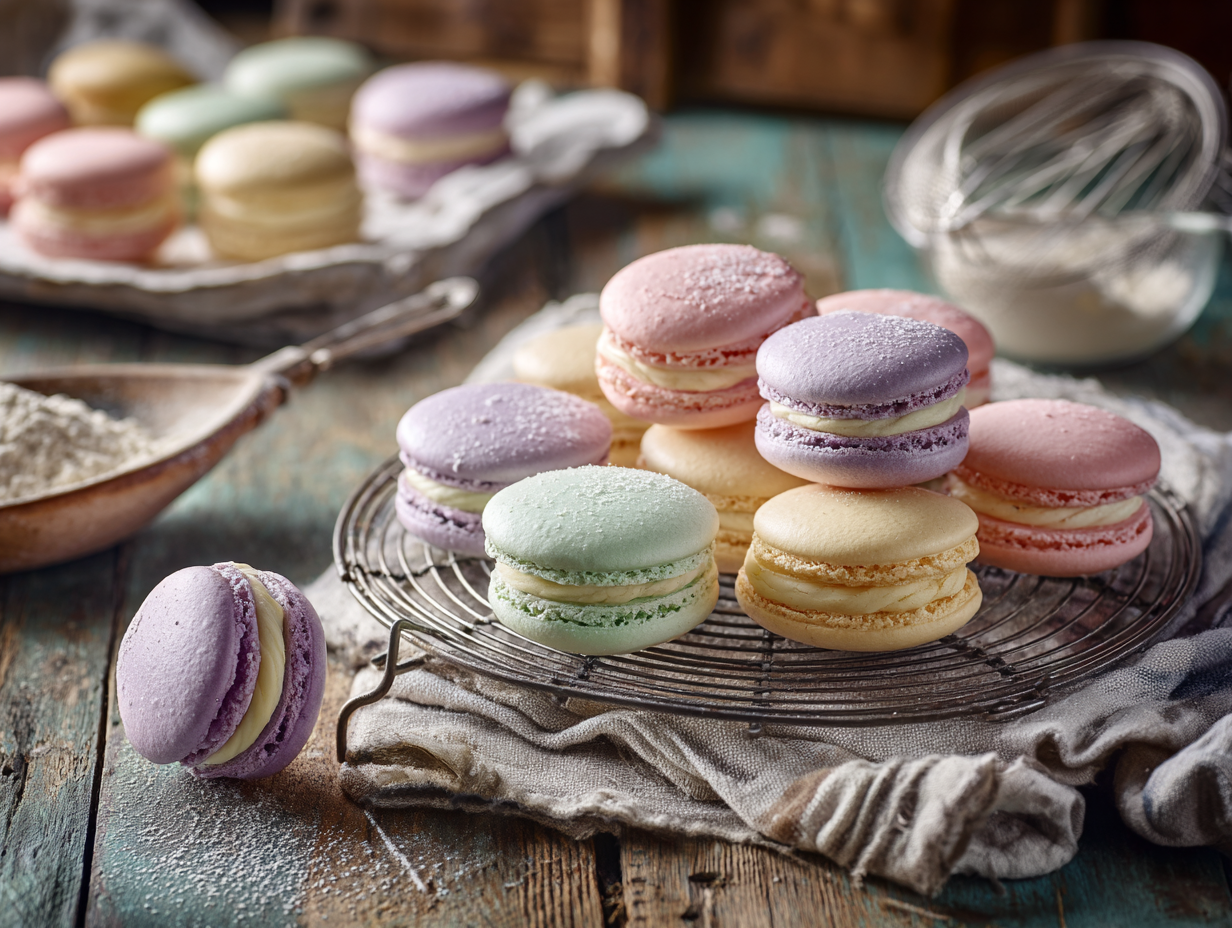
Classic French Macarons

Equipment
- Baking sheet
- Parchment Paper
- Mixing Bowls
- Kitchen scale
- Sifter
- Mixer with whisk attachment
- Piping bag with a round tip
- Cooling Rack
Ingredients
For the Macaron Shells:
- 1 cup almond flour finely ground for best texture
- 1 cup powdered sugar sifted to remove clumps
- 3 large egg whites room temperature
- ¼ teaspoon cream of tartar to stabilize the meringue
- ¼ cup granulated sugar
- ½ teaspoon vanilla extract or any preferred flavor extract
For the Filling:
- ½ cup unsalted butter room temperature
- 1 cup powdered sugar
- 1 teaspoon vanilla extract
- 1 tablespoon heavy cream for desired consistency
Instructions
- Preheat your oven to 300°F (150°C) and line a baking sheet with parchment paper.
- In a mixing bowl, sift together the almond flour and powdered sugar to ensure a fine texture.
- With a mixer fitted with a whisk, beat egg whites and cream of tartar until frothy. Gradually add granulated sugar, beating until stiff peaks form.
- Gently fold the almond flour mixture into the meringue with a rubber spatula until smooth and shiny. Add extract and desired food coloring.
- Transfer the batter into a piping bag fitted with a round tip. Pipe small circles onto the prepared baking sheet.
- Let the piped macarons rest at room temperature for 20-30 minutes until a skin forms.
- Bake for 12-15 minutes. Allow them to cool completely on a cooling rack.
- For the filling, beat butter and powdered sugar until smooth. Mix in vanilla and heavy cream to achieve a desired consistency.
- Pair macarons of similar size and spread or pipe a small amount of filling onto the flat side of one macaron, then sandwich with another.
Notes
- For perfect macarons, ensure all equipment is dry, and egg whites are free of yolk.
- To add a twist, experiment with different fillings such as fruit jams or ganache.
Nutrition
FAQ
Do my egg whites really need to be at room temperature?
Yes — room-temperature egg whites whip to a higher volume than cold ones, which gives you a more stable meringue. Take them out of the fridge at least 30 minutes before you start, or set the bowl in warm water for 5 minutes if you forgot.
Can I use a regular zip bag instead of a piping bag?
You can — snip a small corner off and it works fine for piping rounds. The circles won’t be quite as uniform as with a proper round tip, but for a first batch it’s a perfectly reasonable shortcut.
My kitchen is humid. Will that ruin the macarons?
Humidity is the biggest environmental enemy of macarons because it slows or prevents the skin from forming. On a humid day, run your air conditioning or a dehumidifier, and rest the piped shells near a fan rather than just on the counter.
How do I know when they’re done baking?
A done macaron shell will feel set on top and the foot won’t wobble when you gently nudge the pan — that’s the most reliable test. If the top shifts when touched, give them another 2 minutes and check again.
Can I make the shells a day ahead?
Absolutely — baked, unfilled shells can sit in an airtight container at room temperature for up to 24 hours before you fill them. This is actually a good strategy because it lets you split the work across two sessions.
Try these next
- Sweet Canadian Maple Cream Sandwich Cookies
- Luxurious French Chocolate Truffles
- Mediterranean Pistachio Cream Éclairs
- Classic Royal Icing Made Simply Without Meringue Powder