

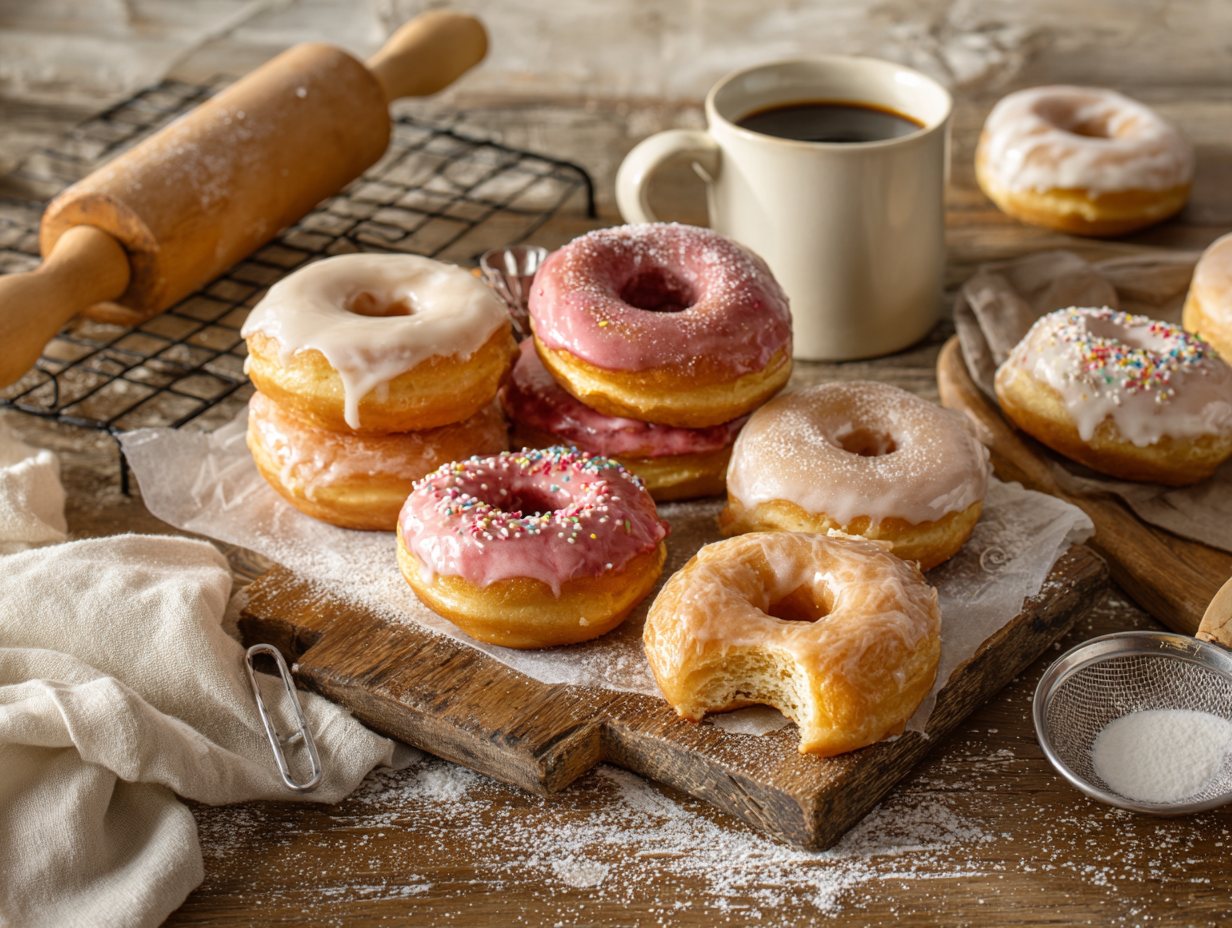
These are yeasted, fried donuts with a vanilla glaze — the kind with a crisp outside and a soft, airy inside that you genuinely cannot get from a box mix. The dough takes about two hours start to finish, mostly hands-off rise time, and the result is a dozen donuts that are worth every minute. If you’ve never fried donuts at home before, this recipe is a solid place to start.
The technique that matters
Oil temperature is the single thing that separates a good donut from a greasy, dense one. At 350°F, the outside sets quickly and the inside cooks through without absorbing excess oil. Drop below 325°F and the dough soaks up fat before it can form a crust — you’ll taste it. Go above 375°F and the outside browns before the center is done. Use a thermometer every time, not just at the start. The oil cools slightly each time you add donuts, so check it between batches and let it recover before adding the next round. Fry only two or three at a time to keep the temperature stable.
Substitutions that actually work
- Whole milk: 2% works fine. Skim milk produces a slightly less tender crumb, but it’s not a dealbreaker. Non-dairy milks (oat, soy) work for the dough but may cause the glaze to set more slowly.
- Active dry yeast: Instant yeast works as a 1:1 swap — skip the 5-minute proofing step and mix it straight into the dry ingredients.
- Vegetable oil for frying: Any neutral high-smoke-point oil works — canola, sunflower, or refined coconut oil. Skip the garnish of flavored finishing oils — not worth the extra dish.
- All-purpose flour: Bread flour produces a chewier donut. It’s not wrong, just different. Stick with all-purpose if you want the classic soft texture.
Storage and make-ahead
Glazed donuts are best eaten the day they’re made — within a few hours of frying if you can manage it. They soften overnight and the glaze turns sticky. If you need to get ahead, make and refrigerate the dough after the first rise (punch it down, wrap it tightly, and refrigerate for up to 16 hours). The next day, let it sit at room temperature for 20 minutes, then roll, cut, and do the second rise as normal. Unglazed fried donuts can be frozen for up to one month — freeze them in a single layer first, then transfer to a bag. Reheat from frozen in a 350°F oven for 5–7 minutes, then glaze while still warm.
If something goes sideways
- Donuts didn’t rise much after cutting: Your kitchen is probably too cold. Put the tray in an unheated oven with just the oven light on, or near a warm stovetop. They need a genuinely warm, draft-free spot to puff properly in that second 30-minute rest.
- Dough is sticky and won’t hold its shape when rolling: Chill it for 15 minutes before rolling. Over-kneading or a warm kitchen can make the butter soft and the dough slack. A short rest in the fridge firms it back up without affecting the rise.
- Donuts came out flat and dense, not airy: The yeast likely didn’t activate. Check that your milk was around 110°F — hotter kills yeast, cooler won’t wake it up. If the yeast mixture didn’t turn frothy after 5 minutes, start over with a fresh packet before mixing the full dough.
- Glaze is too thin and slides right off: Add more sifted powdered sugar a tablespoon at a time until it coats the back of a spoon. Dip donuts while they’re warm but not straight-from-the-fryer hot — about 2 minutes of cooling gives the glaze something to grip.
- Donut holes are browning faster than the rings: They’re smaller and cook in under a minute per side. Watch them separately and pull them first — they’re easy to burn while you’re focused on the rings.

Classic Artisan Donuts

Equipment
- Mixing Bowl
- Stand mixer with dough hook
- Rolling pin
- Donut cutter
- Deep fryer or large pot
- Baking sheet
- wire rack
- Thermometer
Ingredients
For the Dough:
- 2 ¼ teaspoons active dry yeast fresh
- 1 cup whole milk warm (about 110°F)
- ½ cup granulated sugar
- 2 tablespoons unsalted butter softened
- 2 large eggs room temperature
- 4 cups all-purpose flour plus more for dusting
- 1 teaspoon salt
For Frying:
- 4 cups vegetable oil for frying
For the Glaze:
- 2 cups powdered sugar sifted
- ¼ cup whole milk
- 1 ½ teaspoons vanilla extract
Instructions
- In a mixing bowl, combine the yeast with warm milk and 1 tablespoon of sugar. Allow it to sit for 5 minutes or until frothy.
- In a large bowl, or the bowl of a stand mixer, whisk together the remaining sugar, butter, eggs, flour, and salt. Add the yeast mixture and knead using the dough hook for about 8–10 minutes until smooth and elastic. Add more flour if the dough is too sticky.
- Place the dough in a greased bowl, cover with a clean cloth, and let it rise in a warm place for about 1 hour or until doubled in size.
- Turn the risen dough onto a floured surface and roll it out to about 1/2-inch thickness. Use a donut cutter to cut out donuts and transfer them to a baking sheet. Re-roll and cut any remaining dough pieces.
- Cover the donuts loosely and let them rest for 30 minutes to rise again.
- Heat oil in a deep fryer or large pot to 350°F (175°C). Carefully add donuts into the oil, a few at a time, and fry for 1–2 minutes on each side until golden brown. Remove and drain on a wire rack.
- For the glaze, in a medium bowl, whisk together powdered sugar, milk, and vanilla until smooth. Dip warm donuts into the glaze and return them to the rack to set.
Notes
- For a unique twist, try adding a hint of nutmeg to the dough for extra depth of flavor.
- Experiment with flavored glazes like chocolate or strawberry for a different take on classic donuts.
Nutrition
Frequently asked questions
Can I bake these instead of frying them?
You can, but the result is a different product — closer to a dinner roll in texture than a donut. Baking at 375°F for 10–12 minutes produces a soft, bread-like ring without the crisp exterior that makes a fried donut worth making. If frying feels intimidating, it’s worth trying it once — a deep pot with a thermometer is all you need.
How do I know when the dough has risen enough?
It should roughly double in size and feel noticeably puffy and light when you press it gently. The poke test works: press a floured finger about half an inch into the dough — if the indent springs back slowly, it’s ready; if it springs back immediately, give it more time; if it doesn’t spring back at all, it may be over-proofed.
Do I need a donut cutter, or can I use something else?
Any two round cutters work — a large biscuit cutter or wide-mouth jar lid for the outer ring, and a small bottle cap or piping tip for the center hole. Aim for roughly a 3-inch outer diameter and a 1-inch hole. Dip the edges in flour before each cut to get clean edges without dragging the dough.