

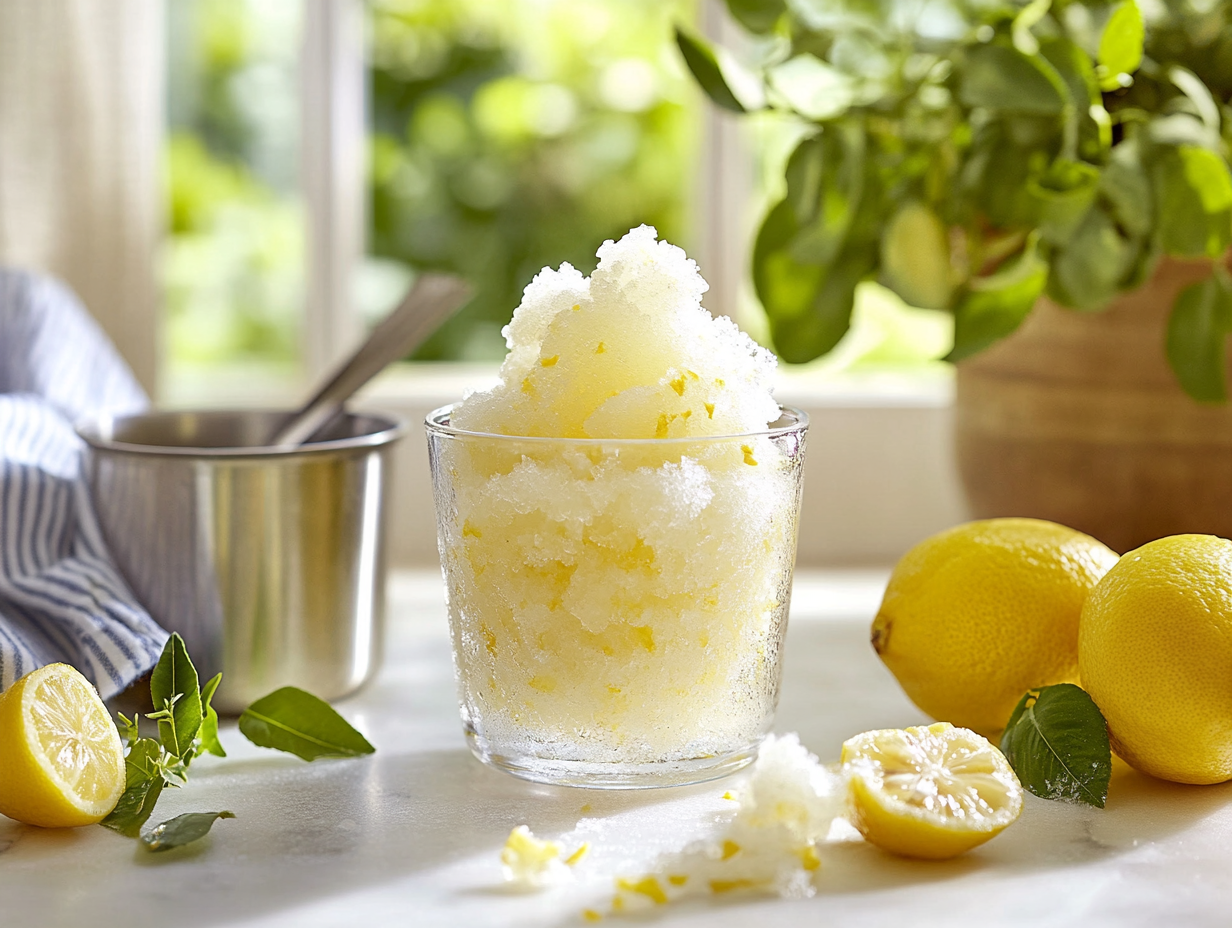
Lemon Granita is a timeless Italian frozen dessert that expresses the beauty of minimalism in cooking. Hailing from Sicily, a sun-drenched island famous for its lemons and citrus groves, this icy treat embodies the region’s zest for life and love for pure, unadulterated flavors. With only a handful of ingredients—water, sugar, lemon zest, and freshly squeezed lemon juice—Lemon Granita captures the soul of Sicilian summers like few other desserts can.
Historically, granita’s roots can be traced back to ancient Arab influences in Sicily. The original version was born during the Arab occupation of the island between the 9th and 11th centuries. It evolved from “sherbet,” a chilled drink made with fruit juice or rosewater and snow brought down from Mount Etna. Early Sicilians would collect snow from the mountains in winter, storing it in stone ice houses called “nivere” for use during the hot summer months. This snow was later flavored with local ingredients like lemon juice or almond, resulting in a coarse frozen dessert eaten with a spoon. Over centuries, the process modernized somewhat, but the method still honors its rustic origins—eschewing blenders, churners, or ice cream makers in favor of simple hand-scraping to achieve its signature crystalline texture.
The appeal of Lemon Granita lies in its natural balance of sweet and tart, matched only by its light, refreshing texture. Unlike smoother frozen treats like sorbet or gelato, granita is characterized by its granular consistency formed by periodic scraping during the freezing process. The result is a spoonable ice with unexpected depth—bright from the fruit, fragrant from the oils in the zest, and wonderfully icy on the tongue.
This dessert isn’t just delicious—it’s seasonal, versatile, and almost meditative in its method. The use of Sicilian lemons, known for their intense aroma and brightness, makes it particularly special. Often incorporated as a breakfast item in parts of Italy during warmer months (sometimes with a fresh brioche bun on the side!), granita is also a common palate cleanser between courses in elegant meals, refreshing the senses without weighing them down.
Today, granita has found its way into kitchens around the world, lauded for being both simple to make and naturally gluten- and dairy-free. Its popularity stems not only from its taste but from its adaptability: while lemon is a classic, seasonal fruits like strawberry, watermelon, or coffee can be used to create flavor variations.
Crafting Lemon Granita is an ode to simplicity, a reminder that great flavor doesn’t require complexity. It invites chefs and home cooks alike to slow down and celebrate each stirring and scraping as part of the process. Whether served at a classy dinner party or enjoyed barefoot on a summer porch, this Sicilian specialty is summertime frozen in time—a bright, crystalline taste of Mediterranean sunshine in every spoonful.
Lemon Granita

Equipment
- Saucepan
- Freezer-safe container
- Fork
- Grater
- Citrus juicer
Ingredients
- 1 cup water
- ½ cup granulated sugar superfine if possible
- 2 tablespoons lemon zest from organic lemons
- 1 cup freshly squeezed lemon juice preferably from Sicilian lemons
Instructions
- In a saucepan over medium heat, combine water and sugar. Stir until the sugar has dissolved completely, forming a syrup. This should take about 5 minutes.
- Remove from heat and stir in the lemon zest, allowing the aroma to infuse the syrup for about 5 minutes. This imparts a lively lemon fragrance to the granita.
- Stir in the freshly squeezed lemon juice. Transfer the mixture to a shallow, freezer-safe container.
- Place the container in the freezer and after about 1 hour, use a fork to scrape the ice crystals that have begun to form around the edges.
- Return to the freezer, scraping the mixture with a fork every 30 minutes to create a fluffy, snowy texture. This process will take approximately 3-4 hours.
Notes
- For a deeper lemon flavor, allow the zest to steep in the syrup for longer.
- For an additional twist, consider adding a splash of Limoncello to the mixture before freezing.