

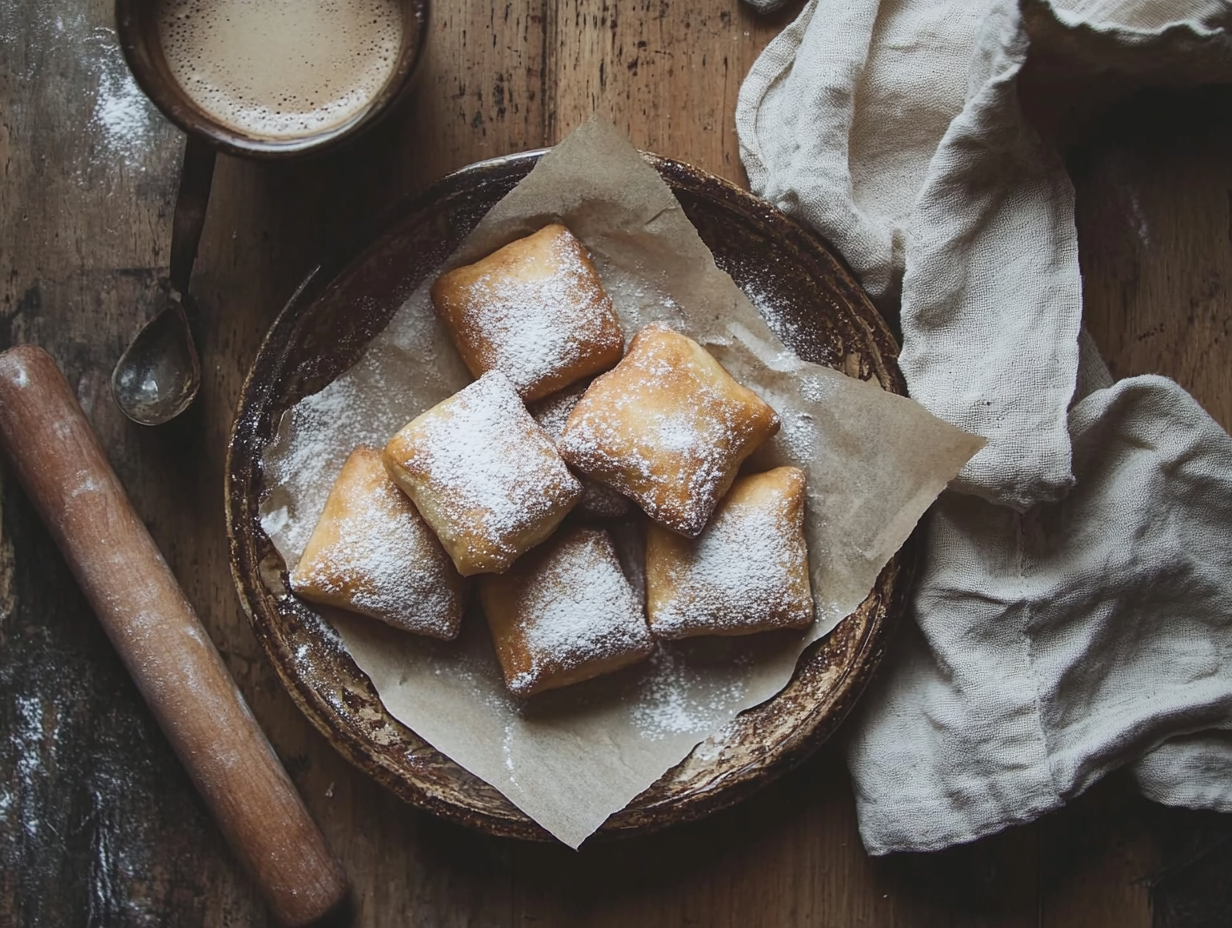
Beignets are yeasted, square-cut doughnuts fried until puffed and hollow, then buried under powdered sugar. They take about two hours start to finish — most of that is hands-off rise time — and the payoff is a batch of light, crispy-edged pastries that are genuinely hard to stop eating. If you want something impressive that scales well for a crowd, this is a strong choice.
The technique that matters
Two things determine whether your beignets puff or flatten: dough hydration and oil temperature. This dough is intentionally soft and slightly tacky — resist the urge to add extra flour to make it easier to handle. A stiffer dough produces dense, bready beignets instead of the airy ones you’re after. Oil temperature is equally non-negotiable. At 360°F the outside sets quickly, trapping steam inside, which is what forces that dramatic puff. Drop below 340°F and the dough absorbs oil before it can puff; go above 375°F and the outside browns before the inside cooks through. If you’re frying multiple batches — which you will be if you’re making these for a group — check the temperature between every batch, not just at the start. Cold dough squares pull the oil temp down fast.
What can go wrong
- Beignets don’t puff at all: The yeast was likely dead before you started. Always proof it in the warm water first and wait for genuine foam — a faint swirl doesn’t count. Water above 115°F kills yeast; use a thermometer.
- They puff unevenly or tear open: The squares were rolled too thin in spots, or they were stretched when transferred to the oil. Roll to an even ¼ inch and lower them in gently. Uneven thickness means one side overcooks while the other is still raw.
- Greasy texture after frying: The second rise was skipped or cut short. That 30-minute rest after cutting lets the gluten relax and the yeast produce a bit more gas, which helps the exterior seal faster in the oil. Don’t rush it.
- Powdered sugar melts into a wet paste immediately: The beignets are too wet from excess oil. Drain them on paper towels for a full minute before dusting. Also, dust right before serving — skip pre-dusting if you’re staging batches for a party.
- Batches come out inconsistent in size: Freehand cutting with a knife leads to irregular squares, which cook at different rates. Use a ruler or a bench scraper with a straight edge, especially when cutting a large batch. Consistent 2-inch squares fry evenly and look better on a platter.
Storage and make-ahead
Beignets are best eaten within 20 minutes of frying — the texture degrades quickly as they cool and the powdered sugar absorbs moisture. That said, the dough is very make-ahead friendly. After the first rise, punch it down, wrap it tightly in plastic, and refrigerate for up to 24 hours. Cold dough is actually easier to roll and cut cleanly. Pull it out, let it sit at room temperature for 20 minutes, then roll, cut, and do the second 30-minute rise as normal. If you want to work even further ahead, the unfried cut squares can be frozen flat on a baking sheet, then transferred to a zip bag for up to one month — fry them straight from frozen at 360°F, adding about 90 seconds to the cook time. Already-fried beignets can be reheated in a 350°F oven for 5 minutes, but skip the powdered sugar until after reheating, and accept that the texture won’t be quite as good as fresh. For a large batch, stagger your frying in waves so guests always get a hot one.

New Orleans Style Beignets

Equipment
- Deep fryer
- Mixing Bowl
- Rolling pin
- Baking sheet
- Slotted spoon
Ingredients
- ¾ cup warm water about 110°F
- 1 package active dry yeast or 2 1/4 teaspoons
- ¼ cup granulated sugar
- 1 whole large egg beaten
- ½ cup evaporated milk
- 3 ½ cups all-purpose flour plus more for dusting
- ½ teaspoon salt
- 2 tablespoons unsalted butter softened
- 1 bottle vegetable oil for deep frying
- 1 pinch powdered sugar for dusting
Instructions
- Prepare the Dough: In a large mixing bowl, combine warm water and yeast. Let sit until foamy, about 5 minutes. Add granulated sugar, egg, and evaporated milk. Beat until well combined.
- Mix the Dough: Add 2 cups of flour and salt to the yeast mixture. Stir to combine. Gradually add the remaining flour and softened butter, mixing until the dough forms a ball.
- Knead the Dough: Transfer the dough to a floured surface and knead for 5-7 minutes until smooth and elastic. Place the dough into a lightly oiled bowl, cover it with a damp cloth, and let it rise in a warm place until doubled in size, about 1 hour.
- Roll and Cut: Roll the dough to a 1/4 inch thickness on a floured surface. Cut into 2-inch squares using a sharp knife. Place the squares on a baking sheet and cover them loosely with a cloth, allowing them to rise for another 30 minutes.
- Fry the Beignets: Heat the oil in a deep fryer to 360°F (182°C). Fry the beignets in batches, turning occasionally, until they are puffed and golden brown, about 2-3 minutes. Remove with a slotted spoon and drain on paper towels.
- Dust and Serve: Dust the hot beignets generously with powdered sugar before serving. Enjoy immediately.
Notes
- For a spiced variation, add a pinch of cinnamon to the powdered sugar before dusting.
- Use a thermometer to ensure your oil is at the right temperature for frying.
- For an added twist, serve with a side of chocolate or caramel dip.
Nutrition
Frequently asked questions
Can I make the dough the night before?
Yes — this is actually the most practical approach for a big batch. After the first rise, punch the dough down, wrap it tightly, and refrigerate overnight for up to 24 hours. Let it rest at room temperature for 20 minutes before rolling, then proceed with the second rise as directed.
Can I double or triple the recipe?
Yes, this recipe scales up well. The main constraint is frying capacity — overcrowding the oil drops the temperature and leads to greasy, under-puffed beignets. Fry in small batches of 3 to 4 regardless of how much dough you’ve made, and keep finished batches warm in a 200°F oven on a wire rack while you work through the rest.
What oil works best for frying?
Any neutral oil with a high smoke point works — vegetable, canola, or peanut oil are all good choices. Avoid olive oil or coconut oil; their lower smoke points and stronger flavors are not a good fit here.
Can I use instant yeast instead of active dry yeast?
Yes, use the same amount — 2¼ teaspoons. You can skip the proofing step and add instant yeast directly to the flour, but proofing it anyway is a useful check that your yeast is still active, especially if the packet has been open for a while.
Why is evaporated milk used instead of regular milk?
Evaporated milk has a higher concentration of milk solids, which adds richness and helps the dough stay tender after frying. Regular whole milk can be substituted in a pinch, but the texture will be slightly less soft.
How do I keep the powdered sugar from going everywhere?
Use a fine-mesh sieve and dust from about 6 inches above the beignets — it gives more even coverage than shaking from a bag. For a party, dust each batch just before it goes out rather than all at once; sugar sitting on warm beignets starts to dissolve within a few minutes.
More sweet things to bake
- Lemon Ricotta Pancakes
- Luxurious Almond Croissant Bread Pudding
- Southern Maple Bourbon Bread Pudding
- Espresso Chocolate Crinkle Cookies